As of today, Tuesday, February 24, the spotlight of the energy market turns to Washington, as the U.S. administration convenes a ministerial summit on the Vertical Gas Corridor, with the participation of 12 countries.
At the summit, organized by the White House and the National Energy Dominance Council under the theme “Transatlantic Gas Security Summit”, Greece is represented by Minister of Environment and Energy Stavros Papastavrou, accompanied by executives from Aktor, DESFA, Gastrade, and DEPA Commercial.
Senior officials from the European Union as well as major U.S. and European energy companies are also taking part.
Also in the U.S. capital as of today is Giorgos Stassis, CEO of the Public Power Corporation, who will participate in discussions within the framework of the Gas Forum and is expected to hold meetings with executives from major hyperscalers.
This development had already been foreshadowed last week by the Greek Prime Minister during his visit to India, when he revealed PPC’s transatlantic plans for a major €2.3 billion investment in Western Macedonia, including the design of a new giga data center with a capacity of 300 MW.
Is the €750 billion deal hanging in the balance?
The summit is taking place amid shifting balances following a ruling by the Supreme Court of the United States, which declared illegal certain tariffs imposed a year earlier by Donald Trump without congressional approval.
This decision has led to a temporary suspension of the ratification of the 2025 EU–U.S. trade agreement, which includes the €750 billion natural gas supply package for the next three years. From the outset, serious doubts had been raised as to whether such an agreement was feasible, given that Europe would need to quadruple its annual gas imports during the 2026–2028 period—an outcome widely considered unrealistic.
Within this complex environment, the success of the Washington summit will depend on a range of parameters, involving both political will and the commercial viability of the project.
The key points
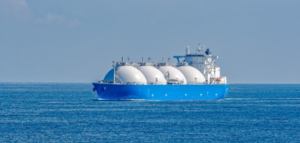
First, a decisive factor will be whether clear and measurable commitments are made for long-term LNG contracts. Both the U.S. side and companies supporting the Vertical Corridor have repeatedly stressed that without multi-year purchase and transportation agreements, the Corridor cannot reach the volume of flows required to become economically viable.
Banks and financial institutions require long-term revenue visibility in order to finance new gas infrastructure. Willingness to contribute has also been expressed by U.S. entities such as the U.S. International Development Finance Corporation and the Export–Import Bank of the United States.
Second, the signal sent by the European side—particularly the EU—will be critical. The EU will be represented by Ditte Juul Jørgensen, Director-General of DG Energy.
Regulatory clarity regarding specialized gas capacity booking products (Routes 1, 2, and 3) is a fundamental prerequisite for freeing the Vertical Corridor from the traps and competing interests of other EU member states that intensify competition. Without political backing to overcome bureaucratic and cross-border obstacles, the project will continue to run into national particularities and differing tariffs that undermine the route’s competitiveness versus alternative corridors.
Third, it is of decisive importance that EU countries demonstrate a unified stance and uphold their commitment to full disengagement from Russian gas within the next 18 months. As prices offered by Moscow remain highly competitive, doubts are being voiced as to whether Europe’s “defensive line” will hold firm until the end. Markets such as Ukraine are already sourcing more than 60% of their gas from Russia via Turkey and Slovenia.
The temporary freeze of the €750 billion agreement deprives Washington of a key pressure tool vis-à-vis European countries, while at the same time strengthening voices in Brussels calling for further supplier diversification, notably toward Canada and Qatar. This sentiment has been further reinforced by the stance taken by the U.S. president from the podium in Davos on Greenland, triggering alarm among European governments.
Canada’s position
Following its tariff policy, the Canadian government is seeking to diversify its exports beyond the traditional U.S. market. In 2024 and early 2025, U.S. crude oil imports from Canada averaged between 3.5 and over 4 million barrels per day, accounting for roughly 60% of total U.S. crude imports.
Canada has built bridges toward India, while simultaneously urging European leaders to reduce their dependence on the United States. Canada and India have agreed to strengthen bilateral trade in oil and petroleum products. The agreement provides for increased Canadian exports of crude oil, LNG, and LPG to India, while India will boost exports of refined products to Canada.
A race against time
Time pressure is intense. With the EU’s decision to fully phase out Russian natural gas by September 2027, the next three years are decisive. If contracts, financing, and the regulatory framework are not secured within this period, the Vertical Corridor risks losing momentum.
The Washington summit, therefore, will not be judged by declarations of support, but by tangible outcomes: political guarantees, commercial commitments, and financing tools. Only if these elements converge will the project be able to move definitively from the stage of political ambition to full commercial maturity.
Ask me anything
Explore related questions