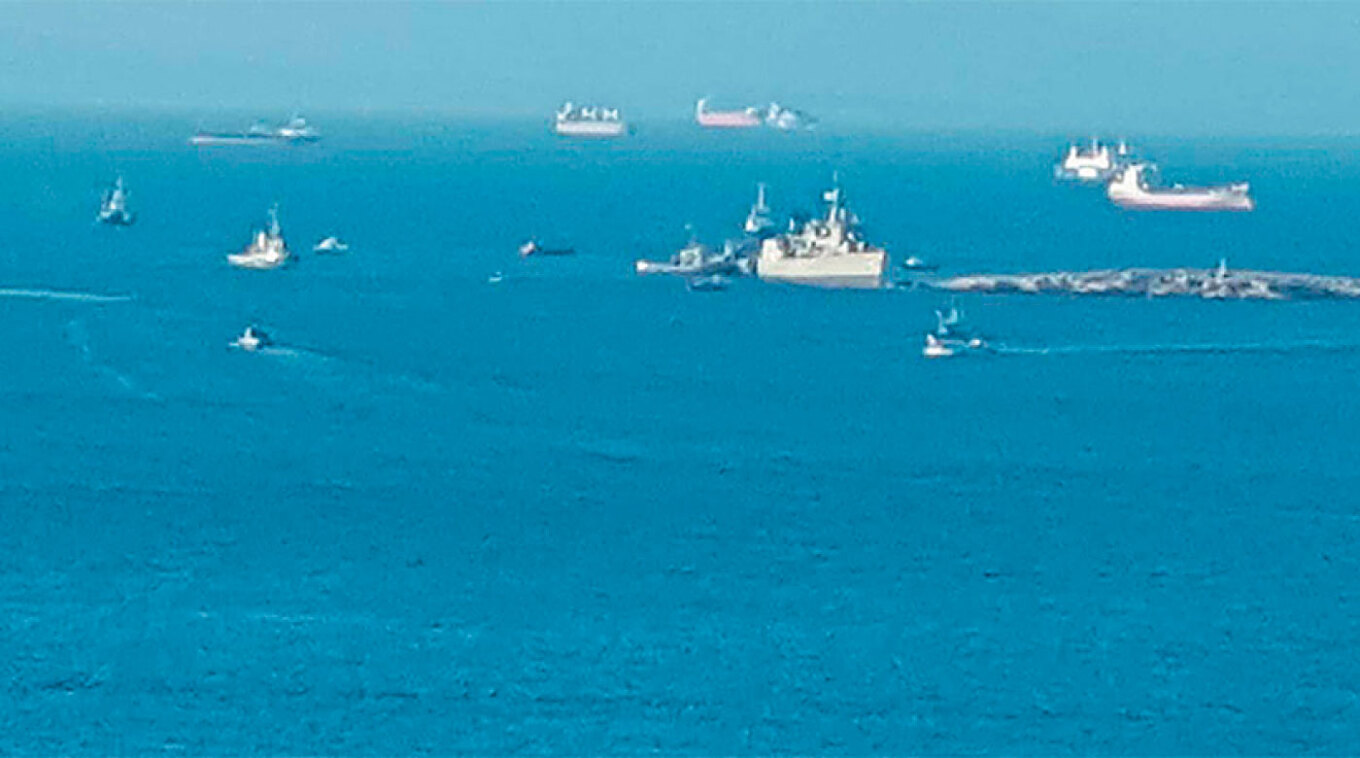
The Supreme Court (Areios Pagos) upheld the sentence previously imposed by the Five-Member Revisory Court of Athens on the captain of the frigate Kanaris, Georgios Pelekanos, after his Hellenic Navy ship, en route to the Salamis Naval Base, ran aground on the eastern side of the islet of Atalanti at 05:57 on November 2, 2017.
However, the Supreme Court decided that the then-lieutenant commander Eleni Antoniou, who was serving as the director of Navigation/Steering (D/NK) and was also convicted, should be granted a second mitigating circumstance, which will result in a reduced sentence.
The frigate Kanaris had been anchored in the port of Amorgos on November 1, 2017, in a state of high readiness. In naval terms, it was performing the duties of a “guard ship,” prepared to respond to incidents in the Aegean Sea. It later handed over these duties to the frigate Kountouriotis. From Amorgos, Kanaris sailed toward the Saronic Gulf, specifically to the Salamis Naval Base.
Minute by Minute
The ship’s captain was then-commander Georgios Pelekanos, and the D/NK duties were performed by then-lieutenant commander Eleni Antoniou. In the early hours of November 2, 2017, at 05:57, while approaching the Salamis Naval Base, Kanaris ran aground on the eastern tip of Atalanti islet. According to the Supreme Court decision, “the conditions in the area at that time were generally very good (clear weather, NW wind 4B), though it was dark due to the hour,” and “the illuminated coastline of the greater Piraeus area was visible.”
The Supreme Court recorded, step by step, the final moments before Kanaris ran aground: “At one point, the bridge ensign reported ‘North 04.’ Around the same time, Antoniou, as D/NK, realized that the ship’s position was significantly west of the intended course (due to earlier maneuvers to avoid fishing vessels) and ordered the helm to turn 10° to starboard.”
The Court continued: “The captain, who had been on the bridge since 05:35, became concerned about the safe navigation of the ship, and the evolving situation prompted Pelekanos to order ‘helm hard starboard’ and then ‘full reverse both engines.’ Only the first order was executed, which, according to the findings of the Board of Inquiry (EDE) based on objective data (video recording from the helm), was given 10 seconds before grounding. The ‘full reverse’ command was issued about four seconds before the final event and could not take effect on the ship’s propellers to stop its movement.”
Alarm
The court noted: “According to the evidence, a Type S frigate like Kanaris, moving at 16 knots, requires 1.5 minutes and 350 yards to come to a full stop when going full reverse.” Immediately after grounding, an alarm was sounded on the frigate. The captain informed the Navy Operations Room and then-Fleet Commander Ioannis Pavlopoulos.
The grounding incident attracted significant media attention and public commentary. Tugboats from the Salamis Naval Base and private companies assisted in refloating the frigate. After being freed from Atalanti, Kanaris proceeded under its own power to the Naval Base. No water ingress, fuel leaks, or crew injuries were reported. Following the incident, the Navy General Staff replaced the captain and the D/NK. Total damages amounted to €188,411, and the frigate remained out of service for about six months for repairs.
Grounding of Kanaris on Atalanti Islet
“No situational awareness”
Immediately, the Fleet Headquarters ordered an investigation and appointed an expert committee. The committee included the then-director of Operational Evaluation at Fleet Headquarters and current Fleet Commander, Vice Admiral Christos Sasiakos, who testified to the Revisory Court: “The captain needed to be alert as this was his first boarding. I would have intervened if I were the captain, even without having control. The responsibility lies with the captain. There was no awareness of time or position. They should have requested a new, accurate fix, taken control, and slowed the vessel to allow a safe approach to Salamis. Both the D/NK and captain are responsible, but the captain is the one who intervenes and corrects each officer.”
Sasiakos further explained: “The captain on the bridge must ensure the ship’s safe navigation. He should have obtained a position fix as soon as the ship changed course. They did not. In my opinion, they did not know where they were because no proper fix had been taken, and at 05:46, the ship turned left on a 3-5-7 course. I assume the lights caused confusion, compounded by the propulsion system dynamics.”
The Fleet Commander added: “The captain eventually reacted. He reduced engine speed and said ‘starboard.’ Objective data do not show a speed reduction. ‘Hard starboard’ was not recorded anywhere. The proper response would have been ‘all stop.’ ‘Full reverse’ was also correct. If you understand the spatial situation and ship characteristics, ‘helm hard starboard’ could also be valid. The captain lacked full awareness. His response was late. It would have taken one and a half minutes to stop fully and go full reverse, or 30–40 seconds to turn hard starboard and pass between Atalanti and Psittalia.”
An EDE report also cited excessive speed in the passage between Atalanti and Psittalia, stating: “The frigate exceeded the designed speed just before and during the incident, and neither the captain nor the D/NK were aware of the consequences of prolonged high-speed navigation.”
Excessive Speed
The court noted: “When the frigate reached the northeastern waters of Aegina, it entered restricted waters at an unjustifiably high speed of 16 knots instead of the safe 10 knots. Despite this, the captain did not take control or order ‘all stop’ and ‘full reverse,’ leading the ship outside restricted waters.”
The report concluded that the captain had a delayed awareness of the ship’s precarious position and reacted late to the ‘hard starboard’ and ‘full reverse’ commands, which were issued only seconds before grounding. There was also a lack of active monitoring and concern from both the captain and the D/NK regarding the ship’s exact position.
Defenses
At the Piraeus Naval Court, the captain claimed he did everything possible to avoid grounding. He noted that he had served on the frigate only 15 days before the incident and that it was his first voyage on the ship. He believed “the ship was moving at 50 RPM, which would have required less than a minute to stop and 500 yards, and that the ship’s speed before grounding was 10 knots.”
The captain argued that the grounding was due to the slow return to course by the D/NK, not the ship’s speed. Antoniou testified that when she began her watch at 04:00, the captain informed her the ship was sailing west of the traffic separation zone, which she deemed unsafe. Later, when she entered the bridge, after discussion, the captain initially agreed with her, but then ordered the ship to follow its original course. She felt her role was merely administrative, as the captain controlled all decisions. She admitted “errors in my handling, but I lacked the assistance and support I should have had.”
Three-Year Suspension
Both Navy officers were unanimously sentenced to 15 months in prison, suspended for three years, for negligent grounding of a ship. Pelekanos was convicted for grounding by a captain through negligence during peacetime, and Antoniou for grounding by another officer, not the captain, also through negligence during peacetime.
Both officers were granted mitigating circumstances under the Penal Code, acknowledging that they had lived honest personal, family, professional, and social lives up to the time of the incident.
Both filed appeals with the Supreme Court. The 7th Criminal Division rejected Pelekanos’s appeal and imposed €800 in court costs. However, the Supreme Court referred Antoniou’s case back to the Revisory Court only regarding the recognition of a second mitigating circumstance—acknowledging her good conduct for a relatively long period after the act, including during detention. Following this, her sentence will be recalculated and reduced accordingly.
Ask me anything
Explore related questions