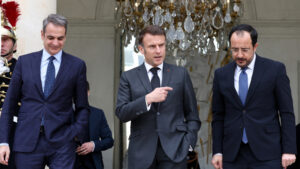
The French President, Emmanuel Macron’s commitment to defend Cyprus has been highlighted by the international press since yesterday, as his image alongside Greek Prime Minister, Kyriakos Mitsotakis and Cyprus President, Nicos Christodoulides at Paphos airport sent more messages than the obvious about the day ahead in the South East Mediterranean.
Athens’ reflexes
Both the determination and the speed of the Greek government to assist the megalithic island in its defence equally mobilised the Elysée, as the French side not only recognised a first-class opportunity to project its power in the wider region, but also to declare its emphatic presence alongside Greece in a new balance of power that seems to be emerging on the… field.
For this reason, the French President yesterday also expressed his full support for the Cypriot side as the ultimate limit of European territory, while indirectly underlining the role of the EU and especially Brussels in the Middle East, a role that is not yet clear at the operational level, despite the rapid escalation of the war.
Britain’s gaps
The fact, moreover, that Emmanuel Macron said yesterday that “when Cyprus is attacked, Europe is attacked” after his talks with his Cypriot counterpart Nikos Christodoulides and Greek Prime Minister Kyriakos Mitsotakis also contained a strong reminder to the British side of its initial stance, but also the foothold that London lost with its domestic public opinion and the international community by initially leaving the British territory at the RAF base at Akrotiri undefended.
The new alliances in the Mediterranean
On the opposite side, “we are linked by strategic partnerships”, the French President claimed before Messrs Mitsotakis and Christodoulides, and while his country’s Navy has sent the Languedoc frigate off Cyprus, preceded by Paris’ defence assistance to the island’s ground-based anti-missile and anti-aircraft defences. Besides, France will deploy eight warships in the region, while the nuclear-powered aircraft carrier Charles de Gaulle, equipped with 20 Rafale fighter jets, is already in the field, which the French President inspected yesterday off Crete.
The French President was received in Souda by the Minister of National Defence, Nikos Dendias, while for his part, Emmanuel Macron did not hide for a moment during his visit to the Mediterranean yesterday the importance the French Presidency attaches to the wider region. In this context, he announced an initiative to escort oil and gas tankers in order to ensure navigation in the Strait of Hormuz “as soon as possible after the end of the most intense phase of the conflict.”
End to… loneliness
For his part, Cyprus President Nicos Christodoulides stressed that “our countries have the common conviction that the European Union must engage more actively, more strategically and more coherently with the wider region, in the framework of an integrated approach”, with Greek Prime Minister Kyriakos Mitsotakis making it clear in all tones that “Cyprus is not and will never be alone”, adding that “every inch of European territory is inviolable”. The warm embrace with which the President of Cyprus greeted both Mr Mitsotakis and Mr Macron sent another extra-linguistic message as to the levels of solidarity and readiness of France and Greece to defend the security of Cyprus, while the number of European countries that will contribute with air forces to the defence of the island is increasing, in order to ensure a prominent position in the next day.
Ankara’s embarrassment
The “Paphos triumvirate”, however, i.e. the alignment of the leaders of Greece, Cyprus and France, did not leave the Turkish press indifferent, with the online version of Sabah commenting that “France and its allies are planning a defensive naval mission to secure the Strait of Hormuz” while avoiding mentioning by name the presence of Greece and Cyprus in the region. However, the further strengthening of relations between Greece, Cyprus and France was, according to some, the reason for yesterday’s phone call between Turkish Foreign Minister Hakan Fidan and French Foreign Minister Jean-Noel Barrot to discuss the dangers arising from the ongoing war in the region, diplomatic sources said. According to the same sources, both Mr. Fidan’s talks with the Frenchman and his counterpart from the United Arab Emirates discussed the possible implications of escalating tensions for regional stability.
At the same time, the Turkish President referred yesterday to the second interception of an Iranian ballistic missile in Turkey, saying that “the necessary warnings were issued to Iran. Despite these warnings, it continues to take the wrong steps.” Crystallizing, in part, its stance after the first week of the war, Recep Tayyip Erdogan asserted that “as in other wars, Turkey stands on the side of justice and supports conflict resolution through dialogue,” claiming, as in the case of Ukraine and Gaza, the “bloodless” role of mediator. In the case of Iran, however, the pressure on Ankara is clearly greater and the US strategy is conflicting with the interests of Ankara, which maintains chaste relations with the Iranian regime and has appeared embarrassed in the first twenty-four hours of the conflict to choose sides.
Ask me anything
Explore related questions