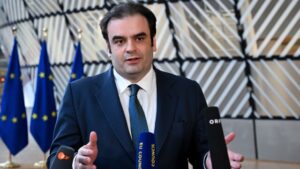
Europe must act quickly to limit pressures and protect its economies and citizens if high energy prices persist for a prolonged period due to the war involving the United States and Israel against Iran, said on Friday the head of the Eurozone’s finance ministers, Kyriakos Pierrakakis.
Oil prices have risen by around 37% since the start of the war, intensifying concerns about inflation and pushing European governments to support households and businesses. Pierrakakis, who also serves as Greece’s finance minister, said the consequences of a prolonged conflict would inevitably be reflected in energy markets, transport costs, financial markets, and ultimately consumer prices.
“That is why it is important for Europe to act quickly and in a coordinated manner to limit pressures and protect our businesses, our citizens and our economies,” he told Reuters in response to emailed questions.
Possible European measures
The European Union is examining energy taxes, network charges and carbon costs as potential areas for short-term measures aimed at easing the pressure on industries affected by high energy prices.
France, Greece and Poland introduced this week price caps on oil and limits on profit margins, but the limited fiscal capacity of some large economies reduces the effectiveness of these measures.
Pierrakakis said that the recent profit caps introduced in Greece on fuel and food would not have a “significant immediate fiscal impact on the budget.” So far there are also no signs that tourism and investments—key pillars of Greece’s economic recovery—have been affected.
The Greek economy remains strong and resilient
Pierrakakis noted that Greece’s budget already accounts for the worst-case scenario for the entire year.
“Even under these conditions, economic growth will remain close to 2%, which shows that the Greek economy remains strong and resilient,” he said.
He added that no one can predict with certainty how long the current crisis will last, but the European economy “has the capacity and resilience to absorb such shocks.”
The European Union is planning major investments in clean energy, infrastructure and energy grid projects, while also considering additional funding for small modular reactors (SMRs) in order to reduce its energy dependence on oil imports.
Pierrakakis also called for faster strengthening of the EU’s competitiveness.
“One of my main goals is the Savings and Investments Union. Well-functioning and competitive financial markets are crucial,” he said.
Ask me anything
Explore related questions