The newspaper Stuttgarter Zeitung, in its report, focuses on a finding that raises serious concern about the state of Greek seas: images from the deepest point of the Mediterranean, known as Calypso, southwest of the Peloponnese near Pylos.
According to Deutsche Welle, the research published in the journal Marine Pollution Bulletin is presented as a wake-up call, as it proves that pollution is not limited to coastlines but reaches even the most inaccessible depths.
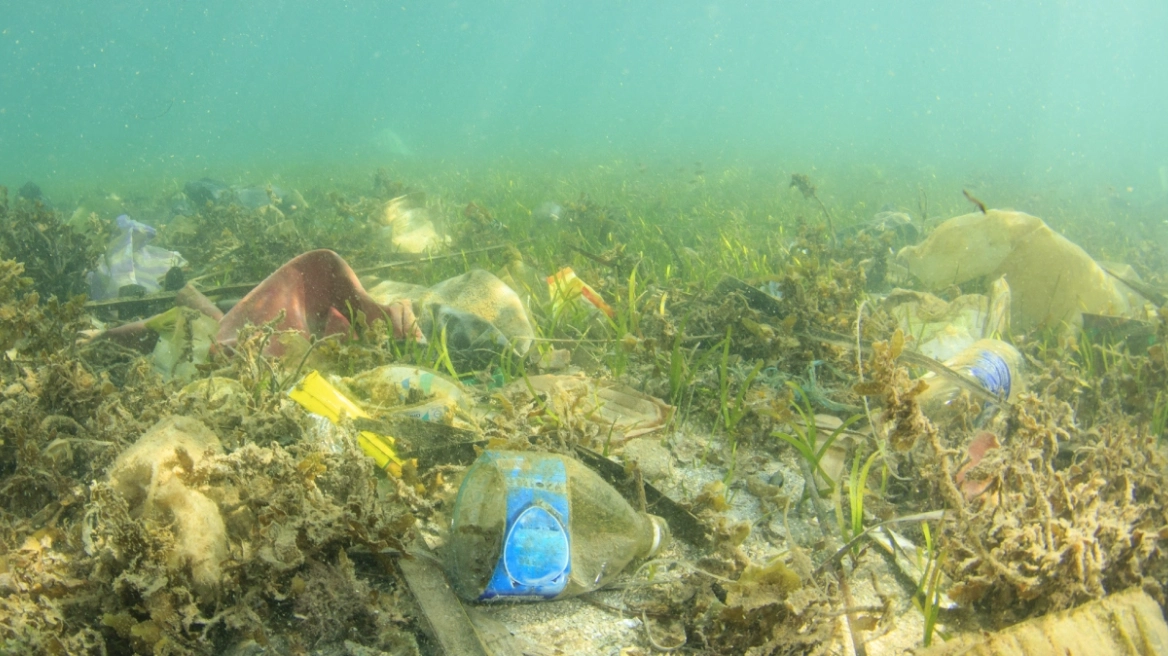
Scientists who descended to 5,109 meters with the submersible DSV Limiting Factor recorded not rare ecosystems, but an extensive presence of waste, as the article notes. Its density—reaching 26,715 items per square kilometer—is among the highest ever recorded at such depths.
As highlighted, “the deep sea is often the final ‘destination’ of pollution,” confirming that marine ecosystems ultimately act as receivers of human activity.
Analysis of the findings shows that about 90% of the waste is plastic, highlighting the long-standing failure to curb plastic pollution in the Mediterranean.
Fears of further deterioration
According to oceanographer Miquel Canals, “light waste such as plastics originates from the coasts,” underscoring the link between everyday human activity and phenomena occurring even at extreme depths.
The process of transport and settling of plastics is slow but continuous, and as noted, “plastics move near the seabed until they are buried or break down into microplastics,” creating an invisible but persistent cycle of pollution that ultimately returns to humans through the food chain.
Particular emphasis is also placed on the geomorphology of the area, as the Calypso site acts like a “trap,” capturing waste and allowing it to accumulate. According to the report, this explains why the problem is so intense at this specific location and why it is expected to worsen.
At the same time, indications of waste dumping from ships add another dimension, touching on issues of monitoring and enforcement of environmental legislation in maritime transport.
Overall, the study is part of a broader discussion about the Mediterranean as a “closed sea” under intense human pressure, from tourism to shipping. Canals’ observation that “there isn’t a single inch that is clean” dramatically illustrates the scale of the problem.
For Greece in particular, this news carries special weight, as it is directly linked to the economy, the environment, and public health, highlighting the need for stricter policies on the prevention and management of marine pollution.
Ask me anything
Explore related questions