





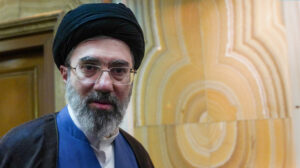
The CIA, Mossad and other intelligence agencies around the world monitored Nowruz on Friday to determine whether Iran’s new Supreme Leader, Mojtaba Khamenei, would deliver the traditional New Year message.
Instead of a public appearance, only a written statement was released, further fueling questions about his health condition, his location, and the extent of his involvement in managing the war.
According to Axios, his limited public presence is considered expected, as Israel has made it clear that Mojtaba Khamenei is now one of its primary targets. US Defense Secretary Pete Hegseth claimed that the new Supreme Leader was seriously injured during the attack that killed his father. However, the absence of even a pre-recorded video three weeks after assuming office intensifies uncertainty about his condition.
According to US and Israeli sources, there are indications that Mojtaba Khamenei is still alive, as Iranian officials attempted to schedule face-to-face meetings with him, though unsuccessfully due to increased security measures.
The issue of the actual distribution of power in Tehran has been part of intelligence briefings given to US President Donald Trump. According to a US official cited by the American outlet, the national security team is trying to determine who is making key decisions.
A senior Israeli official stated that there is no clear evidence that Mojtaba Khamenei is the one issuing orders, while a US source noted that there is no confirmation that he is fully exercising leadership.
Mojtaba Khamenei was announced as Supreme Leader on March 9, following backing from hardline factions within the regime. His first public reaction was limited to a written message on Telegram a few days later, reinforcing speculation that he was seriously injured during the Israeli strike on his father’s residence.
US and Israeli intelligence services had believed that Ali Larijani had assumed a temporary de facto leadership role, until his assassination by Israel last Tuesday. In remarks on Friday, Donald Trump said that the loss of successive leadership figures is making it difficult to identify counterparts within the Iranian regime.
Israeli officials say that Iran’s top leadership is now operating under constant threat, moving between secure locations and avoiding digital communications.
In his written Nowruz message posted on Telegram, Khamenei called for unity, accompanied by photos of himself. A US official said the CIA is examining whether the images are recent.
At the same time, Iran’s president Masoud Pezeshkian released a video message for the same occasion despite security threats, raising further questions about the absence of a similar appearance by the new Supreme Leader.
Raz Zimmt, head of the Iran program at the Institute for National Security Studies in Tel Aviv, noted that there is no evidence that Mojtaba Khamenei is unable to perform his duties, emphasizing that security conditions and possible injury may be limiting his public appearances.
In a closed-door hearing on Thursday before the House Intelligence Committee, CIA Director John Ratcliffe and Defense Intelligence Agency chief General James Adams assessed that the Iranian regime is facing a serious crisis in its command-and-control structure, though there are no indications of an imminent collapse.
Israeli officials believe that the assassination of Ali Larijani has deepened the power vacuum, which is now largely being filled by the Islamic Revolutionary Guard Corps, an organization with significant influence over the country’s economy, politics, and security. According to assessments, Mojtaba Khamenei’s close ties with this body contributed to his rise to leadership.
Some analysts believe that the weakening of the traditional leadership group could lead to the emergence of even more hardline figures. At the same time, Israeli officials argue that external pressure may intensify internal strains within the Iranian regime, increasing the likelihood of political developments inside the country.
Ask me anything
Explore related questions




