





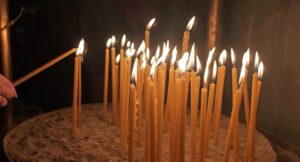
In an atmosphere of deep devotion and contemplation, the faithful flooded into churches across the country on Good Tuesday night, as the divine drama.
At the heart of the evening was the evocative Troparion of Kassian, one of the leading examples of Byzantine poetry, which tells the story of repentance and redemption.
The Orange Press Agency was at the Church of St. Spyridon in Pangrati in the early evening.
On Eratosthenes Street, hundreds of worshippers stood in silence under the candlelight to hear the stirring phrase: “Lord, the woman in many sins…
The poet who “frightened” an Emperor
The story behind the hymn is as fascinating as the text itself. Cassiani, a woman of rare beauty and intelligence, participated in 830 AD in the gathering organised by Euphrosyne to choose a wife for the Emperor Theophilos.
As recounted by believers met by the Orange Press Agency:
“When Theophilus wanted to choose a wife, they all lined up. She was the prettiest and the smartest. He saw her, admired her beauty, and said, “Out of woman began all evil”, meaning Eve. But Cassiani answered him at once: “But from woman also proceed the best things,” meaning the Virgin Mary. Theophilus did not want a woman who surpassed him in intelligence; he feared her virginity and gave the apple to Theodora. So Cassiani became a nun and wrote about that woman who sought forgiveness and washed the Lord’s feet.”
“It is a trigger for repentance and redemption of the soul”
Despite the common belief that the troparion refers to Mary Magdalene, it is thought that Cassian was inspired by the unnamed woman in the Gospels who repented and asked for forgiveness. She who washed Jesus’ feet with myrrh and tears, seeking redemption.
Another believer who attended the service at St. Spyridon’s shared her own perspective:
“It is a trigger for repentance. With our thoughts, we have all erred before God. Holy Week is a process of repentance, a ‘crucifixion’ not physical, but of our passions and our imperfections, until we reach the Resurrection. A Resurrection that heralds not only the redemption of the soul, but also the resurrection of the body.”
The troparion lyrically describes the inner struggle of the penitent woman, who likens her situation to a “night and a dark moon” (nux moi there, oestros acelasia, the gloomy and moonless eros of sin).
“Receive from me the fountains of tears, thou who changest with the clouds the water of the sea… Despise not thy servant, thou who hast infinite mercy,” writes Kassian, concluding a hymn that for centuries has been the ultimate symbol of human humility.
Ask me anything
Explore related questions




