


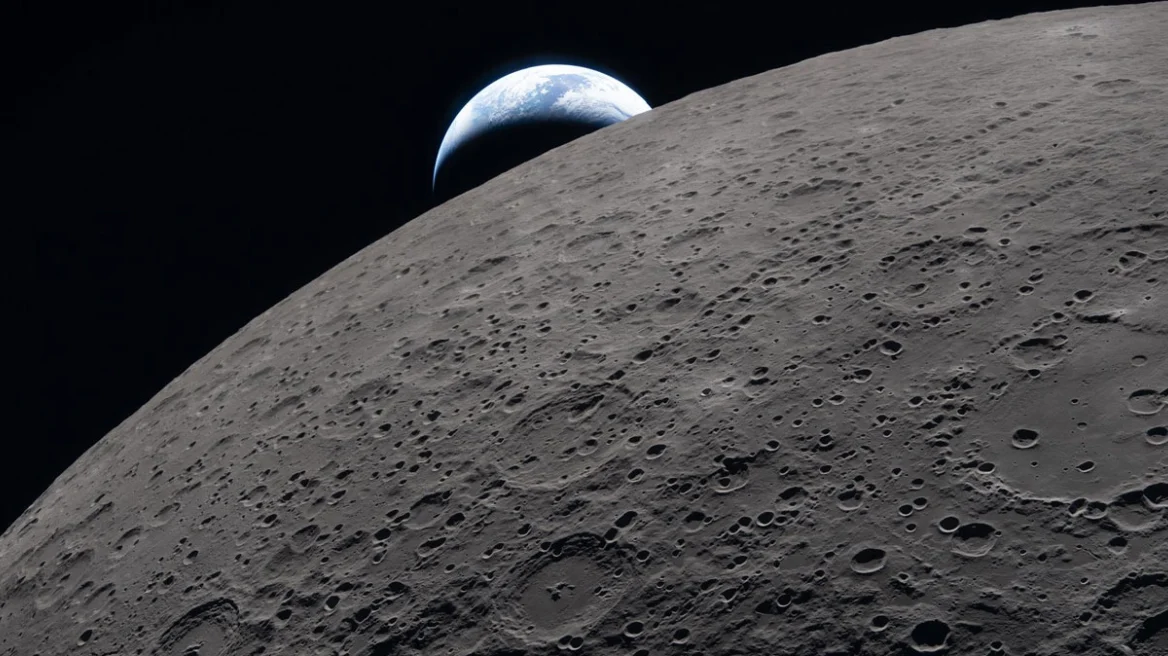
Flashes of light, attributed to meteorite impacts on the Moon’s surface, were observed by the Artemis II astronauts during their mission around the Moon.
“It was clearly impact flashes on the Moon. And Jeremy (Hansen) just spotted another one,” mission commander Reid Wiseman said on Monday while orbiting the Moon, on a journey marking the first human presence in the region in more than 50 years.
“I’m amazed,” replied Kelsey Young, head of the science team. Speaking to reporters the next day, she said she had not expected the crew to observe such phenomena during this mission, which explains her visible surprise when she was informed of the recordings.
At NASA’s Mission Control in Houston, scientists reacted with excitement when the crew described the flashes of light caused by meteorite impacts, with Young mentioning “cheers of joy” heard during the communication.
Astronaut Jenny Gibbons told AFP that this phenomenon “is not something we see often,” noting that recording such events was a high scientific priority.
“It was extremely important for us, and the fact that the crew saw four or five such flashes is truly impressive,” she said.
As the crew returned to Earth, NASA requested more details about the phenomena recorded over nearly seven hours of observation.
Young asked the astronauts whether the flashes had duration and whether they noticed any color.
“They looked like a small bright dot,” replied Canadian astronaut Hansen, suggesting there were likely even more impacts than those detected.
Wiseman added that each flash lasted an extremely short time, “about a millisecond—roughly the time it takes a camera shutter to open and close,” while their color was described as “white and bluish-green.”
“There was no doubt we were observing it, and that we all saw it,” he emphasized.
According to NASA data, the mission recorded a total of six meteorite impacts on the lunar surface during the flight, which also set a record for the greatest distance from Earth ever achieved by a human crew.
Scientists are now trying to cross-check the observations with data from a satellite orbiting the Moon, with Young noting that most flashes were recorded during a solar eclipse, when the Moon passed in front of the Sun.
Bruce Betts, chief scientist of the Planetary Society, said the number of observations surprised him, despite the crew being trained to detect such phenomena.
As he explained, the astronauts’ descriptions will help scientists estimate both the frequency of such collisions and the size of objects that produce visible flashes.
A key question, he said, is the minimum size an object must have to create light visible to humans orbiting the Moon.
“It’s not a dust particle, but it’s not a one-meter-sized rock either,” he noted.
Peter Schultz, professor emeritus of geological sciences at Brown University, emphasized that these observations highlight the need for more systematic monitoring of the daily influx of meteorites before establishing a permanent base on the Moon.
On Earth, smaller objects usually burn up in the upper atmosphere before reaching the ground—something that does not happen on the Moon, which lacks a dense atmosphere.
“The challenges are greater on the Moon,” Betts concluded.
Ask me anything
Explore related questions