





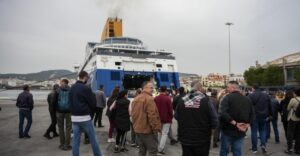
The emergence of foot-and-mouth disease in sheep and goats has escalated into a major crisis for the local economy of Lesvos, as it now affects not only the primary sector but also tourism. Earlier today, three days of protests culminated in a rally in Mytilene.
Local businesses remained closed, the port is under partial blockade, while at least until next Wednesday ferry routes from Turkey have been cancelled, in a period when Lesvos traditionally benefits from tourist flows from the neighbouring country.
All eyes are now on the meeting scheduled for tomorrow at 12 noon at the Ministry of Rural Development, convened by Minister Margaritis Schinas, with the participation of livestock farmers, cheesemakers, municipal representatives, and officials from the North Aegean Region.
Lesvos counts millions in damages due to foot-and-mouth disease: port blocked, cheese factories shut down, cancellations also in tourism
Lesvos is already recording incalculable losses, as the Easter market has been lost, while the restrictive measures in place since March 14 have resulted in not a single kilogram of cheese leaving the island. More than 75,000 sheep and goats that were expected to enter the Easter market in Athens and Thessaloniki have remained in the barns. Producers who expected income from meat received not even a single euro and are instead paying for animal feed. In addition, since Holy Thursday, cheese factories have stopped receiving milk, as they no longer have storage capacity for cheeses, with everything produced over the past 32 days remaining in storage.
More than 25 tanker trucks are now filled with milk that cannot be distributed anywhere. According to the Governor of the North Aegean, Kostas Moutzouris, speaking to protothema.gr, preliminary estimates place the damage to the local economy—from milk, unsold livestock, and unsold cheese—at over €30 million, and the figure continues to grow as the problem remains unresolved.
The region is already preparing a milk dehydration facility to reduce volume and enable storage, though even this solution requires time; funding will come from the regional authority.
“The damage is enormous, we fear long-term consequences”
“Since Holy Thursday all cheese factories have been closed. We had been promised an €8 million fund for milk, but through the de minimis mechanism, which imposes restrictions, we do not know whether compensation will be sufficient,” says the president of Lesvos cheesemakers, Ignatios Thymelis, speaking to protothema.gr.
As he stresses, at tomorrow’s meeting they will request the reopening of the port so that mature cheeses can be transported for storage in Attica, but above all they want cheeses already produced up to the end of 2025 to be allowed to enter the market normally. “The damage is enormous and we fear the situation will have lasting consequences. Orders are being cancelled, the Easter market is lost, but above all customers are lost. Once they could not source cheese from Lesvos, they turned elsewhere. Will they come back to us, or will some of them stay with their new suppliers? Certainly, if not all, some will not return.”
He notes that during the first wave of the disease, preventive measures such as spraying and disinfection had been implemented, but these stopped once the outbreak in mainland Greece was considered under control.
Tourism’s collateral damage
The Governor of the North Aegean, Kostas Moutzouris, says the main demand of local stakeholders at tomorrow’s meeting at the Ministry of Rural Development is the reopening of the port so that mature cheeses can be transported, easing pressure on cheese production facilities and allowing milk to be absorbed.
He notes that 70% of Lesvos’ local economy is linked to livestock farming, adding that there are now “collateral damages” affecting tourism as well.
Until Wednesday the 22nd, ferry routes from Turkey are being cancelled, a development causing a chain reaction in the local market. According to tourism agent Aris Lazaris, speaking to stonisi.gr, around 1,500 arrivals from Turkey had been scheduled just for Friday and Saturday, all of which are now cancelled, while there is also uncertainty about the following weekend, when the Taxiarchis festival takes place.
He expresses concern about the situation forming, noting understanding and support for livestock farmers’ demands, but stressing that closing the port does not lead to a solution and instead adds further burden to the island. As he points out, the damage to the primary sector combined with the loss of tourism revenue creates a double blow for Lesvos.
It is recalled that livestock farmers in Lesvos have been blocking the port of Mytilene for three consecutive days. On Thursday morning, a second ferry arrived on the route, with boarding taking place under restrictions already in force in recent days.
Specifically, only passengers and private cars are allowed to board, while trucks and heavy lorries remain prohibited. So far, according to Kostas Moutzouris speaking to protothema.gr, there are no supply issues with goods and consumer products on the island.
Ask me anything
Explore related questions




