





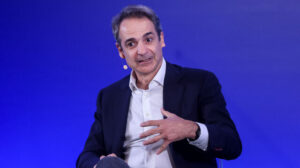
Prime Minister Kyriakos Mitsotakis sent a message of political differentiation and comparison with the opposition while speaking at the pre-congress, emphasizing dialogue on the real problems of citizens and planning for the country’s future.
Referring to the earlier meeting in the Region of Crete on water scarcity, where solutions to this major issue were discussed, he said that the ruling party consciously chooses a different path of political confrontation: “We set aside any rivalries and toxicity and discussed the problems of the place.”
The Prime Minister stressed that this stance constitutes a clear political differentiation, highlighting the role of citizens in the final judgment: “This is a government that discusses the future, and you will judge it. On the other hand, we have an opposition that dismisses everything.”
In the same context, he described the main dividing line in the political landscape, contrasting two different approaches to the country’s course: “This is the dividing line: between a party that speaks with a plan for Greece in 2030 and another that wants to take us back to 1980.”
With his remarks, Kyriakos Mitsotakis sought to highlight the dilemma of the coming period, placing stability, planning, and perspective at the center, as opposed to what he described as a policy of denial.
Speaking at the 4th pre-congress of New Democracy, he also highlighted the crucial role of local leadership in shaping the future of small islands, stressing that it “can make a big difference to their prospects.”
During a discussion with the Mayor of Halki, the President of the Fodele Community, a tour operator, and an Antiquities Ephor, the Prime Minister underlined that insularity should not be treated in a fragmented way or only as a summer issue, but holistically throughout the year. “If we want to turn it into an opportunity, we must consider citizens’ needs not only in the summer but also in the winter,” he noted.
Referring to development prospects, he pointed out that appropriate funding tools exist so that islands currently considered “unprofitable lines” can be transformed into “productive places,” with sustainable economic activity and improved infrastructure.
He placed particular emphasis on the use of technology, which, as he said, offers significant opportunities to overcome geographical limitations. In this context, he thanked Hatzioannou for the initiative to support doctors, recognizing the importance of private contributions in supporting local communities.
Referring to developments in tourism and the strategic goal of extending it throughout the year, Mitsotakis spoke of “impressive progress” in recent years, noting that Crete is the “flagship” of Greek tourism development.
As he emphasized, available data confirm that the country is moving in the right direction, with particular emphasis on improving the quality of the tourism product. “For the first time, we are seeing a major increase in the amount of money visitors spend, and this should be the main direction of Greek tourism,” he said, highlighting the importance of increasing per capita spending.
In the same context, he reiterated that the goal of year-round tourism is not just a plan but is already being implemented. However, he acknowledged that the number of visitors coming primarily for cultural reasons remains limited, noting that this is gradually beginning to change.
He made special reference to the prospects of Crete, estimating that it will “inevitably become a leading player in year-round tourism,” thanks to its comparative advantages and momentum. At the same time, he noted that the foundations of tourism recovery were laid through the way the country managed reopening after the COVID-19 pandemic.
The Prime Minister also addressed the international context, noting that Greece is “on the right side of the geopolitical line,” at a time when competing destinations in the Middle East face significant challenges. Despite the difficulties, he stressed that “crises will always be ahead of us, but the key is to be able to manage them effectively.”
“We are equipping Crete with infrastructure for the next 50 years,” Kyriakos Mitsotakis also said, referring to projects being implemented to strengthen tourism.
Ask me anything
Explore related questions




