





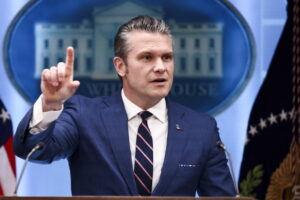
Pete Hegseth stated during a press briefing that the naval blockade imposed by the United States on Iranian ports has now taken on global dimensions, while reiterating that Tehran still has room to choose the diplomatic path. At the same time, he stressed that the U.S. is not relying on Europe.
Specifically, the U.S. Defense Secretary said that the blockade of Iranian ports has expanded internationally, noting that two vessels from Iran’s so-called “shadow fleet” were seized, even though they had set sail before the measure came into effect. “The Revolutionary Guards behave like terrorists and pirates,” he said at another point.
He argued that Iran is aware it still has an “open window” to make the right decisions at the negotiating table. “All it has to do is abandon the pursuit of a nuclear weapon in a meaningful and verifiable way,” he noted.
At the same time, he appeared skeptical about Europe’s role, stating that the United States is not relying on it, while emphasizing that Europe needs the Strait of Hormuz more than the U.S. does. “This conflict concerns them far more than us, and perhaps they should stop the talk and flashy conferences in Europe and get on a ship,” he said characteristically.
Later, however, when asked a follow-up question, Hegseth said the U.S. would welcome “a serious European effort to take measures regarding the Strait of Hormuz, given that their energy capabilities are more at stake.”
He also stressed that the U.S. is not under time pressure, noting that Iran has a “historic opportunity” to reach an agreement. “The ball is in their court,” he said.
Referring to the military operation named “Epic Fury,” he said it has delivered “decisive military results” within just a few weeks.
According to him, Tehran will ultimately not acquire a nuclear weapon, while the U.S. blockade is being strengthened daily with the support of American armed forces.
He added that any ship meeting U.S. criteria—whether Iranian vessels or ships heading to or from Iranian ports—is being forced to change course. “As of this morning, 34 ships have already turned back,” he concluded.
Ask me anything
Explore related questions




