





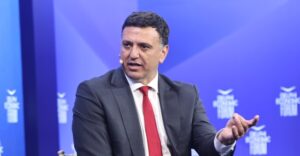
Ferry ticket prices remain at last year’s levels so far, said Minister of Shipping Vasilis Kikilias at the 11th Delphi Economic Forum, while also expressing concern over the crisis in the Persian Gulf.
Mr. Kikilias noted that there are 11 Greek ships currently in the Persian Gulf and more than 90 Greek-owned vessels exposed. “No one can predict when and how this situation will end,” he said.
Regarding ferry tickets, he stated that the government has taken measures to keep prices in check, although this year “conditions are much more difficult.”
On decarbonisation, he aligned himself with the sector’s criticism of Brussels: “Don’t talk to us about biofuels. We cannot be talking about 2050 if we cannot survive today,” he said, adding that Europe wanted “to implement things that were not feasible.”
Mr. Kikilias also referred to maritime professions, calling on young people to pursue them. As he said, unlike in the public sector, salaries in shipping “are more than sufficient,” and there is guaranteed career stability. He announced that the ministry will visit schools and regions to attract young people.
Laskaridis: It is not true that shipowners profit from war
Shipowner Panos Laskaridis accused Europe of inertia and bureaucracy.
“As much as we may not like Trump, he is telling the truth: Europe did not act, cannot act, and just waits,” he said at the 11th Delphi Economic Forum, speaking on a panel with Vasilis Kikilias and Antonis Sroiter. “I have experienced the wretched bureaucracy of Europe, which prevents anyone from getting ahead,” he added, referring to issues around maritime decarbonisation, noting that Europe sets targets without having the solutions.
Mr. Laskaridis also referred to the crisis in the Strait of Hormuz, with dozens of Greek-owned ships exposed. He appeared optimistic that the disruption is temporary. “The long-term course of shipping will not change much. We have seen crises before, and shipping has overcome them easily,” he said. At the same time, he described as a myth the idea that war brings profits to shipowners: “It is not confirmed. Some categories benefit, but it is not true that if there is war, shipowners will make money.”
He also noted that the fleet operating in the Strait of Hormuz “will not solve the problem from a military standpoint, but is there for other reasons.” Now, he said, the game is being played elsewhere: “They are moving toward economic strangulation.”
According to the shipowner, the real problems lie elsewhere. The first is decarbonisation. Shipping, he said, accounts for 2.5% of global greenhouse gas emissions. Decarbonisation, he argued, has been based on flawed assumptions. “Climate change exists, measures must be taken, but the problem cannot be solved with solutions that do not exist,” he said.
Another issue concerns the shortage of seafarers. “The new generation is not entering these professions. It is a global phenomenon—we saw it in Britain, Norway, Japan, Korea, and now in Greece. We shipowners are not making enough effort,” he said.
Mr. Laskaridis also emphasised the need for unity among Greek shipowners. “With more than 60% of European shipping, we can block any proposal that does not align with our interests. In alliance with Cyprus and Malta, we can impose our own views,” he said.
He also made special reference to the Armed Forces, expressing support for their strengthening. “In recent years, Greece has effectively become an air-naval power. The navy must be reinforced, as our borders are now in a different domain than where the army once prevailed. We hear a lot of talk. We need strong armed forces.”
Ask me anything
Explore related questions




