





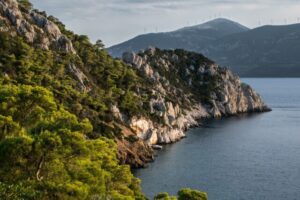
For more than 100,000 years, the Methana volcano—part of the South Aegean volcanic arc—appeared inactive. An international research team led by ETH Zurich reconstructed in detail over 700,000 years of its volcanic activity and found that during this quiet period, the volcano continued to have underground activity. “Greek volcanoes have much more to reveal,” notes Popa.
The team’s analyses cover 31 eruptions over roughly 700,000 years. To understand the volcano’s history, researchers conducted field sampling, collecting material from lava flows, volcanic domes, and ash deposits. They also studied more than 1,250 tiny magma crystals called zircon, which, as Popa explains, act like “microscopic time capsules”: they grow in magma at different times and record the conditions and timing of their formation.
The reconstruction showed that the volcano once remained inactive for about 110,000 years before reawakening and restarting its current activity cycle. Until now, such a long dormant period was considered evidence that a volcano had permanently gone extinct. However, the new study—published in the journal Science Advances—overturns this assumption, surprising even the researchers. “Our study challenges this idea and shows the opposite may be true. It overturns how we define extinct volcanoes, as a long dormancy does not necessarily mean a system has stopped,” the lead researcher emphasizes.
Researchers also found something even more striking: during the dormant period, magma production did not decrease. Instead, magma continuously accumulated at depth, and the magma chamber actually grew in size. During this time, zircon crystal growth peaked, showing clear signs of intense magmatic activity.
According to Popa, the “secret” lies in the magma’s high water content, which slowed its ascent to the surface through crystallization, preventing eruptions. “Thus, it accumulates in the magma chamber for vast periods without erupting. However, when deeper magmas become drier, eruptions can resume unexpectedly, and there is now a larger magma chamber to feed them,” he explains.
These findings fundamentally change how volcanologists understand dormant and extinct volcanoes. “Many volcanoes we consider extinct today may actually be in this state,” Popa explains, adding a warning: “These results show we should start reassessing our ‘dead’ volcanoes, as they may simply be gathering strength. During long dormant periods, such systems can sometimes evolve into much larger igneous bodies capable of more energetic eruptions. In other words, volcanoes in long-term dormancy do not necessarily weaken or become safer; in some cases, the opposite may be true—they may become more dangerous and require attention.” Methana, he clarifies, “is not currently a dangerous volcano, but if it undergoes another long ‘sleeping beauty’ period, it could become one.”
Methana is not an exception. Popa notes that similar behavior is observed at the Ciomadul Volcano, which last erupted about 30,000 years ago but remains clearly active, with geophysical measurements indicating an active magma chamber forming beneath it.
Popa stresses the importance of monitoring volcanic regions, as “magma chambers may be forming beneath our feet without us knowing it.”
Ask me anything
Explore related questions




