





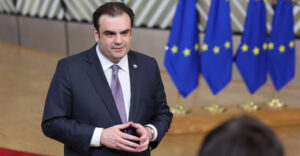
Greece is moving toward upgrading its investment profile, driven by the impressive reduction of public debt and the integration of its capital market into the Euronext ecosystem. Speaking at an event of the Hellenic–French Chamber of Commerce and Industry in Athens, the Minister of National Economy and Finance, Kyriakos Pierrakakis, presented the framework for the next phase of the economy, emphasizing investment, the capital market, and the expansion of Greek–French cooperation.
According to the data he presented, public debt—after reaching 210% of GDP following the pandemic—is projected to fall to 136% by 2026, recording what he described as the largest decline at least in Europe and possibly globally. At the same time, the primary surplus is expected to reach 4.9% of GDP in 2025, while unemployment has fallen close to 8%, down from over 27% in the previous decade.
He stressed that this development “creates the necessary fiscal space for targeted support measures.” In this context, he referred to the return of €800 million to citizens within a short period, as a response to energy crisis pressures, as well as the promotion of permanent income-support measures.
A key element of the government’s strategy, he said, is the integration of the Greek capital market into Euronext, a move expected to broaden access for Greek companies to international capital and strengthen their ability to finance larger investment projects. The goal is to create larger-scale companies with greater extroversion and the ability to participate in European structures.
In this context, Pierrakakis warned that there is no room for delays, noting that “time is already running in reverse” for Europe. He stated that every postponement widens the investment and competitiveness gap, making it necessary to accelerate market integration and mobilize capital at the European level.
He also placed special emphasis on the Greece–France strategic partnership, which is gaining a stronger economic footprint. He noted that “from major infrastructure projects to investments in energy and defense—such as the Belharra frigate program—the bilateral cooperation is presented as an example of partnership involving technology transfer and the participation of Greek companies in the supply chain.”
In the energy sector, he referred to the presence of French groups and the strengthening role of Greece as an energy hub in the southeastern Mediterranean. In infrastructure and transport, he highlighted synergies that enhance connectivity and development.
The minister stressed the need for deeper market integration and coordinated investment policy, warning that fragmentation limits EU competitiveness. In this context, he referred to the need for joint action in areas such as defense, energy, and technology, as well as the importance of creating larger European “champions.”
He also mentioned the Savings and Investment Union as the next step for the European economy, aimed at better utilizing European savings and directing them toward productive investments.
Ask me anything
Explore related questions




