





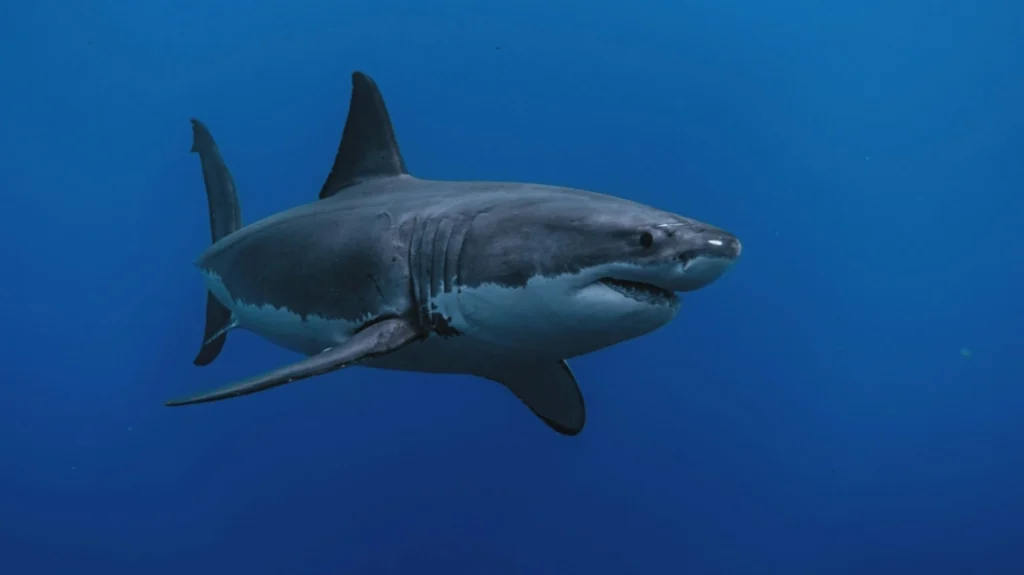
An extremely rare shark fossil, approximately 9 million years old, with an intact jaw and its last meal preserved, has been uncovered in the coastal desert of Peru, giving scientists one of the most complete images ever found of an ancient relative of the great white shark.
Researchers from Peru’s Geological and Mining Institute (INGEMMET) presented the find in Lima. It is a nearly complete Cosmopolitodus hastalis, a top predator of its time, measuring about seven meters in length—similar to a small fishing boat. Its blade-shaped teeth reach up to 8.9 centimeters, while sardine remains were found inside its abdominal cavity, confirming what it hunted in the southern Pacific Ocean during that period.
INGEMMET engineer César Augusto Chacaltana described it as an “exceptional fossilization,” while paleontologist Mario Urbina emphasized: “There are not many complete shark fossils in the world.” According to Reuters, the fossil was found about 235 kilometers south of Lima, in the Pisco Basin, an area that in recent years has continuously revealed significant marine discoveries.
The significance of the discovery is even greater given that sharks do not have bony skeletons. Their bodies are made of cartilage, which decomposes and does not preserve easily over time. For this reason, the fossil record of sharks consists almost exclusively of scattered teeth, without jaws or complete body structures.
The Pisco Basin is an exception to this rule. During the Miocene period, the area was a shallow and protected sea, where conditions allowed skeletons to be preserved before being broken down by currents or decay. In the same region, fossils of whales, marine sloths, sea turtles, a young crocodile over 10 million years old, and the skull of a giant river dolphin 16 million years old have also been found.
Of particular importance is the shark’s stomach content. Scientists found it was full of sardines, revealing not only its diet but also the structure of the ecosystem at the time. As noted, anchovies had not yet evolved, so sardines were a key food source for large predators.
The discovery and the debate over the origin of the great white shark
The fossil adds to a long-standing scientific debate regarding the evolution of the modern great white shark (Carcharodon carcharias). One side argues it descended from the giant megalodon, while another believes it evolved from the broad-toothed mako shark, formerly known as Isurus hastalis.
A 2009 study in the Journal of Vertebrate Paleontology had already supported the second theory, examining a younger 4–5 million-year-old fossil from the same region that included 222 teeth and 45 vertebrae in full arrangement. Researcher Dana Ehret described it as a transitional form, explaining that “the shark develops serrations and evolves toward the great white, but has not yet reached it.”
The new Cosmopolitodus hastalis fossil is placed even earlier in this evolutionary line. Its teeth, although sharp and elongated, do not have the full serrations of the modern great white shark, supporting the view that it is an ancestor evolving in that direction.
Scientists emphasize that complete jaws are crucial, as they reveal tooth arrangement and how the bite functioned—something that cannot be determined from isolated finds.
The research team will continue analyzing the fossil, while experts such as paleontologist Kenshu Shimada note that definitive answers will require similar complete fossils from other shark groups, including the megalodon.
The Pisco Basin continues to reveal remarkable discoveries, each adding new pieces to a story millions of years old. This fossil is another fragment of that puzzle: a predator with “knife-like” teeth and a stomach full of sardines, preserved in a desert that was once a sea.
Ask me anything
Explore related questions




