





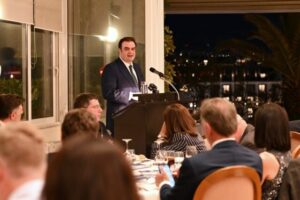
At a time when geopolitics is forcefully returning to the center of economic policy, Kyriakos Pierrakakis, speaking at a dinner at the Athenian Club organized by the University of Piraeus and the Panteion University as part of the “3rd Maritime Security Conference,” referred to maritime security, the energy crisis in the Strait of Hormuz, Europe’s technological sovereignty, and the Greek economic experience.
Mr. Pierrakakis noted that current events gave the conference a dimension that likely could not have been foreseen when its agenda was designed. As he said, the global economy now faces a new reality in which crises follow one another, while geopolitics has returned as a decisive factor in the decisions of governments and European institutions.
The minister referred to his own generation, which grew up in an environment where globalization, technology, and the idea of the “virtual state” seemed to outweigh classical geopolitical analysis. As he admitted, this assessment proved wrong. Geography, maritime power, and strategic routes for transporting energy and goods have returned in a decisive way to international politics.
The crisis in the Strait of Hormuz
At the center of his speech was the crisis in the Strait of Hormuz, which Mr. Pierrakakis described as a critical “chokepoint” for the global economy. Citing the Executive Director of the International Energy Agency, Fatih Birol, he stressed that unless the Strait reopens quickly, the current crisis has the potential to become the largest energy crisis in history.
According to the data he presented, oil losses exceed those of the crises of 1973 and 1979, as they are now estimated at 13 million barrels per day, compared to about 10 million then. Similarly, in natural gas, annual losses—if extrapolated over a full year—reach 110 billion cubic meters, compared to 75 billion cubic meters during the crisis following the Russian invasion of Ukraine.
The minister emphasized that the international mission is to prevent such an outcome. Europe, he said, has already learned from the 2022 energy crisis and now knows that support measures must be temporary, targeted, and tailored, without fiscal policy clashing with monetary policy.
The importance of free navigation
Mr. Pierrakakis pointed out that the closure of the Strait does not only concern oil and natural gas. It also affects critical supply chains such as fertilizers, helium, and petrochemicals. Asia is hit hardest, as 80% of oil and 90% of natural gas passing through the Strait is directed there. However, the effects are already visible in Europe and the United States, mainly through higher fuel prices.
For a European finance minister, as he said, resolving the crisis depends on three parameters: its duration, the extent of damage to energy infrastructure, and the regime that will emerge after the Strait reopens. On this point, he was clear: “We do not believe in tolls. We believe in the freedom of the seas.”
Technology, sovereignty, and European strategy
The minister then linked geopolitics with technological sovereignty. Referring to artificial intelligence, he noted that no country or government is now large, powerful, or autonomous enough to regulate it alone to the required extent. The very nature of new technological models demands international cooperation and a coordinated response.
At the European level, he argued that a broader technology policy is needed—perhaps even a kind of “doctrine”—to define where Europe seeks autonomy and where it opts for strategic partnerships. Sovereignty, he said, can no longer be equated with full autonomy. In an interdependent world, the key is to avoid asymmetric dependencies.
As a characteristic example, he mentioned 5G networks. Policies of the first Trump administration, he said, indirectly strengthened two European companies, Ericsson and Nokia. However, Europe failed to seize the opportunity to build a unified industrial strategy around these “winners.” Instead, it remained in a fragmented model with 27 different spectrum auctions, 27 strategies, and 27 regulatory authorities.
The Greek “Phaistos” example
Mr. Pierrakakis contrasted this with Greece’s experience in 5G, when, as Minister of Digital Governance, a model was implemented linking spectrum auctions with innovation. Twenty-five percent of the proceeds was directed to the creation of the “Phaistos” fund to finance 5G applications, while startups and universities gained access to spectrum.
According to the minister, a similar pan-European model—with a unified auction, EU-level funding, and utilization through the European Investment Bank—could form a genuine industrial strategy for Europe.
Greece as a case study of change
In the final part of his speech, Mr. Pierrakakis referred to the Greek economy and the lessons that Europe can draw from it. He recalled that last week a primary surplus of 4.9% of GDP was announced, while Greece shows the fastest debt reduction globally, sustained primary surpluses, and a growth rate twice the European average.
He also highlighted the digital transformation of the state, noting that Greece—once one of the most bureaucratic countries in Europe—now provides more than 2,200 digital services. He also mentioned the Cadastre, the electronic patient file, and projects under the Recovery Fund.
He made special reference to energy, noting the transformation of Public Power Corporation, the gradual phase-out of lignite, the increase in renewable energy sources, and the importance of the vertical LNG corridor for the energy security of Greece and Europe.
The “dividend of the obvious”
Closing, the minister returned to the need for a dual policy mindset: on the one hand, implementing the obvious reforms that have been pending for years, and on the other, the ability to respond to the unexpected.
As he said, Europe has before it a large “dividend of the obvious,” from the Savings and Investment Union to the digital euro, the Banking Union, and the Capital Markets Union. If these plans move forward, they can add significant growth momentum to member states.
Within this same framework, he included the reform of private universities in Greece, describing it as an obvious step by international standards that had nonetheless been delayed for decades in the country.
The message of his speech was that Europe cannot afford to delay the obvious nor be caught off guard by crises. It needs planning, adaptability, and strategic thinking—knowing, as he said referencing Carl von Clausewitz, that every plan changes once the battle begins.
Ask me anything
Explore related questions




