





Athens is attempting to maintain delicate balances between its obligations as an EU member and its participation in initiatives aimed at developing strategic autonomy, while also preserving Greek-American strategic relations at their current high level amid the turbulence affecting the international system.
In this “tightrope exercise,” as described by a senior diplomatic source, Greece is also trying to maintain balance so as not to disrupt its strategic partnerships with both Israel and the Arab world. At the same time, it seeks a return to the Balkans, a region of vital importance that in recent years had been sidelined in Greek foreign policy.
Athens aims to reposition itself strategically within the new balance of alliances being shaped, due both to the often contradictory choices of President Trump and the reshaping of the global chessboard caused by the war involving Iran.
At the same time, attention remains focused on Turkey, as there is concern in Athens about possible reactions from Ankara—even through informal actors or private individuals—regarding both Greece’s developing alliance framework and the strengthening of its deterrent capacity, which is creating a new balance of power in the Aegean and Eastern Mediterranean.
Dendias’ message
Last week, Defense Minister Nikos Dendias delivered a strong message to the other side of the Aegean, stating that there are now alternative options for responding to a threat such as the hypothetical occupation of a small Aegean island.
In the past, planning foresaw either a general conflict, an invasion of Eastern Thrace, or an attempt to retake the island—something that would be extremely difficult.
Outlining the core of a new defense doctrine, Dendias warned that any aggressor should know that “we will have the capability to respond with a significant number of strategic missiles from platforms deployed not only in the Aegean, but also in the Eastern Mediterranean and wherever deemed useful, with those platforms being protected.”
French Belharra frigates and new missile systems being introduced into the armed forces play a key role in this capability.
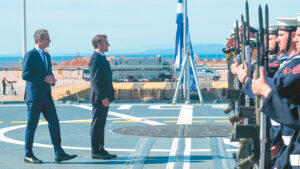
The visit of French President Emmanuel Macron highlighted not only the depth of the strategic relationship between the two countries but also Greece’s active role in shaping the EU’s major new project: strategic autonomy.
Prime Minister Kyriakos Mitsotakis, meanwhile, has consistently sent reassuring messages across the Atlantic, emphasizing that this new EU role complements NATO, does not undermine the alliance, and ultimately aligns with what Donald Trump himself has called for—greater European responsibility and investment in defense.
A non-negotiable relationship
Greece’s relationship with Europe is non-negotiable, and Athens does not want to see a conflict between the EU and the U.S. that would force countries to choose sides, as this would be disastrous for Europe’s security architecture and dangerous for Greece’s national interests.
In today’s turbulent times, while France provides important security guarantees, the role of the U.S. remains critical and decisive for both asymmetric and conventional threats facing Greece.
In recent years, the government has invested in its strategic relationship with the U.S., believing it can not only avoid crisis amid tensions between Trump and European allies but also expand further through concrete plans.
Athens continues to invest in Greek-American relations—a stance that appears to be accepted in Washington even after the change of administration.
The ongoing strategic dialogue and the MDCA defense agreement (automatically renewed) provide a solid foundation. Greece has also offered significant military facilities to the U.S., whose importance was highlighted during the recent conflict involving Iran.
Talks are ongoing to set a date for the strategic dialogue, likely by July, depending on developments in the Persian Gulf and the schedule of U.S. Secretary of State Marco Rubio.
Energy independence
A major step has been taken with the project of energy independence for Balkan and Eastern European countries, including Ukraine, from Russian natural gas. Greece plays a central role by supplying energy from the south via the Vertical Corridor.
The operational FSRU and pipeline networks are critical infrastructure, along with future projects (including a second FSRU), supporting the region’s economic and energy path without dependence on Russian energy, which has long been a tool of political and economic influence.
Agreements reached last autumn and reaffirmed at the Three Seas Initiative Summit in Croatia, along with strong support from the Trump administration’s energy leadership, are key assets for Athens.
At the regional level, despite political costs, Greece seeks to maintain its strategic relationship with Israel amid developments in Gaza and Lebanon—not only because Israel strengthens efforts to build the “Achilles Shield” air defense system, but also as a counterbalance to Turkish revisionism.
This cooperation also opens doors in Washington, which Athens values in a time of uncertainty in transatlantic relations.
3+1 cooperation
In June, an important meeting is expected in Washington, bringing together the 3+1 cooperation (Greece, Cyprus, Israel + U.S.) at the level of energy ministers.
Discussions will focus on energy cooperation, alternative energy sources for Europe, and electrical interconnections, highlighting the strategic importance of this partnership for the Eastern Mediterranean and Middle East.
This meeting will also serve as a direct response to Turkish claims portraying the cooperation as an “anti-Turkey axis.”
The Vertical Corridor also lays the groundwork for political initiatives in Southeastern Europe. By acting as an energy hub for Ukraine and the Balkans, Greece has the opportunity to reestablish its influence in the region.
Foreign Minister Giorgos Gerapetritis, at the Delphi Forum, signed the Delphi Declaration reaffirming the European perspective of Western Balkan countries and Greece’s role ahead of its EU presidency in 2027.
Energy ties deepen relations, especially as Greece becomes a gateway for natural gas supplies from the U.S. and elsewhere.
Gerapetritis in the Balkans
Energy and EU accession will be central to Gerapetritis’ upcoming visits to Western Balkan capitals, with expectations of restoring Greece’s influence in this vital region.
At the same time, Greece is strengthening ties with Arab and Gulf countries for reasons related to regional security, investment, and future connectivity corridors between Europe and the East.
Its stance on freedom of navigation and military support—such as the deployment of Patriot systems in Saudi Arabia—has brought it closer to these countries.
Last Wednesday, the Emir of Qatar visited Greece, thanked the prime minister for support, pledged investments, and requested military cooperation—significant given Qatar’s previous close ties with Turkey and Iran.
However, delicate balances are required in the Gulf due to rivalries, especially after the Iran conflict, with countries like the UAE and Bahrain taking different paths from Saudi Arabia and Qatar. There is a growing risk that Gulf states may remain vulnerable to Iranian influence.
Ask me anything
Explore related questions




