





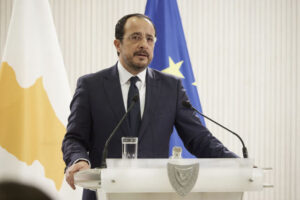
Nikos Christodoulides described today’s nearly two-hour one-on-one meeting with Turkish Cypriot leader Tufan Erhürman as part of a broader effort by the United Nations to advance the Cyprus issue toward a new expanded conference, with the informal aim of convening it during the summer.
According to President Christodoulides, the renewed diplomatic momentum is linked to the increased engagement of UN Secretary-General António Guterres. He said the initiative has already moved beyond public statements and into direct contacts with all parties involved. The effort, he noted, began after Guterres met with Turkish President Recep Tayyip Erdoğan in Ankara and continued through discussions in Brussels.
Focus on substantive issues
President Christodoulides emphasized that the UN initiative is centered not on confidence-building measures, but on substantive political issues aimed at creating the conditions for the resumption of negotiations. He explained that the proposed expanded conference, if convened, should ultimately lead to the formal relaunch of the negotiating process.
“What matters most is not when it will take place, but addressing the substance of the issue, which is the resumption of talks,” Christodoulides said, while avoiding presenting the summer timeframe as a strict deadline. However, he referred to it as an “informal target,” suggesting that Nicosia sees a window of diplomatic opportunity in the coming months.
Tensions in the Buffer Zone
The meeting also addressed tensions in the Buffer Zone. Christodoulides directly attributed the provocations to what he described as a “very specific direction,” namely the Turkish occupation forces. He added that the Cypriot government is raising the matter with both the United Nations and the European Union.
The Cypriot president linked the recent tensions in the Buffer Zone, as well as disputes surrounding religious services, to attempts by certain actors to undermine the positive momentum that he believes is developing. He also referred to the electoral period in the occupied territories, noting that it is influencing political decisions and attitudes.
Practical agreements of low political intensity
Beyond the political dimension, the meeting also produced several practical understandings. According to a UN statement, the two leaders agreed on:
- the creation of an advisory body involving civil society;
- the preparation of a six-month plan for island-wide religious services;
- coordination on addressing foot-and-mouth disease; and
- the establishment of a subcommittee on products with Protected Designation of Origin (PDO) and Protected Geographical Indication (PGI).
Christodoulides said the proposal for the advisory body originated from the Greek Cypriot side and had previously been submitted to former Turkish Cypriot leader Ersin Tatar. He also recalled that the concept was first introduced in 2007 by former Cypriot President Tassos Papadopoulos.
Regarding religious services, the president explained that the goal is to agree in advance, every six months, on the locations and dates of services in order to avoid the obstacles seen in recent days. On halloumi and other PDO products, he stressed the importance of ensuring that regulations submitted by the Republic of Cyprus to the European Union are implemented across the entire island.
The political stakes
While today’s meeting did not result in the formal resumption of negotiations, it signaled an effort by the United Nations to shift the Cyprus issue away from day-to-day management and toward substantive political dialogue. This is particularly significant for the Greek Cypriot side, which insists that no genuine prospect for a solution can exist without meaningful discussions on core issues.
The coming months will determine whether the Turkish side is prepared to support a process leading to renewed negotiations within the agreed UN framework, or whether tensions in the Buffer Zone, disputes over religious services, and electoral dynamics in the occupied territories will slow or obstruct the effort.
For Nicosia, the informal summer target now serves as a key diplomatic test — not only of whether an expanded conference can be convened, but also of whether it can produce more tangible results than another declaration of intent.
Ask me anything
Explore related questions




