





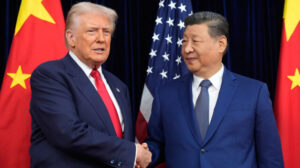
Donald Trump’s new meeting with Xi Jinping in Beijing is not simply another stop in the long cycle of U.S.–China rivalry. It is clearly a critical test of power, endurance, and composure for the world’s two largest powers, at a moment when nearly all the major fronts of international politics intersect at the same point: the Washington–Beijing competition.
The American president and the Chinese leader are expected to meet in the coming days, on May 14 and 15, in the Chinese capital, for a two-day summit with low official expectations but major real-world significance. On the agenda will be the war involving Iran, trade, Taiwan, technology restrictions, artificial intelligence, the South China Sea, and the fentanyl issue.
The agenda appears almost vast. In reality, however, everything revolves around one question: can the United States and China keep channels of communication open while simultaneously preparing for a long-term rivalry with no turning back?
The fragile pause after the trade conflict
The last Trump–Xi meeting took place last October in South Korea. At that time, the two sides agreed to a temporary de-escalation of the trade war, which had reached extreme levels. Washington had imposed triple-digit tariffs on Chinese products, while Beijing had threatened to restrict the global supply of rare earths — one of the most powerful tools China possesses in the global industrial chain.
That truce resolved none of the deeper problems. It merely froze the crisis temporarily. The meeting in Beijing will show whether this delicate balance can be prolonged or whether the two sides are heading back into a new phase of economic confrontation.
Washington is approaching the talks with the logic of the so-called “five Bs”: Boeing, beef, soybeans, board of investment, and board of trade. In simple terms, the United States wants China to buy more American aircraft, beef, and soybeans, while also creating two mechanisms that would define safe zones for economic cooperation away from national security issues.
Beijing, meanwhile, comes with its own “three Ts”: tariffs, technology, and Taiwan. For China, these are the three areas that will determine whether the meeting can produce anything more than photo opportunities and statements of goodwill.
Iran between Washington and Beijing
The major difference compared with the previous meeting is the war involving Iran. Trump arrives in Beijing already entangled in a military conflict involving China’s closest partner in the Middle East. The crisis has already triggered an energy shock, diverted American military resources away from Asia, and raised questions about the real limits of American power.
For Beijing, the war involving Iran is both a problem and an opportunity. A problem because China depends on the Gulf’s energy stability and has no interest in seeing the Strait of Hormuz become a permanent source of global instability. An opportunity because U.S. involvement in the Middle East distracts attention, ammunition, and strategic energy away from the Indo-Pacific.
This is perhaps the most sensitive point of the meeting. Trump is expected to ask Xi to pressure Tehran to reopen the Strait of Hormuz. China, however, does not appear willing to bear the political cost of resolving what it views as an American problem. It is pressuring Iran to negotiate, but it has not abandoned the position that Tehran has a “legitimate right” to the peaceful use of nuclear energy.
In other words, Beijing wants de-escalation — but not on terms that amount to an American victory.
Taiwan and the question of American credibility
Taiwan will be the heaviest strategic issue at the meeting, even if it does not dominate the public statements. For Xi, the issue is not diplomatic. It is existential for the national narrative of the Communist Party.
The Chinese leader has already conveyed to Trump that China “will never allow” Taiwan to separate from Chinese territory. Beijing will push for limits on American support for the self-governed island, especially at a time when Washington appears militarily strained by the Iran front.
This is the point Chinese analysts are watching especially closely. The use of large quantities of American ammunition in the Middle East, the redeployment of assets from other theaters, and the overall pressure on the American war machine raise a critical question in Beijing: how quickly and effectively could the United States defend Taiwan if a crisis erupted in Asia?
Washington knows this question is not theoretical. It is the core of deterrence.
Technology, semiconductors, and artificial intelligence
The second major battleground is technology. China will seek a relaxation of American export restrictions on advanced semiconductors, which it needs to upgrade its industrial base and accelerate the development of artificial intelligence.
For the United States, however, semiconductors are not merely a commercial product. They are strategic infrastructure. Washington does not want to fuel China’s rise in sectors connected to military applications, surveillance systems, cyber capabilities, and AI.
The two sides are also expected to discuss risk management surrounding artificial intelligence. It is one of the few areas where limited cooperation may be possible — not because there is trust, but because both recognize that uncontrolled technological escalation could create risks that neither Washington nor Beijing could easily manage.
Trump wants the image of success — Xi wants time
Trump has invested politically in his relationship with Xi. He calls him a “friend” and seeks to present himself as the only American leader capable of pressuring China without losing direct communication with its leadership. That is why he would welcome an announcement about increased Chinese investment in the United States or new purchases of American products.
Xi has a different need: time. China’s economy is growing more slowly, energy costs are rising, and a global recession would hurt the country’s export engine. The Chinese leader does not need a major agreement as much as he needs a controlled extension of stability.
This explains why the most likely outcomes will not be dramatic. An extension of the trade truce. Some investment agreements. Possibly a mechanism for continuing dialogue. Perhaps shared language on artificial intelligence or the need for stability in energy markets.
That would not be insignificant. But it would not be a solution either.
What could go wrong
Iran is the first and most immediate risk. Xi has already indirectly criticized American policy, speaking about a return to the “law of the jungle.” Beijing does not want to appear aligned with Washington against Tehran. Trump, on the other hand, does not want to appear in Beijing as a president asking for help from America’s main strategic rival.
The second risk is economic confrontation. Both countries have strengthened their tools of economic warfare. The United States uses tariffs, sanctions, and export controls. China responds with compliance restrictions, investigations against foreign companies, and threats involving critical raw materials.
The third risk is Taiwan. Even a statement perceived as a concession or excessive pressure could trigger chain reactions in Asia, Washington, and Beijing itself.
The real significance of the meeting
The Trump–Xi meeting is unlikely to resolve the major open disputes. It will not end the trade rivalry. It will not settle the Taiwan issue. It will not turn China into Washington’s mediator with Iran. Nor will it erase the deep distrust entrenched on both sides. But it may achieve something more realistic: buying time.
And at this moment, time has value for both sides. Trump needs to show he can simultaneously manage a war in the Middle East, an energy crisis, and the strategic confrontation with China. Xi needs to navigate a difficult economic period without being pushed into a direct rupture with the world’s largest market.
The Beijing summit, therefore, will not be judged solely on whether an agreement is reached. It will be judged on whether the two leaders manage to keep the confrontation within limits in a world where crises are becoming increasingly interconnected.
Ask me anything
Explore related questions




