





This Sunday, the Sunday of the Samaritan Woman, brings before us one of the most revealing encounters in the Gospel, the meeting of Christ with the Samaritan Woman.
Christ does not merely pass through Samaria. He abolishes boundaries—ethnic, religious, and social. The Samaritan Woman is not simply a “random” woman, but a figure representing the whole human race. Christ undertakes a personal salvation for a marginalized woman whom no one would have considered important.
Christ does not approach a person with social prestige. He does not meet a Pharisee, nor a teacher of the Law, nor someone with a good reputation in society. He meets a woman wounded by sin, a woman who had experienced rejection by her fellow human beings, and yet it is to this woman that He both reveals and reveals Himself.
God descends into the well of our life, seeking contact, dialogue, and opening His heart.
Saint John Chrysostom notes: “He was not speaking only of water, but He thirsted for the faith of the woman.”
The Church never romanticized the life of the Samaritan Woman. The Fathers speak clearly about her sinful life, yet at the same time they admire the sincerity of her heart.
Saint John Chrysostom says that the Samaritan Woman did not become indignant when Christ revealed her sin, nor did she attempt to justify herself. On the contrary, she stood before Him with a spirit of discipleship and a search for truth, and for this reason Christ continued to reveal Himself to her.
The holy Father especially admires the fact that this woman immediately becomes a missionary. “The woman says to Him: ‘I know that the Messiah is coming, who is called Christ. When He comes, He will tell us all things.’ The harlot philosophizes about spiritual matters and brings the Divine Scriptures to her lips. Even if her body had been immersed in the impurity of fornication, her soul had been purified through her reference to and reading of the Divine Scriptures. ‘I know that the Messiah is coming.’ Behold spiritual progress; behold a harlot who knows all things. Observe how from the depths of the earth she flew to the heavens. Jesus says to her, ‘I who speak to you am He.’ What He concealed from many apostles, He openly reveals to the harlot.”
The Golden-Mouthed Father concludes his homily by praising the missionary calling of Saint Photini: “But she left her water jar, entered the city, and cried out to the citizens: ‘Come and see someone who told me everything I ever did. Could this be the Christ?’ She awakens their desire to come forth and be caught. Just as she herself had been caught in the net, she desires to catch others as well. A harlot with the conscience of an apostle, who became stronger than the apostles themselves. For the apostles waited until the entire Divine Economy had been fulfilled before beginning their apostolic preaching. But the harlot, even before the Resurrection, proclaims Christ. ‘I proclaim my sins in order to lead you. So that you may see the God who came into the world, I publicly reveal my faults.’”
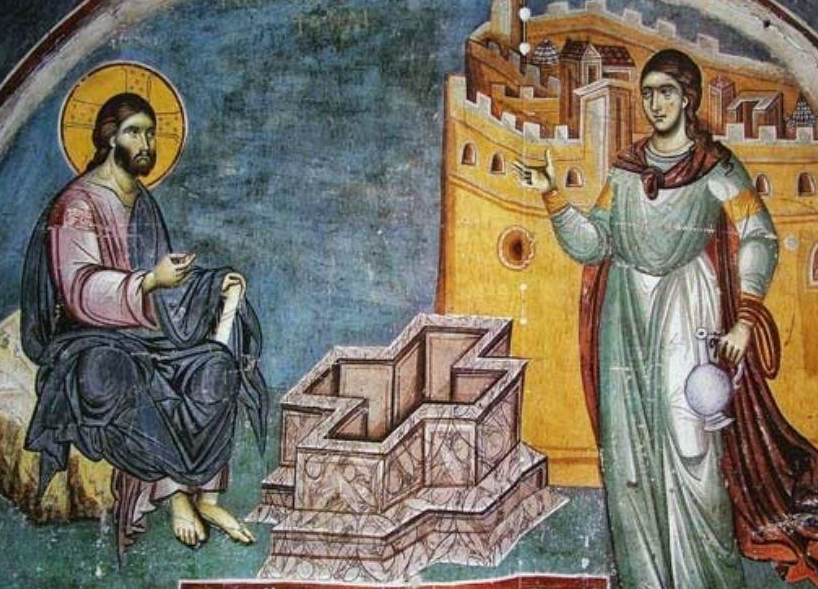
What does the Samaritan Woman do once she understands who Christ is? She leaves her water jar and runs into the city: “Come, see a man who told me everything I have done.”
Saint Cyril of Alexandria says that the abandonment of the water jar is not merely a practical detail. It is a sign of spiritual transformation. The water jar symbolizes earthly desires and former concerns. The Samaritan Woman leaves behind everything that until then had filled her life, because she has now found the “living water.”
Here begins the great spiritual contrast presented by the Church. On the one hand are the people of outward religiosity; people who appear pious, yet inwardly are ruled by pride, judgment, hardness of heart, and hypocrisy.
Saint Gregory Palamas emphasizes that God does not dwell in a heart filled with egotism, even if it appears religious. On the contrary, the humble heart becomes the place of divine visitation.
On the other hand, stands the Samaritan Woman; a woman whom society had stigmatized, a woman who avoided people and went to the well at midday, in the heat of the day. She went to draw corruptible water and found the source of eternal life.
Christ reveals Himself to the Samaritan Woman when He says to her: “I am He, the One speaking to you.” Seeing her good disposition, He gradually leads her from material things to spiritual realities, from the water of the well to the living water of salvation, from curiosity to faith, and from faith to mission.
And here the tremendous difference between the sinner and the hypocrite becomes apparent. The sinner can be saved when he possesses humility. The hypocrite struggles to be saved because he believes he has no need of repentance.
Saint Ephraim the Syrian says that tax collectors and harlots often enter the Kingdom of God before others, not because their sins were small, but because their repentance was genuine.
Today’s Sunday is a powerful answer to every Pharisaical mentality that may dwell within us. Christ came to resurrect the human person inwardly, and therefore He is moved more by a sinful person with a broken heart than by a proud “righteous” man.
The Samaritan Woman did not have a pure life, but she had a sincere search. She did not possess honor in the eyes of the world, but she possessed thirst for God, and this thirst became the beginning of her holiness. For this reason, our Church remembers her not as “the sinful Samaritan woman,” but as Saint Photini, Equal-to-the-Apostles.
The world remembered her fall, but the Church remembers her repentance. The world saw her sin, but Christ saw her heart.
Let us therefore be attentive today lest we too possess merely an external and formal religiosity. Perhaps we know how to speak about God, yet do not love the human person. Perhaps we judge, condemn, and slander easily, while our heart remains far from His Grace.
Christ does not seek a mask. He does not seek religious display. He does not seek hypocritical piety. He seeks a true and pure heart.
In our revelatory encounter with Christ, our whole existence is transformed into “a fountain of water springing up into eternal life.” The living water—that is, the word of God, which gushes forth within the Church—revives our existence, which has been deadened by sin.
In our life, we too carry a symbolic jar filled with insecurities, sins, and thirsts that cannot be quenched. Christ awaits us at the “well” of prayer and the Divine Liturgy. He desires that we open a dialogue with Him, just as He once did with Cleopas and Luke on the road to Emmaus, in a revelatory dialogue that led to the opening of the apostles’ eyes and the warming of their hearts. Let us follow Him and confess Him before the world!
Ask me anything
Explore related questions




