





Minas Tsamopoulos
In an era of rising geopolitical uncertainty and shifting global trade patterns, shipping is once again proving its ability to adapt, absorb shocks and remain resilient. Yet, as two leading figures of Greek shipping underlined during Posidonia, the industry’s strength is not built only on strategy, capital and vessels. It also rests on people, trust and long-standing relationships.
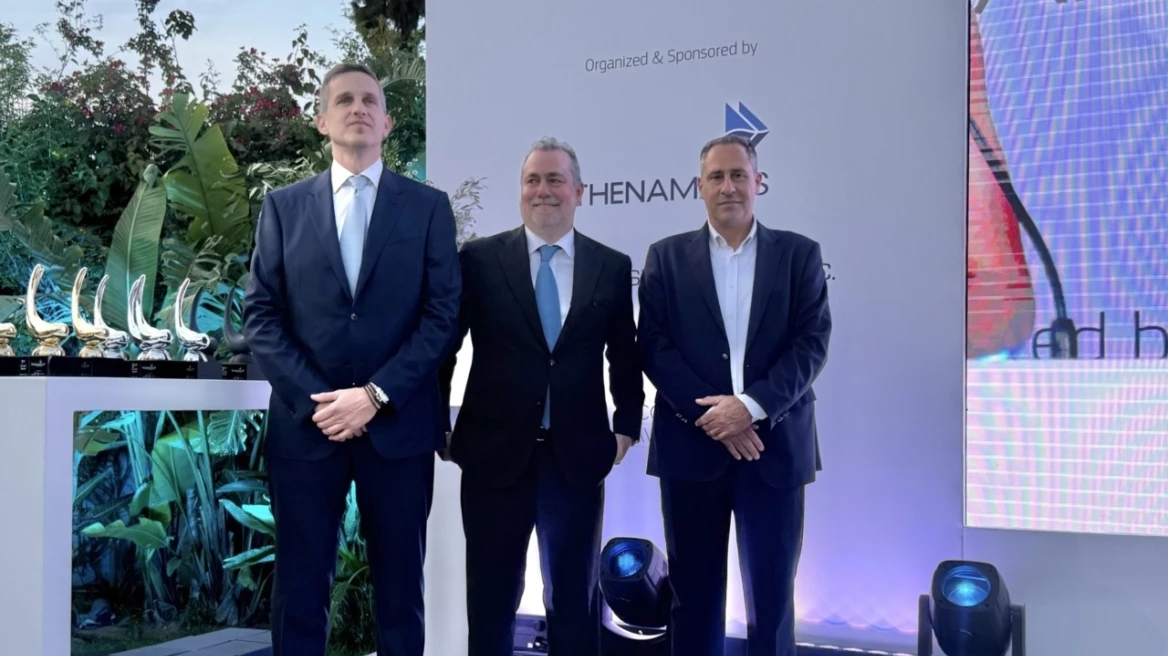
Speaking at the event, Nikolas Martinos of Thenamaris and Achilleas Constantakopoulos of ENSOFI, representing the Costamare shipping family, offered two complementary perspectives on the present and future of the sector.
Martinos focused on the strong performance of shipping over the past four years, noting that companies in Greece and abroad benefited from high freight rates and solid demand. But he also stressed that this favourable cycle cannot be separated from the broader international environment.
Conflicts in the Middle East and elsewhere have helped push freight rates higher, while at the same time increasing risks for crews and adding pressure to global supply chains. Shipping, he noted, must remain aware that profitability often comes amid crises that carry a heavy human cost.
Looking ahead, the head of Thenamaris pointed to a complex landscape shaped by geopolitical instability, regulatory change and growing social polarisation. In such an environment, shipping cannot simply switch to another line of business. It must adapt, redesign and evolve.
For Martinos, flexibility, focus and resilience are not abstract concepts, but core survival tools in an industry that operates under constant uncertainty. He also emphasised the value of cooperation across the entire maritime chain – from crews and office teams to clients, service providers and brokers.
Constantakopoulos placed the emphasis on the human side of shipping. Speaking about the long-standing relationship between Costamare and Thenamaris, he described a bond that goes beyond conventional business cooperation and is rooted in trust, respect and shared values.
He underlined that, despite its scale and technical complexity, shipping remains above all a people-driven business. No success in the sector is achieved alone, he said, pointing to the network of charterers, financiers, shipyards, insurers, classification societies, brokers and service providers that support every maritime operation.
For Costamare, he added, continuity and values remain central. More than 50 years after its founding by Captain Vassilis Constantakopoulos, the company continues to be guided by principles that combine professionalism, long-term thinking and respect for partnerships.
The message from both speakers was clear. Greek shipping has endured crises because it knows how to adjust, take calculated risks and operate in volatile conditions. But its lasting advantage also lies in the relationships built over time.
In that sense, Posidonia is not merely a trade fair or a week of meetings. It is a point of reconnection for the global maritime community, a place where old partnerships are renewed, new ones are formed and the human infrastructure of shipping is strengthened.
At a time when global trade is being reshaped by war, energy disruption and regulatory pressure, the Greek shipping ecosystem continues to project a familiar lesson: resilience depends not only on fleets and balance sheets, but also on people, trust and continuity.
Ask me anything
Explore related questions




