





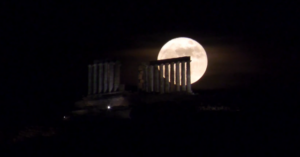
An immersive landscape was created at the Temple of Neptune in June, by the sunset moon that rose majestically over the Aegean Sea, closing the last day of May in the most atmospheric way. Tonight’s curtain call was accompanied by a special astronomical phenomenon, as the sky played host to the famous “Blue Moon” (Blue Moon).
The moon rose at around 20:36 and will remain visible throughout the night until the early hours of Monday, June 1 (just after 04:00), offering a unique sight for those in Sounion or looking up at the sky.
The images recorded from the Blue Moon in Nafplio were impressive.
.
What is the “Blue Moon”
Despite its name, the moon tonight is not blue. The term is purely astronomical and metaphorical. “Blue moon” is the name given to the second full moon that coincides within the same calendar month.
Since the time between two full moons averages 29.53 days and our months have 30 or 31 days, it is mathematically certain that every 2 to 3 years we will have two full moons in the same month – one at the beginning and one at the end, as is the case now.
The establishment of this definition arose from a misinterpretation by the American amateur astronomy magazine Sky & Telescope in March 1946, which was repeated by the popular radio show Stardate in 1980, replacing the earlier definition of four full moons in a single season of the year.
The rarity of the phenomenon has been deeply imprinted in language as well. In English, the proverbial expression “once in a blue moon” is used to describe something that occurs extremely rarely, “once in a while.”
There is a chance that the moon could become… actually turn blue? The answer is yes, but this is not related to astronomical data, only to earthly atmospheric disturbances. It is a rare visual phenomenon, in which the Moon (not necessarily in a full moon phase) takes on a bluish tint to the observer’s eyes because large dust or smoke particles are suspended in the atmosphere.
There have been a few such cases recorded in history, all associated with major natural disasters:
1883: After the horrific eruption of the Krakatoa volcano, the moon appeared with a blue tint for about two years.
At the same time, the sun was shining for two years for two hundred years for two centuries.
1950 – 1951: The phenomenon was observed again after huge forest fires in Sweden and Canada.
1980 & 1991: Azure hues on the Moon were also recorded after the eruptions of volcanoes on Mount St. Helena (USA) and Pinatubo (Philippines) respectively.
See photos from Nafplio:


Ask me anything
Explore related questions




