





Restrictions and the introduction of new operating requirements have led this year to a reduction in the number of Airbnb-type accommodations in Greece compared to last year, reaching 143,000 listings. At the same time, there has been an increase in average prices, occupancy rates, and demand, which rose by 2%. Greece is among the European markets recording positive demand growth based on overnight stays in May, in contrast to the negative European average in short-term rentals, with Greek “hosts” also seeing higher earnings compared to last year.
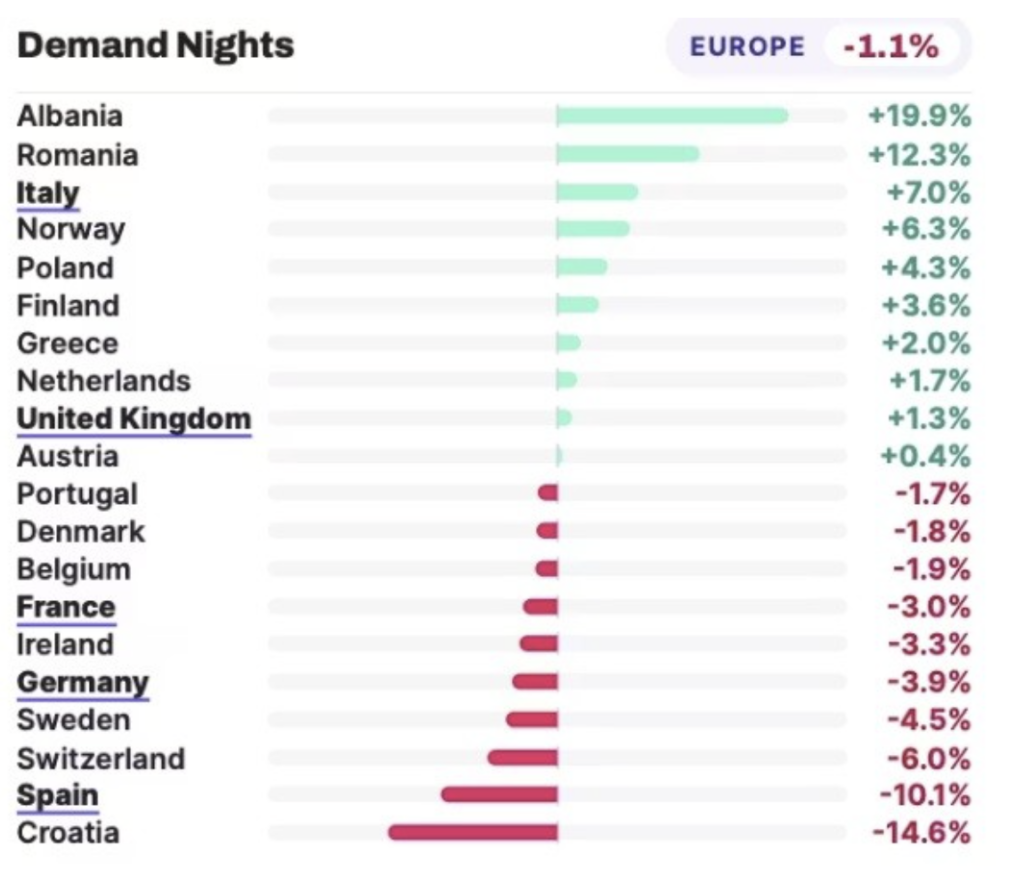
The data come from analysis by the well-known short-term rental data analytics company AirDNA. According to the report for May, the European market overall recorded a 1.1% decline in demand (based on overnight stays) compared to last year, reflecting possible pressure on travel budgets amid economic uncertainty and geopolitical factors.
The situation in Greece
More specifically, AirDNA reports that the Greek short-term rental market moved upward in May 2026, performing better than the European average. Demand increased by 2% year-on-year, while at European level there was a 1.1% decrease. At the same time, supply continued to decline, with available listings reaching 142,633, down 2.3% compared to May 2025. The combined effect of rising demand and reduced supply led to a significant improvement in occupancy, which increased by 5.4% to 58.1%.
Prices in Greece also rose, with the average daily rate (ADR) reaching €135.5, up 9.1% year-on-year. As a result, revenue per available night reached €78.7, marking a strong increase of 15.1% compared to the same month last year.
Demand, occupancy, and prices therefore increased simultaneously: “This is therefore a market growing both in volume and value. Revenue growth is driven by demand and is not solely based on higher prices, as may be the case in other markets to offset declining demand.”
The analytics company notes that the continued reduction in the number of available listings appears to be linked to regulatory measures introduced in October 2025. “These measures aimed to improve the quality of short-term rentals through stricter operating standards, likely contributing to the exit of lower-quality properties from the market.”
The European market
Across Europe, according to AirDNA, the short-term rental market continues to show resilience despite a slight decline in demand. “The European short-term rental market is entering the summer season with signs of stabilization, despite a small dip in demand. Supply continues to grow at a slower pace, while prices and revenues are improving,” the company notes.
Demand for the summer remains strong, as bookings for June–August are already 4.9% higher compared to the same period in 2025. Meanwhile, higher-end properties continue to drive occupancy growth.
In terms of supply, growth continues but at varying speeds across countries, as regulatory interventions and local conditions affect destinations such as Spain, Greece, and Croatia differently.
Specifically, for May:
- Available short-term rental listings in Europe reached 3.86 million, up 2.6% year-on-year.
- Demand (overnight stays) fell slightly by 1.1% year-on-year to 39 million nights.
- Despite the small decline in demand, average occupancy increased by 1.1% to 58.3%.
- The average daily rate (ADR) rose by 6.8% to €140. As a result, revenue per available night (RevPAR) increased by 8% year-on-year to €81.6.
Supply trends in Europe’s largest short-term rental markets show significant variation, reflecting both local conditions and regulatory measures.
Among the five largest European markets, supply grew by 1.9% year-on-year, below the European average of 2.6%. The main reason for this slowdown was Spain, where listings fell by 14% due to property removals from platforms introduced in early Q3 2025. Excluding Spain, major European markets continued to grow, with Germany recording the strongest increase at 6.3%.
A similar pattern is seen in markets with more than 70,000 active listings. In this category, Croatia and Greece acted as a drag on overall supply growth, while countries such as Portugal, Poland, and Denmark saw further increases.
In Croatia’s case, May marked the tenth consecutive month of declining supply. According to AirDNA, this trend is linked to weaker demand following a period of excessive price increases, which reduced the market’s competitiveness.
Ask me anything
Explore related questions




