





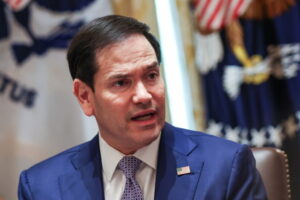
U.S. Secretary of State Marco Rubio stated that Iran will not be able to charge tolls on the Strait of Hormuz as part of any final agreement with the United States, saying such an arrangement would violate international law.
“This is an international shipping route. No country is allowed to impose tolls or fees on an international shipping lane,” Rubio told reporters, adding that he believes “all countries in this region would agree with us.”
The head of U.S. diplomacy arrived in Abu Dhabi on Tuesday night, the first stop on a Gulf tour aimed at reassuring U.S. allies, which were hit by Iranian missiles and drones during the war with Iran, which they opposed.
Upon arrival in Abu Dhabi, the U.S. Secretary of State confirmed that the protocol agreement with Iran would be discussed in the talks.
“This will certainly be discussed during these talks,” he told reporters when asked whether he would seek to reassure Gulf allies, who were heavily affected by Iran’s retaliation for U.S.-Israeli strikes.
“Some points that are not included in the memorandum of understanding will undoubtedly be discussed, but the memorandum itself must certainly be examined,” he said.
He added that “a careful reading of the memorandum of understanding clearly shows that when we talk, for example, about a full and permanent cessation of hostilities across the region, this is not possible as long as Iran’s proxies are launching missiles and drones from Iraq and engaging in terrorist actions, as Hamas and Hezbollah have done.”
The U.S. Secretary of State will meet Emirati officials on Wednesday, before traveling to Kuwait, and then to Bahrain for the Gulf Cooperation Council meeting on Thursday.
Ask me anything
Explore related questions




