





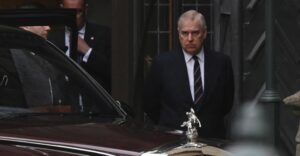
Although he has lost his titles and withdrawn from public life amid the scandal surrounding his relationship with Jeffrey Epstein, Andrew Mountbatten-Windsor reportedly remains included in British government plans for a royal ceremonial funeral, according to the Mail on Sunday.
Senior government sources told the newspaper that the 66-year-old former Duke of York remains on a confidential list of members of the royal family for whom detailed, high-profile funeral plans have been prepared.
The revelation has already triggered a backlash in Britain, with politicians and lawyers who have represented Epstein victims openly questioning whether Andrew should receive royal honors—and, in particular, whether British taxpayers should have to bear any of the cost.
The Secret “Bridge” Plans
The preparations form part of the British government’s so-called “bridge plans,” which are drawn up years in advance and set out in detail what will happen following the death of members of the royal family.
The best-known example was “Operation London Bridge,” the plan activated following the death of Queen Elizabeth II in 2022. A similar plan, “Operation Forth Bridge,” was prepared for Prince Philip, taking its name from the famous bridge near Edinburgh.
The details of Andrew’s plan have not been made public. However, royal experts suggest that his funeral could potentially take place at St George’s Chapel at Windsor Castle, where the funerals of Queen Elizabeth II and Prince Philip were held.
The historic 14th-century chapel has also hosted royal baptisms and weddings, including the 2018 wedding of Prince Harry and Meghan Markle.
Where Is Andrew Expected to Be Buried?
According to the report, the most likely scenario is for Andrew to be buried at the Royal Burial Ground at Frogmore, the private royal cemetery located within Windsor’s Home Park.
Several members of the royal family are buried there, including Edward VIII, the king who abdicated the throne in 1936 in order to marry American divorcee Wallis Simpson. Simpson is also buried at Frogmore.
The plan for Andrew is overseen by the Cabinet Office and is reviewed regularly. It is not expected to be needed anytime soon, however, as the 66-year-old is reportedly in good health.
“What Message Does This Send to Epstein’s Victims?”
The disclosure prompted a strong reaction from American attorney Gloria Allred, who has represented 27 victims of Jeffrey Epstein.
Allred argued that Andrew had damaged the reputation of the royal family and Britain through his association with Epstein and questioned why he should receive the honor of a royal funeral under such circumstances.
“What message would such a ceremony send to Epstein’s victims?” she asked.
She also questioned whether British taxpayers should have to cover expenses relating to Andrew, either during his lifetime or after his death.
A similar position was expressed by Conservative shadow Home Secretary Alicia Kearns, who said there were “no circumstances” in which Andrew should receive a royal funeral and called for the plans to be withdrawn immediately.
Former minister and royal-finance expert Norman Baker described the reported provision as a possible “oversight,” arguing that Mountbatten-Windsor is now a private citizen and should not receive any form of royal funeral.
Following the Model of Princess Margaret’s Funeral
Experts believe Andrew’s funeral could more closely resemble that of Princess Margaret, Queen Elizabeth II’s sister, who died in 2002 at the age of 71.
Around 400 people attended her private funeral service at St George’s Chapel, including 30 members of royal families. Flags at royal residences were flown at half-mast during the six-day mourning period.
Before the funeral, her body lay in state at Kensington Palace so that members of her family could pay their respects before it was transported to Windsor. Around 3,000 people gathered to watch the procession pass through the castle gates.
Although it was not a formal state funeral, the ceremony was nevertheless a major royal event accompanied by a significant security and policing operation.
Who Would Carry the Coffin?
Another issue that could arise for funeral planners concerns who would carry Andrew’s coffin.
Traditionally, this role is performed by military personnel from units with which the relevant member of the royal family has a connection.
Andrew served in the Royal Navy, including during the Falklands War as a co-pilot of a Sea King helicopter, and held a number of honorary military titles. He subsequently lost those titles in the aftermath of the Epstein scandal.
Retired Rear Admiral Chris Parry suggested that the Royal Navy could ask for volunteers to carry the coffin. He said he would be willing to do so if asked, pointing to Andrew’s wartime service in the Falklands.
“Taxpayers Should Not Pay”
The financial issue is also at the center of the controversy.
American attorney Spencer Kuvin, who has represented nine Epstein victims, argued that public money should not be used to fund the funeral of a private citizen.
Conservative MP Joe Robertson made a similar argument, saying taxpayers should not finance Andrew’s funeral. He noted that Andrew had lost his royal titles and publicly funded roles “for a reason” and that his funeral should therefore be privately funded.
The Cabinet Office and Buckingham Palace declined to comment on the reports, while Andrew Mountbatten-Windsor did not respond to the newspaper’s request for comment.
Ask me anything
Explore related questions




