





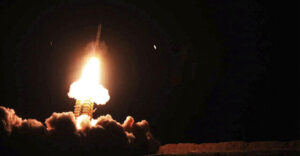
Tensions in the Middle East escalated further after Iran’s Islamic Revolutionary Guard Corps (IRGC) announced it had launched attacks against U.S. military positions in the Gulf, describing the operation as a “swift and decisive” response to recent American strikes. The latest escalation follows attacks on commercial vessels in the Strait of Hormuz, with the United States and Iran exchanging sharp accusations over alleged violations of de-escalation agreements.
In a statement broadcast on Iranian state television, the IRGC declared that its response to the U.S. strikes would be “swift and decisive.” It also claimed to have repelled an attack by U.S. armed forces in the Sirik area near the Strait of Hormuz, though it provided no further details.
⚡️⭕️ Possible ongoing US strikes on Iran after Trump threatened with retaliation on the Iranian bombing of the non compliant cargo ship yesterday :
— Middle East Observer (@ME_Observer_) June 26, 2026
⚡️ 3 explosions believed to be American airstrikes in the city of Sirik, southern Iran, opposite the Strait of Hormuz
⚡️ The sound… pic.twitter.com/U2bjptkCCi
In an earlier statement, the Revolutionary Guards said they had launched attacks against U.S. military positions in the Gulf in retaliation for American strikes on Iranian territory.
U.S. operations and the attack on a commercial vessel
The U.S. Central Command (CENTCOM) confirmed that American forces struck missile and drone storage facilities, as well as coastal radar installations in Iran, in response to an attack on a commercial vessel transiting the Strait of Hormuz.
According to Donald Trump, Iran launched at least four drones at ships operating in the area. He said one drone struck the deck of a large cargo vessel, causing damage but not forcing it to halt its voyage, while the remaining three drones were intercepted.
Trump described the incident as a “serious violation” of the ceasefire agreement but did not provide additional details.
Vance: “Violence will be met with violence”
U.S. Vice President JD Vance said that “violence will be met with violence” following the American strikes on Iranian targets.
In a post on X, Vance stated that Iran had signed a ceasefire agreement and that the United States had honored its commitments. He added that any disputes regarding the implementation of the memorandum of understanding could be resolved diplomatically, “but violence will be met with violence.”
Mutual accusations and uncertainty over the ceasefire
Washington maintains that Friday’s strikes do not signal a return to a broader military campaign, at least for now, while Iran insists the U.S. operations constitute a violation of the de-escalation agreement.
Trump also left open the possibility of further U.S. action, telling reporters, “You’ll find out,” when asked about Washington’s next steps.
The Strait of Hormuz remains at the center of the crisis as one of the world’s most critical energy shipping routes. Attacks on commercial vessels, threats to restrict maritime traffic, and ongoing military operations have fueled tensions with no clear timeline for de-escalation.
The situation remains highly fluid, with both sides maintaining confrontational rhetoric and leaving open the possibility of further military action.
Ask me anything
Explore related questions




