





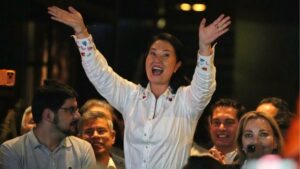
Right-wing candidate Keiko Fujimori was officially declared the winner of the second round of the presidential election in Peru, three weeks after the election was held.
Ms. Fujimori, 51, received 50.13% of the vote, compared to 49.86% for her opponent, Roberto Sánchez, according to the final results released by the National Electoral Process Office (ONPE).
Her victory marks the return of so-called Fujimorism to power, more than two decades after the end of the autocratic rule of her father, Alberto Fujimori (1990–2000), who ruled the Andean nation with an iron fist before leaving office in disgrace and being convicted of corruption and crimes against humanity.
The second round of the Peruvian elections was described as one of the closest races in Latin American history. According to the final results, the margin between Ms. Fujimori and Mr. Sánchez was less than 50,000 votes out of a total of more than 18 million.
Ms. Fujimori’s camp had been awaiting the official confirmation of her victory since last week, when the candidate from the Fuerza Popular (“People’s Power”) took a lead that her opponent could not mathematically overcome.
On the other hand, Roberto Sánchez, 57, the political heir to former President Pedro Castillo, has hinted that he will not recognize the result and has called for the votes of Peruvians living abroad to be invalidated, citing irregularities. These are the votes believed to have secured the victory for his opponent.
On Saturday, for the second consecutive weekend, he led a march in Lima in which hundreds of his supporters participated to denounce the “serious attack on the electoral process.”
“We will appeal to international institutions to ensure that the will of the people is recognized,” he told a crowd to whom he addressed a speech from a balcony before the march.
“Divided”
These elections would put an end to the chronic political instability in the Andean nation, which has already had eight presidents since 2016, against a backdrop of repeated institutional and political crises, and will have its ninth by the end of next month.
The handover of power from acting President José María Balcázar is expected to take place on July 28.
Under the Constitution, the presidential term is five years.
“Every day we are moving closer to a path of order and hope for all Peruvians,” Ms. Fujimori said via X. “We await, with great humility, prudence, and responsibility, the announcement by the JNE,” the electoral commission that will declare her the president-elect, she added.
Keiko Fujimori acknowledges that she will take office in a “divided” country, following an extremely polarized election campaign and given how narrow the margin of victory was. “We know the country is divided. We have a great responsibility to listen to both sides. The door to dialogue is open” for Roberto Sánchez and all political forces in the country, he assured
Ask me anything
Explore related questions




