





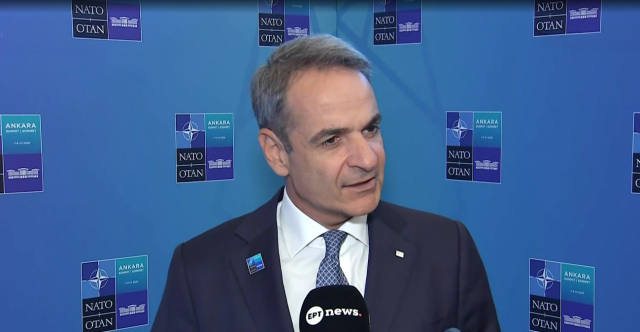
Greek Prime Minister Kyriakos Mitsotakis said Turkey’s possible return to the F-35 programme remains subject to serious legal hurdles in the United States, while also urging Ankara to withdraw its long-standing threat of war against Greece. Speaking at the NATO Summit, he stressed that Athens will continue its own defence planning without accepting external pressure over its procurement choices.
Greek Prime Minister Kyriakos Mitsotakis sent a dual message to Ankara from the NATO Summit, referring both to the obstacles that remain over Turkey’s possible return to the F-35 programme and to the need for Ankara to abandon its 1995 casus belli against Greece.
Responding to a question about whether Turkey could be readmitted to the F-35 programme following Donald Trump’s talks with Recep Tayyip Erdoğan, Mitsotakis avoided commenting directly on decisions to be taken by the United States. He stressed, however, that “there are significant legal obstacles under US law” preventing Turkey from acquiring the aircraft, recalling that Ankara’s exclusion was linked to its purchase of Russia’s S-400 air defence system.
The prime minister also underlined that Greece is moving ahead with its own defence procurement programme as planned. He said Greek pilots are expected to begin training in 2027 on Greece’s F-35s, while the country’s F-16 Viper upgrade programme is progressing rapidly, with more than 50 aircraft already modernised and a target of 83. The Hellenic Air Force also already operates 24 Rafale fighter jets.
Mitsotakis made special reference to Turkey’s casus belli, the threat of war adopted by the Turkish parliament in 1995 in the event that Greece extends its territorial waters in the Aegean.
“It is an anachronism that is inconsistent both with the Athens Declaration and with the positive climate we wish to build as two neighbouring countries,” he said, adding that the threat has existed since 1995 and that “the time has now come to leave it behind.”
According to Mitsotakis, European leaders understand that such a threat is incompatible with the atmosphere that should prevail within the Alliance.
The prime minister also reiterated that Greece will not tell the United States which countries it should supply with defence systems, just as Athens does not accept instructions regarding its own defence choices.
“It is not my job to tell anyone, and certainly not the United States, what to sell and where to sell it. By the same token, I do not accept suggestions on what we, as a country, will purchase in order to fortify our Armed Forces,” he said.
Mitsotakis also referred to his relationship with Erdoğan, saying that although the two countries continue to disagree over what Athens recognises as the sole major outstanding issue, the delimitation of maritime zones, there has been progress in other areas, including migration and people-to-people contacts.
“Even if we do not resolve our biggest problem, that does not mean we cannot live in peace and cooperate in other areas of our shared agenda,” he said.
Ask me anything
Explore related questions




