





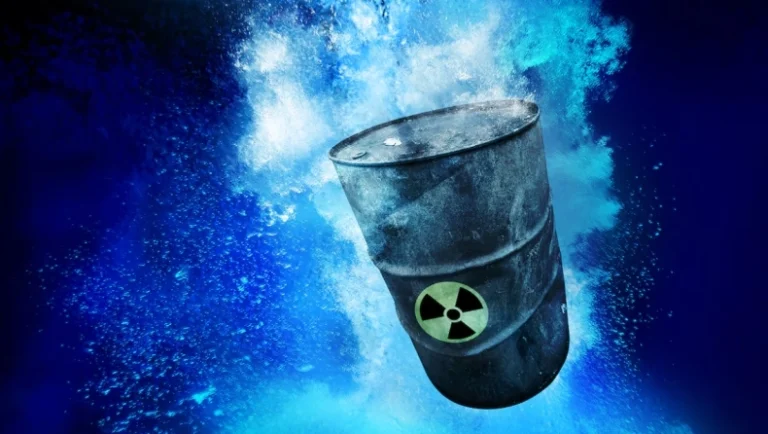
For more than four decades, thousands of barrels containing radioactive waste were deliberately dumped onto the seabed of the Atlantic Ocean. Today, nearly 80 years after the first disposals, a major international scientific expedition is attempting to map their condition and assess their potential impact on the marine environment.
From 1946 to 1990, more than 200,000 barrels containing nuclear waste were sunk in areas of the northeastern Atlantic by European countries. The containers had been sealed with tar or cement and placed at depths exceeding 4,000 meters, approximately 600 kilometers west of the French coast.
The expedition examining the seabed
The NODSSUM research expedition, coordinated by France’s National Centre for Scientific Research (CNRS), in cooperation with Ifremer, the Nuclear Safety Authority (ASNR), and international research organizations, began an extensive seabed-mapping operation in 2025.
Using high-resolution sonar and the autonomous underwater vehicle UlyX, scientists explored an area of approximately 6,000 square kilometers, identifying the locations where the barrels are situated.
At the same time, they collected samples of water, sediments, and marine organisms in order to study whether radioactive elements have escaped into the ecosystem and to what extent they affect life in the deep ocean.
Scientists’ first findings
Initial analyses showed limited traces of radioactive contamination, with no indications of widespread environmental damage. However, researchers emphasize that further study is required in order to draw reliable conclusions regarding the long-term behavior of the waste.
The data from the first phase led to the organization of a second expedition, during which scientists descended in the manned submarine Nautile in order to observe the barrels up close and collect new samples from their immediate surroundings.
“There was life everywhere around them”
Researchers described the moment they encountered the first barrels on the seabed as remarkable.
According to their reports, many of them have become artificial substrates on which marine organisms have developed. The image of an ecosystem growing around objects that represent human pollution was described by scientists as a “strange contrast” between nature and human intervention.
At the same time, the expedition also recorded the presence of plastics and other waste, demonstrating that even the most isolated areas of the oceans have not remained untouched by pollution.
Scientists will continue monitoring the condition of the barrels and the behavior of radioactive elements in the marine environment.
The results of the research are expected to contribute to a better understanding of the risks associated with earlier nuclear waste disposal practices, as well as to the development of safer management policies for the future.
Ask me anything
Explore related questions




