





High temperatures and an increased risk of wildfires are set to define today’s weather conditions across several parts of Greece, according to protothema.gr meteorologist Giorgos Tsatrafyllias.
At the same time, over the coming days, the hot air mass causing the heatwave in Italy will also affect Greece, bringing the first local 40°C temperatures of this summer.
More specifically, today, Thursday (16 July), generally clear weather is expected.
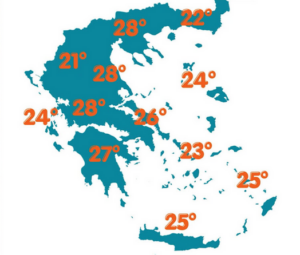
From midday onwards, mainly in central and northern mainland areas, limited instability will develop, with brief showers or downpours, particularly in mountainous areas. The maximum temperature will reach 37 to 38°C in mainland areas, 36°C in Crete and 34°C in the Dodecanese and the Ionian Islands.
Winds will blow from northerly and northwesterly directions. They will be light in the Ionian Sea, while in the central and southeastern Aegean they will locally reach 6 to 7 Beaufort.
In Attica, sunny conditions are forecast. Winds will blow from northerly directions, reaching up to 6 Beaufort, while temperatures will range from 23 to 36°C.
In Thessaloniki, brief showers or downpours are expected from midday onwards. Winds in the Thermaic Gulf will be light, and temperatures will reach 35°C.
Heatwave possible under certain conditions
On Friday, instability will intensify across mainland areas, northerly winds will strengthen in the Aegean, and temperatures will experience a temporary drop. From Saturday through to the beginning of next week, the hot air mass causing the heatwave in Italy will move further eastwards, bringing the first 40°C temperatures of this summer to Greece as well.
Under certain conditions, this hot spell could be classified as a heatwave.
I remind you that in Greece a heatwave is considered to be an extended and persistent period of high temperatures, usually lasting at least three days, with temperatures close to or above 40°C in several areas, accompanied by particularly high overnight temperatures.
A single isolated or localised temperature of 40°C is not, by itself, sufficient for a hot spell to be classified as a heatwave.
Ask me anything
Explore related questions




