






Greece will experience its first major heatwave of the summer from Sunday through Tuesday, with temperatures expected to reach 40°C in Attica and climb even higher in Thessaly, Phthiotis, and Central Macedonia.
The first heatwave of this summer is expected to arrive over the coming days, with temperatures rising sharply and local highs reaching 41–42°C (106–108°F).
According to Proto Thema meteorologist Giorgos Tsatrafyllias, Greece will experience heatwave conditions from Sunday, July 19, through Tuesday, July 21. The regions most vulnerable to extreme heat—including Thessaly, Phthiotis, Aetolia-Acarnania, Boeotia, and Central Macedonia—are forecast to see temperatures approaching 41–42°C.
Attica is also expected to experience very high temperatures. On Sunday, temperatures will exceed 38°C, while on Monday and Tuesday they are expected to locally approach 40°C. After the peak of the heatwave, a significant drop in temperatures is forecast, bringing relief and an end to the extreme heat conditions.
Slight temperature increase begins today
For Saturday, July 18, the Hellenic National Meteorological Service (EMY) forecasts generally clear skies, with temporary cloud development over mainland areas during the afternoon. Local showers are expected over mountainous regions, while isolated thunderstorms are possible in the mountains of Macedonia.
Winds will blow from the north at 3–5 Beaufort, reaching 6 Beaufort in the Aegean, and temporarily up to 7 Beaufort in some areas before gradually weakening.
Temperatures will rise slightly, reaching:
- 32°C in the Cyclades,
- 34–36°C across the rest of the islands,
- 37–38°C over mainland Greece, with local highs of 39°C.
Why cities overheat
As the new heatwave approaches, Meteo.gr, the weather service of the National Observatory of Athens, notes that temperatures become even more intense in urban areas because of the urban heat island effect.
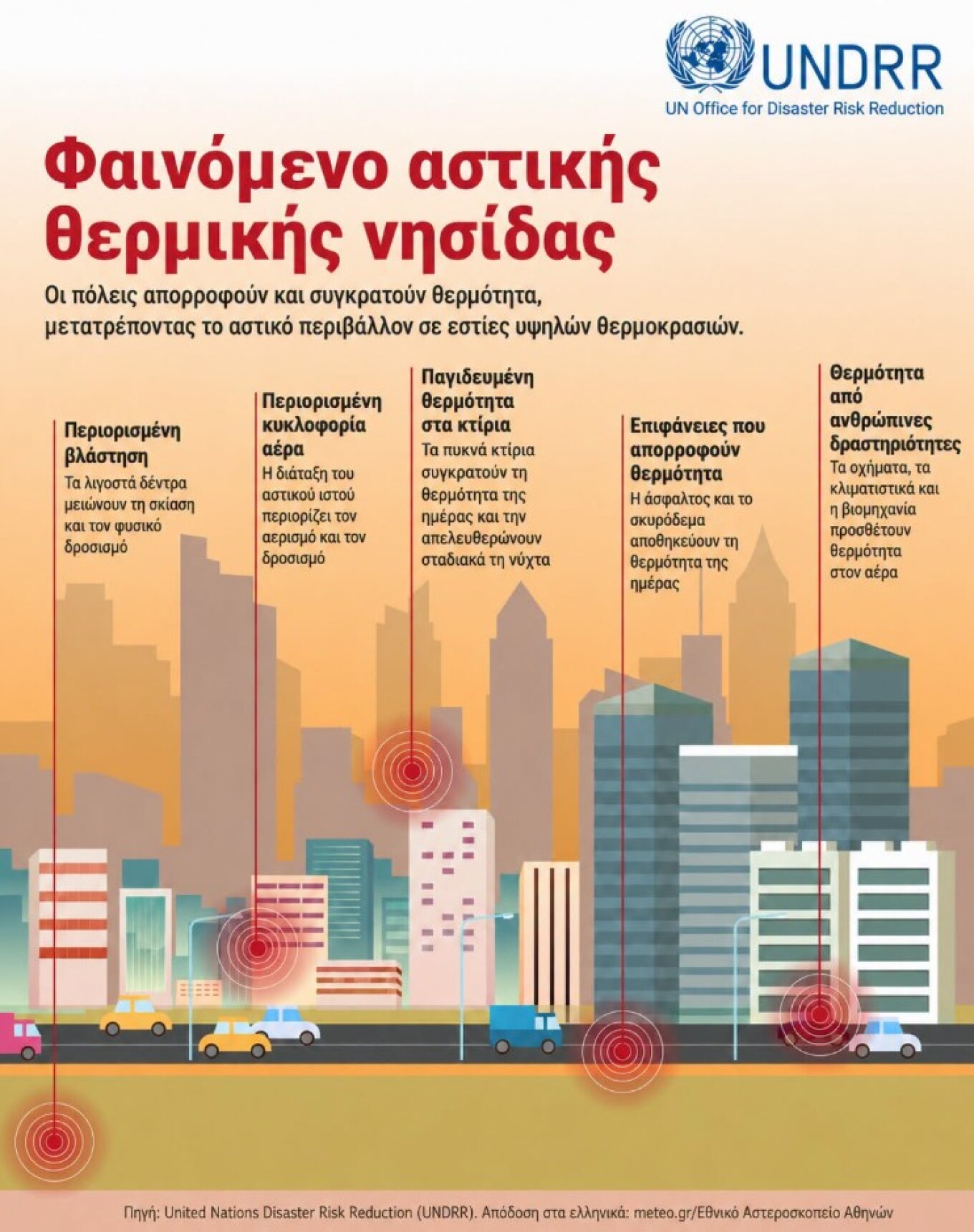
Cities develop their own microclimate. Asphalt, concrete, dense construction, limited vegetation, and reduced air circulation all contribute to the accumulation of heat within urban environments. As a result, cities remain significantly warmer than surrounding suburban and rural areas, particularly during the evening and nighttime hours.
The lack of shade and natural cooling, together with surfaces that absorb solar radiation and heat generated by vehicles, air conditioners, and other human activities, further intensify the problem.
One of the most significant characteristics of the urban heat island effect is that buildings and paved surfaces gradually release the heat they absorb during the day throughout the night. This limits nighttime cooling, which is essential for allowing the human body to recover after prolonged exposure to high temperatures.
Prolonged heat stress disproportionately affects:
- older adults,
- children,
- people with underlying health conditions,
- outdoor workers, and
- those without easy access to cool or air-conditioned spaces.
Making cities cooler
According to Meteo.gr, reducing urban heat requires a combination of measures targeting public spaces, buildings, and infrastructure.
Increasing urban green spaces, creating shaded public areas and cooling centers, preserving open spaces that improve air circulation, and providing water features and shaded areas can significantly reduce people’s exposure to extreme heat.
Building regulations adapted to changing climate conditions can also play an important role, as can the use of reflective or light-colored materials on roofs, roads, and building surfaces to reduce heat absorption.
However, Meteo.gr emphasizes that there is no one-size-fits-all solution. Heat mitigation strategies should be tailored to the specific characteristics of each city and neighborhood, taking into account where heat accumulates most and prioritizing the needs of the populations most vulnerable to extreme temperatures.
The accompanying graphics were produced by the United Nations Office for Disaster Risk Reduction (UNDRR) and translated into Greek by Meteo.gr and the National Observatory of Athens as part of a collaboration aimed at improving public awareness of climate-related risks.
Ask me anything
Explore related questions




