





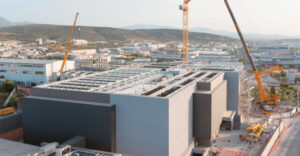
If there is one thing that lies at the heart of artificial intelligence and the broader Fourth Industrial Revolution, it is… the cloud.
As cloud computing becomes the essential solution for storing the vast amounts of data required by the next generation of digital services, Greece is positioning itself as a major player by attracting an increasing number of data centers.
The country is emerging as a key digital services hub amid rapidly growing demand for cloud infrastructure and AI applications, with investments expected to exceed €50 billion over the next decade.
The big story, however, is not just the size of these investments. A closer look at the map of planned data center locations reveals that interest in giga—or hyperscale—data centers is increasingly focused on regions in northern Greece, creating jobs and contributing to regional development beyond Athens.
Consider this: three of the “Big Four” companies in cloud services and data storage—AWS (Amazon), Google, and Microsoft—have already launched investments in Greece to build data centers. At the same time, global real estate and infrastructure giants such as EXA Infrastructure are participating in projects or planning their expansion into the Greek market.
Nothing comes without a cost, however. A typical data center requires:
- Land roughly three times the size of the Olympic Stadium (OAKA) playing field
- Electricity equivalent to the annual consumption of a city like Drama
- Water comparable to the annual drinking water consumption of Trikala
No Longer Lignite
The Greek government has recognized the surge of interest in data centers and aims to secure a leading position in this sector.
A flagship project involves the development of a giga data center in Kozani, in cooperation with major investors and PPC (Public Power Corporation), on the site of a former lignite-fired power plant.
The former coal facility is expected to be transformed into a massive data center storing cloud data from across Europe.
The project is expected to attract €5.75 billion in investment and create approximately 2,000 permanent jobs.
The location is considered highly attractive due to:
- Available land
- Reliable power connections
- Strategic access to northern Europe, western Europe, the Middle East, and Turkey
PPC also benefits from its participation in:
- the EMC West submarine fiber-optic cable project
- the GREGY Greece–Egypt electricity interconnection
According to datacentermap.com, analyzed by Proto Thema, Greece currently hosts:
- 29 data center facilities
- operated by 19 providers/investors
Distribution:
- 19 in Attica (approaching capacity)
- 4 in Thessaloniki
- 2 in Chania
- 1 each in Volos, Kozani, Orchomenos, and Heraklion (Crete)
According to a PwC study prepared for the Greek government, recorded investor interest already exceeds 1 GW of power capacity, concentrated primarily in Attica (approximately 65%).
Overall declared interest ranges between 1.4 GW and 2.2 GW.
PwC’s siting study reports:
- 36 connection requests submitted
- Total requested capacity: approximately 1.4 GW
- About 30% have already received grid connection terms, indicating that many projects are in advanced stages.
Investors have also formally expressed interest in an additional 0.8 GW.
Regional demand
Electricity demand from data centers is estimated at:
- Attica: 800–1,260 MW (330 MW already approved)
- Western Macedonia: 140–440 MW
- Boeotia: 275 MW
- Crete: 45 MW
- Corinth: 40–80 MW
- Thessaloniki: 30 MW
- Megalopolis: 25 MW
- Filippiada: 0.4 MW
PwC concludes that building 1 GW of data center capacity would unlock major economic benefits, including:
- €10 billion in investment
- around 1,000 permanent jobs
- additional infrastructure and supporting services
Combined with submarine fiber-optic cables and supercomputers, these investments are expected to establish Greece as a major digital hub.
$1.34 Billion by 2029
A recent study by consulting firm Arizton estimates that Greece’s data center market will attract cumulative investments exceeding $1.34 billion by 2029.
The report highlights Greece’s strategic geographic position connecting Europe, Africa, the Middle East, and Asia, making it an attractive destination for data center investments.
According to Arizton, Greece is expected to add more than 67,819 square meters of new data center space between 2024 and 2029.
Major cloud providers such as Google and Microsoft have already played a significant role in expanding the country’s data center market.
Heavy Water Consumption
While data centers are welcomed as drivers of economic growth, they come with significant resource demands.
They require:
- secure locations
- mild climatic conditions
- reliable electricity
- abundant water
Every chatbot query consumes both electricity and water, and the rapid growth of AI explains why global computing power requirements are projected to increase by as much as fivefold.
In Europe’s FLAP-D markets (Frankfurt, London, Amsterdam, Paris, and Dublin), occupancy rates exceed 90%, while electricity grids have become saturated, delaying new developments.
In Dublin, data centers already consume roughly 20% of Ireland’s total annual electricity.
PwC concludes that although Greece has sufficient national electricity capacity, there is a mismatch between regions where power is available and regions where demand is concentrated.
Grid capacity dedicated to data centers is expected to increase from 1.9 GW today to 2.9 GW by 2034.
Analysts estimate this creates an addressable regional market of up to 5 GW across southeastern Europe and the Middle East, as demand for data center capacity across Europe, the Middle East, and Africa (EMEA) is expected to triple.
Energy Costs
According to the International Energy Agency (IEA), electricity consumption is enormous.
A typical medium-sized data center (15–20 MW) consumes:
- 130,000–175,000 MWh annually
This is enough electricity to power:
- 30,000–40,000 households
- approximately the annual electricity demand of cities such as Drama or Karditsa
With AI, demand has grown dramatically.
The IEA projects global data center electricity consumption will exceed 1,000 terawatt-hours (TWh)—roughly equal to the total annual electricity consumption of countries such as Japan or Germany.
Even everyday digital activities have hidden energy costs:
- One Google search consumes roughly 0.0003 kWh
- One ChatGPT query uses about 0.003 kWh, around ten times more, because of its more complex processing.
Generating a five-second AI video can consume as much electricity as running a microwave oven at full power for one hour.
Water Consumption
Cooling represents another major resource requirement.
According to Eurelectric, hyperscale data centers using water cooling require between 1 and 5 million cubic meters of water annually.
Much of this water comes from reservoirs.
Some countries, including China, are experimenting with underwater data centers to achieve more efficient cooling.
According to the Brookings Institution, a typical medium-sized (15–20 MW) data center consumes:
- 1.1–1.9 million liters of water per day
Equivalent to the daily consumption of roughly 1,000 households.
Modern hyperscale AI data centers can consume:
- 3.8–19 million liters per day
Equivalent to the annual water consumption of an entire city with 10,000–50,000 residents.
In practical terms, a giga data center may use annually as much water as cities like Nafpaktos, Kos, or Zakynthos, while the largest hyperscale facilities may rival the annual water consumption of cities such as Trikala, Ioannina, Agrinio, or Katerini.
A typical 100 MW data center alone consumes approximately 2 million liters of water every day.
Other Requirements
Electricity and water are not the only necessities.
Data centers also depend on:
- reliable power supply
- high-capacity telecommunications connectivity
The latter is provided primarily through submarine fiber-optic cables, which carry the majority of global internet traffic between continents.
When these cables reach shore, they terminate at Cable Landing Stations, where terrestrial fiber networks connect them to data centers responsible for processing, storing, and routing digital traffic to the internet, cloud services, and end users.
Locating data centers close to submarine cable landings:
- reduces latency
- increases bandwidth
- improves international network reliability
As a result, Athens and Crete are gradually emerging as important digital hubs in the Mediterranean thanks to numerous ongoing investments in submarine cables and digital infrastructure.
Incidentally, Microsoft’s mega-project in Spata and Koropi includes the construction of three data centers.
The main complex in Spata alone is expected to cover approximately 15,000–20,000 square meters—roughly the size of the Acropolis Museum, or about three football pitches the size of OAKA’s playing field.
With major Greek and international companies already investing—or planning investments—in cloud infrastructure across Greece, land outside dense urban areas, particularly in Mesogeia, has become highly sought after.
These locations offer:
- large development sites
- room for purpose-built facilities
- proximity to critical national infrastructure
- favorable climate conditions
- lower exposure to wildfires, floods, and other natural disasters
- and relatively reasonable land prices.
Ask me anything
Explore related questions




