





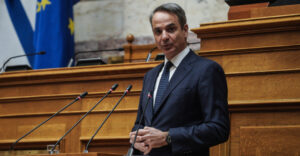
One of the major questions within the governing party had been whether Kyriakos Mitsotakis truly meant what he had been saying about elections taking place in 2027, or whether it was merely a smokescreen intended to allow the prime minister to surprise everyone with elections this autumn.
Following the meeting of New Democracy‘s Parliamentary Group, it became increasingly clear to party members what Mr. Mitsotakis has reportedly been telling a smaller circle of close associates in recent days: that the elections will indeed be held next year, upon the completion of the government’s four-year term.
The prime minister himself reiterated this point while leaving yesterday’s parliamentary group meeting—something rather unusual to be discussing on July 20.
“You’re still here? Haven’t you gone on vacation? I already said the elections will be held in 2027,” he joked in a brief exchange with journalists.
In his formal speech from the parliamentary podium, he emphasized that the 2027 elections should be regarded by the entire New Democracy organization as the most important elections the party has ever fought, and as a single, decisive election day.
“There are no trial elections, no protest votes, no dress rehearsals with supposed messages, and no room for disastrous risks. Given both the international and domestic situation, there is only one choice: a strong government that offers stability, care, and results—a government of one party, though not necessarily of one color.”
With these remarks, Mr. Mitsotakis also reaffirmed his objective of securing an outright parliamentary majority.
Admittedly, more and more New Democracy officials now appear to believe him. A senior party official was overheard telling protothema.gr that he expects elections to be held next May.
A Member of Parliament representing a regional constituency agreed, arguing that late May would be an appropriate date because it would still precede the summer season while also coming after Easter, which falls on May 2.
An experienced parliamentary figure within New Democracy offered an even more unconventional scenario, suggesting that elections could instead be held in July. Under this scenario, Mr. Mitsotakis could invoke Greece’s assumption of the rotating Presidency of the European Union on July 1, make use of the one-month extension permitted under the Constitution, and frame Greece’s EU presidency as the central issue of the election campaign, particularly since negotiations over the EU’s next long-term budget would likely conclude during that period.
In short, an increasing number of party officials appear to be preparing for what the prime minister described as a marathon, comparing New Democracy to Spain’s famous “tiki-taka” football style.
“We have the initiative. We are certainly in good physical condition—we’ve proven that—and therefore we can endure this ‘marathon’ until the elections in the spring of 2027. We also have the resilience to withstand tough play and remain calm in the face of intimidation. Above all, however, we are a team. A team. Teams win—not supposed individual stars.”
Mr. Mitsotakis is now looking ahead to the Thessaloniki International Fair (TIF), where he indicated that the principal beneficiaries of forthcoming government measures will be self-employed professionals and small and medium-sized businesses. He also stressed that he intends to present a policy plan with a four-year horizon.
Subtle Remarks About Kovesi – Criticism From Lawmakers
An interesting aspect of Mr. Mitsotakis’s speech was that, although he strongly criticized the opposition’s handling of the OPEKEPE affair, he did not launch another direct public attack against the European Public Prosecutor’s Office (EPPO). Instead, after 26 New Democracy MPs had spoken, he made only carefully worded and indirect remarks.
“As for the European Public Prosecutor’s Office, there is no turning back from this institution. However, there are questions about the way it handled these cases, because prosecutors are ultimately judged by their results. Their job is to bring cases to trial that are solidly prepared, and judging by the outcome, that work was not done as it should have been.”
Several MPs—both those whose cases had previously been dismissed and those currently facing prosecution—also voiced clear criticism.
Dimitris Vartzopoulos argued that:
“The complete collapse of the initial indictment following the expert report should already have led to resignations or, at the very least, to a basic administrative investigation.”
He also called for additional safeguards in the selection process for Greek European Prosecutors.
Makis Voridis, expressing confidence that the prosecutions against the four defendants would fail at trial, stated:
“We have a disgraceful opposition, but we also have a prosecutorial authority where the charitable interpretation is that it is not doing its job properly, while the less charitable one is that it is doing something other than its job.”
Similar criticisms were voiced by Giannis Kefalogiannis and Kostas Tsiaras, while Katerina Papakosta said:
“This particular case file contains far too many unanswered questions, far too many mistakes, and was put together in an entirely careless manner.”
Finally, Christos Boukoros argued that it constitutes a violation of due process for a press release announcing the case to have been issued before the accused Members of Parliament had even been formally served with the indictment.
According to information obtained by protothema.gr, however, non-political defendants charged as part of the same case have already been served with summonses to appear before the Single-Member Misdemeanor Court on October 27.
Ask me anything
Explore related questions




