





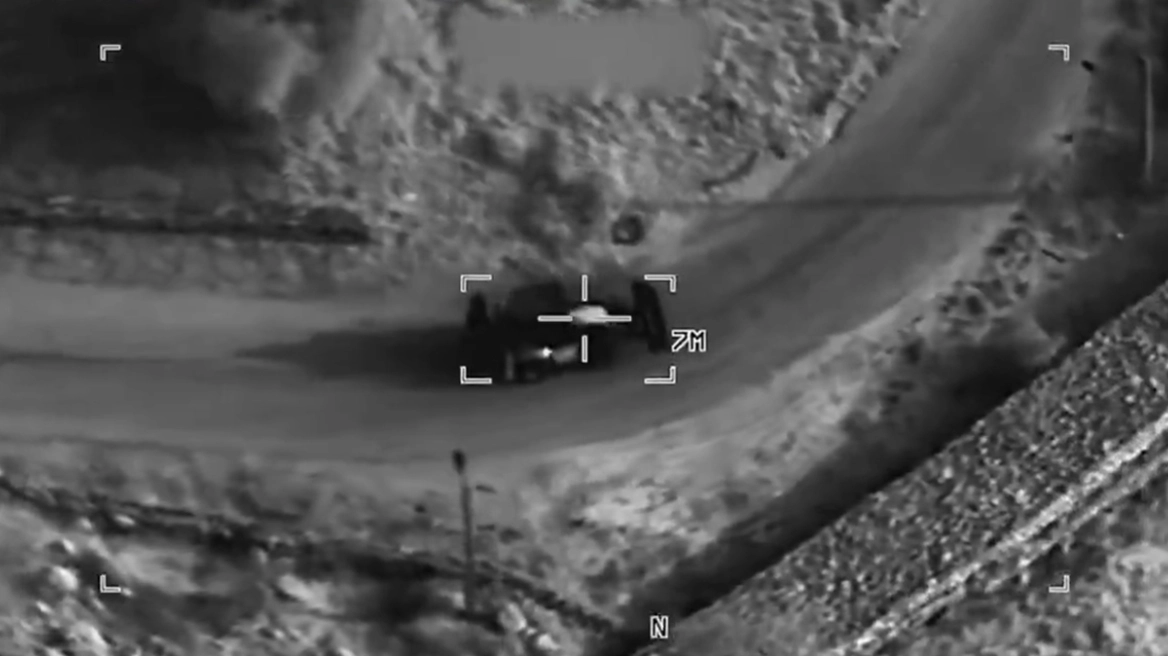
With a new wave of bombings, for the 12th consecutive day, the United States struck Iran, with American forces persistently targeting sites that, according to their statements, hinder freedom of navigation.
At the same time, however, Yemen’s Houthis, with their attack on two Saudi oil tankers, are significantly expanding the front in the Middle East and threatening to destabilize global trade by closing — or at least claiming they will close — the Red Sea.
Houthi attacks
A few days after announcing that it was imposing a naval blockade on Saudi Arabia, Yemen’s Houthis struck two Saudi tankers in the Red Sea with drones and missiles.
The Iran-aligned Shiite movement Ansar Allah said via Telegram that “the Yemeni armed forces,” meaning its military wing, “carried out a successful military operation targeting two Saudi oil tankers that violated the naval blockade.”
They added that the vessels were the “Encelia” and “Layla”, while claiming that they forced another 10 ships to turn back.
The Saudi side confirmed that one of the two ships was on fire.
The United Kingdom Maritime Trade Operations (UKMTO), the British maritime security information service operating under the UK Ministry of Defence, confirmed that a tanker had been struck by an “unknown”-type “projectile” in the Red Sea, approximately 70 nautical miles (130 kilometers) from Saudi Arabia’s Al Shuqaiq port.
The strike caused a major fire that the crew is attempting to extinguish. However, it was reported that there were no deaths or injuries.
New wave of bombings in Iran
The US military announced early Thursday morning that it had launched a new series of strikes against Iran.
“At 00:30 (Greece time), US forces began launching new strikes against Iranian military targets,” CENTCOM said in a post on X.
It added what it has conveyed in almost every statement regarding military operations in the Strait of Hormuz: “The mission will continue in order to reduce Iran’s ability to threaten civilian maritime workers and commercial vessels transiting the waters of the region,” including the Strait of Hormuz.
Initial reports referred to two deaths at a border crossing in Khuzestan, between Iran and Iraq. Explosions were heard in Jask, Bandar Abbas, and Bushehr.
Meanwhile, for another day, the Kuwaiti military announced that elements of its air defense had confronted an attack by “hostile drones.” However, reports indicate that the Ali Al Salem base was hit.
Furthermore, Donald Trump, in new statements, continued to maintain a hard-line stance, emphasizing that the United States “will bomb and destroy a bridge or an electricity generation plant” every time Iran attacks a ship in the Strait of Hormuz.
Meanwhile, Iran’s Islamic Revolutionary Guard Corps announced in the early hours of Thursday that it had “stopped” three oil tankers that attempted to cross the Strait of Hormuz, without clarifying exactly when.
The three tankers were attempting to “pass through the mined southern route,” but “after one of them exploded and caught fire, the other two quickly turned back,” according to the statement.
The Strait will remain “completely closed as long as America continues its satanic actions in the region,” the Guards emphasized. “No oil tanker will enter or leave,” and “if any vessel is deceived by America and attempts to pass without coordination with the Islamic Republic of Iran, it will suffer the same fate,” they added.
Oil rises again for another day
On Wednesday, Brent temporarily exceeded $95 per barrel, increasing concerns about new inflationary pressures and pushing government bond yields higher. Ultimately, the price stabilized slightly above $94, while US crude oil WTI also closed 3% higher at $86.83 per barrel.
Crude oil prices have gained more than 20% this month following the renewed escalation of the conflict between the US and Iran.
On Thursday, when markets opened, Brent moved above $96, its highest level since June 8, while WTI was trading at $88.27 per barrel.
Ask me anything
Explore related questions




