





As enterprise AI becomes more sophisticated, the language surrounding it is evolving just as quickly. Terms like AI assistants, AI copilots, AI workflows, and AI agents are increasingly used in conversations about digital transformation often interchangeably.
However, not all AI solutions are designed to solve the same problems.
Among the most common misconceptions is the belief that AI workflows and AI agents are simply different names for the same technology. In reality, they represent two fundamentally different approaches to designing intelligent systems.
Understanding this distinction is becoming increasingly important for business leaders. Choosing the wrong architecture can lead to unnecessary complexity, while selecting the right one can significantly improve efficiency, decision-making, and scalability.
The question is no longer whether AI can automate business processes.
The real question is how much autonomy those processes actually need.
From Process Automation to Intelligent Decision-Making
For years, organizations have relied on workflow automation to standardize repetitive business activities. Every process was carefully designed, every step was predefined, and software executed the same sequence every time.
AI workflows represent the next evolution of that model.
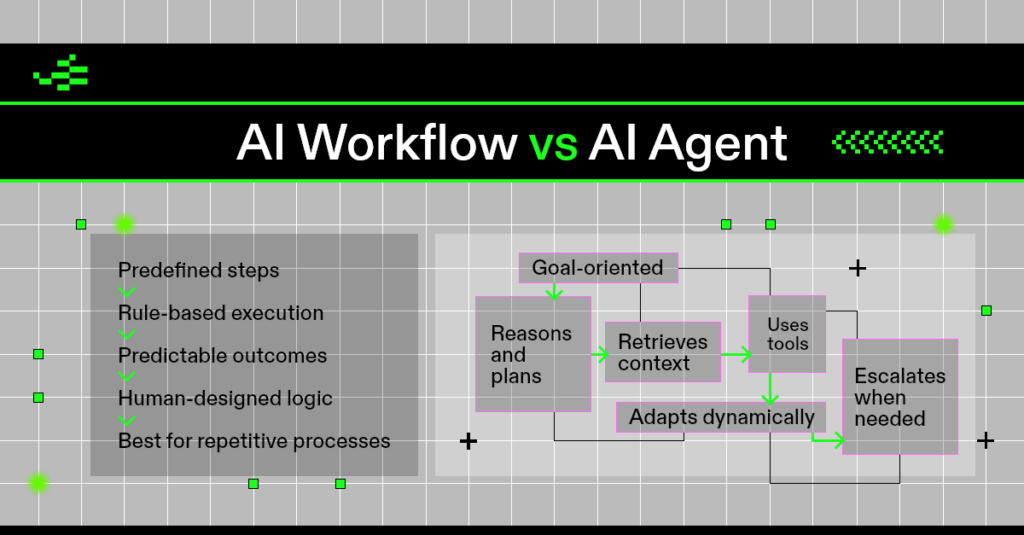
Rather than replacing the workflow itself, AI enhances individual steps within it. A model may classify documents, summarize customer requests, extract information from invoices, or recommend the next action, but the overall process remains structured and predictable.
Every decision follows a predefined business logic established by the organization.
AI agents introduce a different philosophy.
Instead of executing a predefined sequence of tasks, they operate with an objective in mind. They evaluate the available information, retrieve additional context, reason about possible actions, interact with enterprise systems, and determine the most appropriate next step based on the situation.
Rather than following instructions, they work towards outcomes.
Understanding AI Workflows
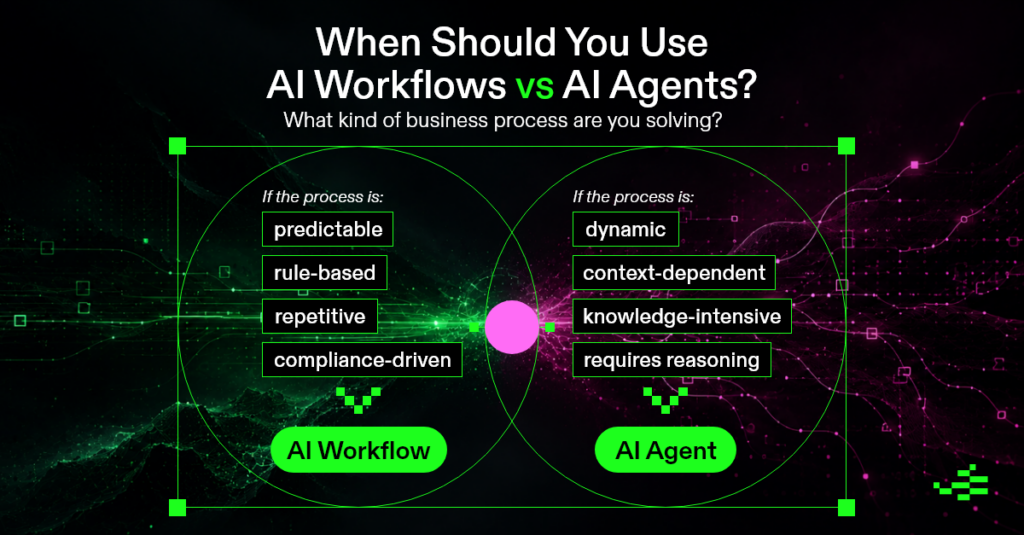
AI workflows are ideal for structured business processes where consistency, predictability, and governance are essential.
The organization defines exactly how the process should unfold, while AI improves specific activities within that sequence.
Imagine an invoice approval process.
Invoices arrive, data is extracted automatically, validation rules are applied, approvals are requested from the appropriate stakeholders, and payments are completed once every predefined condition has been satisfied.
The workflow never changes.
AI simply makes each individual step faster and more accurate.
This makes AI workflows particularly valuable for finance, compliance, HR operations, document processing, reporting, and other processes where every transaction should follow the same business rules.
Understanding AI Agents
AI agents are designed for environments where every situation is different.
Rather than following a script, they continuously interpret information, retrieve knowledge, reason through multiple possibilities, and decide what action should happen next.
Consider a customer support request.
Instead of passing through a fixed sequence of predefined steps, an AI agent can understand the customer’s intent, search previous conversations, retrieve product documentation, access CRM records, verify company policies, interact with internal applications, and decide whether the issue can be resolved automatically or requires human intervention.
The process adapts to the context.
Every interaction may follow a different path.
This ability to reason, plan, and dynamically execute actions is what makes AI agents fundamentally different from traditional workflow automation.
Choosing the Right Architecture
One of the biggest mistakes organizations can make is assuming that AI agents should replace every workflow.
In reality, many business processes don’t benefit from additional autonomy.
Processes such as payroll, expense approvals, invoice processing, regulatory reporting, and compliance checks are designed around consistency. They require transparency, auditability, and strict adherence to business rules.
AI workflows remain the most effective solution in these scenarios.
Other business functions operate in environments that are constantly changing. Customer service, sales enablement, IT operations, internal knowledge management, procurement, and strategic planning often involve incomplete information, evolving requirements, and decisions that cannot be fully predefined.
These are the situations where AI agents deliver the greatest value.
The objective should never be to adopt the newest technology.
The objective is to design the architecture that best fits the business problem.
The Future Is Hybrid
As enterprise AI continues to mature, organizations are increasingly combining both approaches within the same operating model.
Structured workflows continue to manage predictable processes that require governance and operational control.
AI agents operate within those workflows whenever reasoning, contextual understanding, or autonomous decision-making is required.
Consider employee onboarding.
The overall process remains structured. User accounts need to be created, security permissions assigned, equipment ordered, and compliance documentation completed.
Within that structured process, however, an AI agent can answer employee questions, retrieve internal policies, coordinate across systems, recommend learning materials, and proactively identify missing information.
The workflow provides structure.
The agent provides intelligence.
Together, they create an operating model that is both efficient and adaptive.
The Right Tool for the Right Problem
The future of enterprise AI is not about choosing between workflows and agents.
It’s about understanding the role each plays.
AI workflows deliver consistency, reliability, and operational efficiency.
AI agents introduce reasoning, adaptability, and intelligent decision-making where business processes become more dynamic.
Organizations that understand this distinction will build AI solutions that are easier to govern, easier to scale, and ultimately more valuable to the business.
Because successful enterprise AI isn’t defined by how autonomous it becomes.
It’s defined by how effectively it solves real business problems.
Ask me anything
Explore related questions




