





Artificial Intelligence is no longer just another technology initiative. It is reshaping how organizations operate, make decisions, and create value. Yet many companies are still approaching AI in the same way they approached previous waves of digital transformation, by adding new technology to existing processes and expecting fundamentally different results.
This mindset is understandable, but it is also one of the biggest barriers to realizing AI’s full potential.
The organizations leading the next generation of innovation are taking a different approach. Rather than asking how AI can automate today’s workflows, they are reimagining how work should be designed in an era where intelligent systems can reason, learn, and collaborate. This is what defines the AI-native enterprise.
Beyond Automation
For decades, organizations have invested in automation to improve efficiency. Business processes were carefully mapped, standardized, and optimized before technology was introduced to execute repetitive tasks more quickly and consistently.
Artificial Intelligence represents a different category of capability.
Modern AI systems are no longer limited to following predefined rules. They can interpret natural language, analyze large volumes of information, retrieve organizational knowledge, generate recommendations, and increasingly make context-aware decisions. This changes the role AI plays within the enterprise.
Instead of asking how AI can accelerate an existing process, organizations should begin by asking a more strategic question: if AI had existed when this process was originally designed, would we build it the same way today?
More often than not, the answer is no.
What Makes an Organization AI-Native?
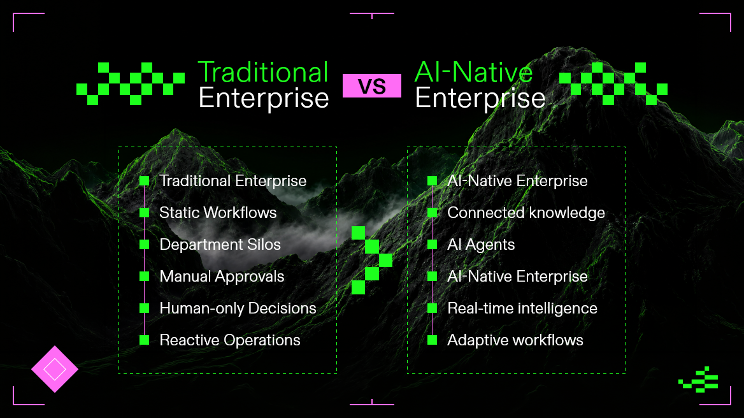
An AI-native enterprise is not defined by the number of AI tools it has deployed or the sophistication of the language models it uses. It is defined by the way intelligence is embedded into everyday operations.
In these organizations, AI supports decision-making rather than simply generating information. Enterprise knowledge becomes instantly accessible, data moves seamlessly across business functions, and employees collaborate with intelligent systems instead of treating AI as another application to interact with.
Being AI-native is therefore less about technology adoption and more about organizational design. AI becomes part of the operating model rather than an additional feature layered onto existing systems.
Enter the Agentic Era
One of the most significant developments in enterprise AI is the emergence of AI agents.
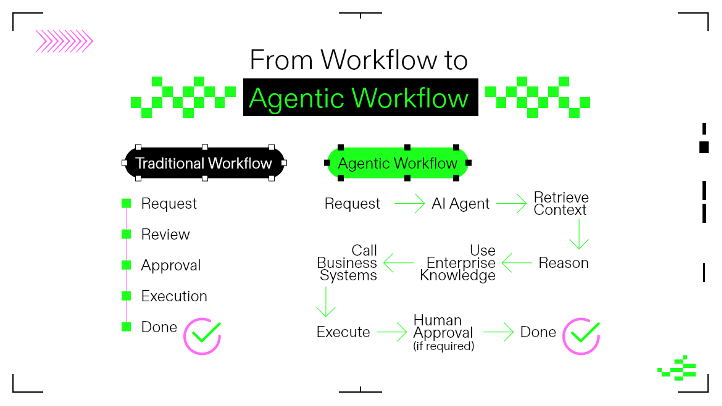
Unlike traditional automation, which follows predetermined sequences of actions, AI agents are capable of reasoning, planning, selecting tools, retrieving relevant information, and adapting their behavior based on changing circumstances. They are designed to achieve objectives rather than simply execute instructions.
This evolution fundamentally changes how organizations think about business processes.
Imagine a procurement request entering an organization. Instead of passing through multiple predefined approval stages, an intelligent agent can evaluate company policies, compare suppliers, assess historical purchasing behavior, estimate financial impact, and recommend the most appropriate course of action before involving a human decision-maker where necessary.
The workflow becomes dynamic rather than static. Intelligence becomes embedded throughout the process instead of appearing only at isolated touchpoints.
Human Intelligence Becomes More Valuable
The emergence of AI-native organizations does not reduce the importance of people. If anything, it increases the value of human expertise.
As intelligent systems take responsibility for repetitive analysis, information retrieval, and administrative coordination, employees gain more time to focus on strategic thinking, creativity, innovation, relationship building, and complex decision-making.
The most successful organizations are not replacing people with AI. They are redesigning work so that humans and AI complement one another.
This collaboration requires careful governance, transparency, and human oversight. AI may provide recommendations, but accountability remains a human responsibility. Building trust in enterprise AI depends as much on organizational culture as it does on technological capability.
Redesigning Business Processes
Perhaps the biggest mistake organizations make today is treating AI as a productivity layer instead of a transformational capability.
Adding AI to an inefficient process may produce incremental improvements, but it rarely creates meaningful competitive advantage. Faster execution of an outdated workflow still results in an outdated workflow.
AI-native organizations begin by challenging the process itself.
Customer service becomes proactive instead of reactive. Financial operations shift from reporting historical events to predicting future risks. Supply chains become adaptive rather than static. Enterprise knowledge evolves from scattered documents into intelligent systems capable of providing contextual answers in real time.
These are not examples of better automation. They represent fundamentally different ways of operating.
The Operating Model of Tomorrow
As enterprise AI continues to mature, a new operating model is emerging.
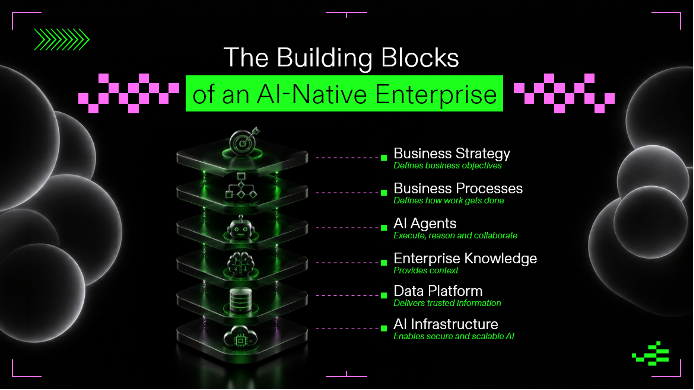
Organizations are moving away from isolated AI initiatives toward environments where intelligence is integrated across every business function. Data is treated as a strategic asset, AI agents collaborate across systems, governance is embedded from the outset, and continuous learning becomes part of everyday operations.
The competitive advantage no longer comes from deploying the latest AI model. Increasingly, it comes from designing an organization that knows how to use intelligence effectively.
This shift is as significant as the transition to cloud computing or the rise of digital platforms. Companies that merely adopt AI will improve efficiency. Companies that become AI-native will redefine how business is conducted.
Looking Ahead
The conversation surrounding Artificial Intelligence often focuses on models, benchmarks, and emerging technologies. While these developments are important, they are not what will ultimately determine which organizations succeed.
Success will depend on something far more fundamental: the willingness to rethink how work happens.
The AI-native enterprise is not simply an organization that uses AI. It is an organization designed around AI.
As we enter the Agentic Era, the question facing business leaders is no longer whether AI should be adopted. The real question is whether their operating model is ready for a future in which intelligence is embedded into every process, every decision, and every interaction.
At Cloudevo, we believe that successful enterprise AI begins long before the first model is deployed. It starts with understanding business challenges, designing the right AI architecture, and creating the foundations that allow intelligent systems to operate securely, responsibly, and at scale.
From AI strategy and enterprise AI platforms to intelligent automation, AI agents, data engineering, and cloud-native architectures, our focus is on helping organizations move beyond isolated AI experiments and build solutions that deliver measurable business outcomes.
Because becoming AI-native isn’t about adopting the latest technology.
It’s about redesigning the way organizations work.
Those who embrace that transformation won’t simply keep pace with change.
They’ll define what comes next.
Ask me anything
Explore related questions




