





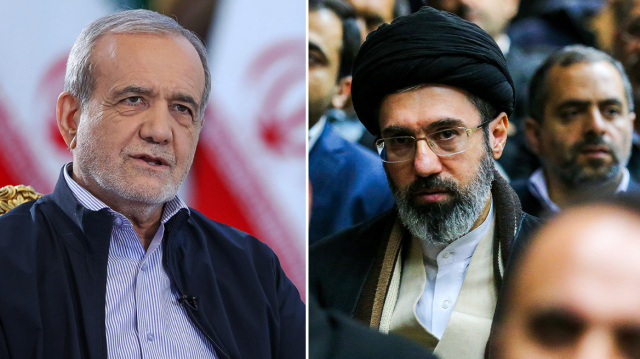
The opposition-linked broadcaster Iran International has published new details of Iran’s President Masoud Pezeshkian‘s meeting with Mojtaba Khamenei, who succeeded his father as the Islamic Republic’s supreme leader, deepening the mystery surrounding him. Pezeshkian himself had revealed the meeting took place several months ago.
According to the report, the Iranian President was driven to a secret location in Tehran and allowed just a few minutes inside a darkened car with tinted windows, sitting beside a man introduced to him as Khamenei. Sources say Pezeshkian could not see the man next to him and later reportedly wondered whether the voice he heard truly belonged to the supreme leader.
That account of what is said to have been Pezeshkian’s only meeting with the third supreme leader of the Islamic Republic differs sharply from what the president has stated publicly. In mid-May, Pezeshkian told representatives of professional associations that he had met the new leader for two and a half hours in a “warm atmosphere.” But according to Iran International’s sources, the meeting lasted only a few minutes before the president was asked to leave.
A meeting granted after threats to resign
The report says the meeting only went ahead after Pezeshkian repeatedly requested it and even threatened to resign. The supreme leader’s office eventually agreed but told the president that, unlike usual practice, he would not be received at the official residence.
Instead, the presidential guard drove him to an undisclosed location in Tehran, where he left his official vehicle and was taken to the back seat of an ordinary car with tinted windows. Khamenei was reportedly already waiting inside. The car was so dark that the two men could not see each other, and Khamenei’s security detail did not even allow a handshake, so Pezeshkian was only able only to listen to the leader’s voice.
“Was it really Khamenei?”
The episode is said to have angered Pezeshkian, who reportedly found it deeply humiliating. Sources close to the president say he later asked whether the man beside him had really been the supreme leader, since he had never seen his face and had heard only his voice in the dark. It is unclear whether the question reflected genuine doubt or simply his anger at how he had been treated. The same sources say Pezeshkian has since requested a second meeting, this time at the leader’s residence, but the request has been turned down.
The “invisible” leader
About five months after Khamenei was chosen by the Assembly of Experts, the clerical body responsible for selecting Iran’s supreme leader, to succeed his father, no audio message or video of him has been made public. According to Iran International, the issue has even preoccupied pro-government media in Iran.
On Sunday, the website of the newspaper Hamshahri published a video claiming foreign intelligence services could locate the new leader’s hideout by analysing any recording of his voice, using acoustic energy, mains electrical frequency and background sound. The same video suggested intelligence agencies could also study the tone of his voice to gauge his health or stress levels, a claim the report says has only fuelled speculation about his condition rather than easing it.
Conflicting assessments
Reports on Khamenei’s condition remain contradictory. About three weeks ago, US President Donald Trump estimated there was a 90% chance Khamenei had been killed, while Israel’s prime minister recently said he was alive. Iranian officials have also given conflicting accounts. Foreign Minister Abbas Araghchi said in a July interview that he had not seen Khamenei throughout that period and that only a limited number of people had met him. A day later, Pezeshkian said in a speech that meetings with the supreme leader had actually increased.
Warning over resignation threats
Tension between the president and the supreme leader’s office is reported to have grown. In a video circulated on social media, Mohammad Bagher Kharazi, a relative of the Khamenei family by marriage, said the new supreme leader had formally warned Pezeshkian that after 28 threats or attempts to resign, the next one would be his last. “He said it officially, and that’s why they stopped threatening to resign,” he said. According to Iran International, this account matches earlier reports that Pezeshkian sent a formal resignation letter to the supreme leader’s office in late May, citing the Revolutionary Guards’ complete control over the running of the government.
Ask me anything
Explore related questions




