





A real-life thriller with crucial pieces still missing is how investigators are describing the death of a 41-year-old paramedic with Greece’s National Centre for Emergency Care (EKAB) in Ano Syros. The longer the investigation continues, the more questions arise over exactly what happened on the afternoon of 23 July, and above all, why.

A written ruling from the Judicial Council of the Misdemeanours Court in Syros, the panel of judges that decides on pre-trial detention when prosecutors and investigating judges disagree, has now ordered the detention of the 41-year-old man accused in the case. The ruling highlights contradictions the judges identified in his account, alongside serious unanswered questions about a case that first appeared to be a break-in gone wrong.
Why did the woman arrive at the property with her face covered? Why was she wearing surgical gloves and carrying a knife? And, crucially, was there any connection between her and the people inside the house? The ruling does not answer these questions.
What it does offer is an extremely detailed account of events, from the moment the woman appeared outside the house with her features hidden to the moment, roughly 70 metres away, when she collapsed to the ground after being struck fatally in the back. Crucially, the council also explains why it was not convinced by the defendant’s claim that the fatal blow was struck inside the house.

The woman’s arrival
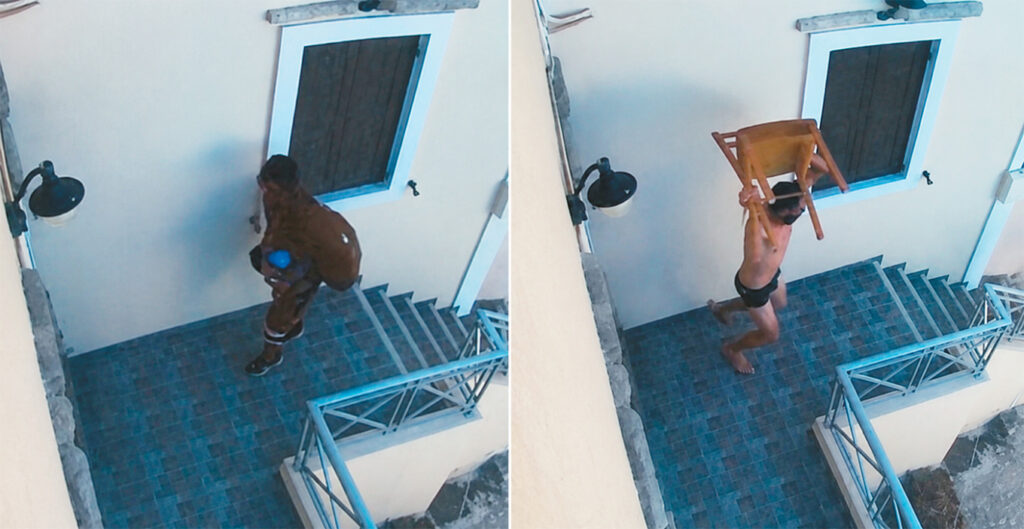
The ruling reconstructs the timeline in detail. At 4.40pm, the defendant returned to his home in Ano Syros. His wife arrived seven minutes later, at 4.55pm. A further seven minutes after that, a figure appeared who could not initially be identified. She wore a black top, black trousers with two grey stripes down each leg, and black trainers with white soles.
She carried an Under Armour backpack, wore blue disposable surgical gloves, had her head covered with a hood or scarf, and wore black sunglasses.
She approached the front door and stood outside for 20 seconds, apparently listening to sounds from inside, as the CCTV footage shows.
Face to face with knives
At 5.02pm and 53 seconds, the defendant’s wife opened the door and the unidentified woman forced her way in. The first attack happened here: she pointed a 30cm knife at the wife, pressing it against her stomach and causing a minor graze. The wife began screaming, backed away and tried to push the intruder off with her hands.
The intruder then turned towards the defendant, who, according to the ruling, had been sitting at the kitchen table with his back to the sink. He stood up, stepped left towards the fridge, and picked up a second knife from the table with his right hand, a green-handled knife with a 12.5cm blade.
For a few seconds the two stood facing each other, both holding knives. The intruder raised hers towards him but, faced with his response, began to retreat and eventually fled.
The chase
From this point, according to the judges, the case takes a different turn. The ruling states that, seeing the intruder retreating and taking into account her smaller build, the defendant “found renewed courage.” Still holding the green knife in his right hand, he followed her out of the house.
At 5.03pm, the woman left the property, quickly scooped her backpack off the floor and hurried down the steps. The defendant came out immediately after her, carrying a wooden chair in one hand and the green knife in the other. He shouted something unintelligible and threw the chair at her as she moved away.
By this point, the judges say, the defendant’s own movements show he could tell from how she moved that she was a woman. Despite this, he chose to keep following her. The judges place particular weight on the wording of the ruling itself, which states that he acted out of “a sense of retaliation for the insult he and his wife had suffered.”
In other words, the judges concluded that once the woman had left the house and was moving away, the defendant did not simply respond to the danger he faced. He chose to pursue her.
The fatal blow
The chase continued through the narrow streets of Ano Syros. The woman was moving quickly and the defendant followed. Along the way, according to the ruling, he picked up a plastic flowerpot and threw it at her.
The pot struck her, causing her to stumble and slow down. This allowed the defendant to close the distance. It is at this exact point, according to the version of events the council has adopted, that the fatal blow was struck.
The defendant caught up with the woman and struck her with the knife in his right hand, wounding her in the back of the chest, between the spine and the right shoulder blade. She lost her balance after being hit.
The spot where she fell was, according to the ruling, roughly 70 metres from the defendant’s home. He restrained her in a headlock, saying he was trying to disarm her, and threw his own knife to the ground.
Shortly afterwards a witness, identified in the ruling only by the initials A.K., arrived at the scene, helped the defendant and took the knife from the woman, whose face remained covered at that point. Her scarf was then removed, revealing her to be Evangelia Zagorianou, a 41-year-old EKAB paramedic.
She lost consciousness soon after. Zagorianou died from her chest injuries. Police called to the scene found her lying on her back on Agios Georgios Street, at its junction with Velissariou Freri Street in Ano Syros, with the fatal wound to her back.
Not convincing enough
One of the most significant parts of the ruling concerns the defendant’s claim about when and where the fatal wound was inflicted. He maintained that he had struck the blow inside the house, holding the knife in his left hand at the time. The council found this account unconvincing, and explains its reasoning in detail. The first factor considered is the absence of blood.
No bloodstains were found inside the house, nor anywhere along the roughly 70-metre route between the property and the spot where Zagorianou was eventually found. For the council, this does not fit with a claim that the wound had already been inflicted indoors before she managed, injured, to cover that distance.
The council also examined the defendant’s claim that he had held the knife in his left hand inside the house. The conclusion is unambiguous.
The judges found it “contrary to common sense” that the defendant would have held the knife in his left hand indoors, only to appear seconds later on camera, just after leaving the house, holding both the knife and the chair he had picked up in his right hand.
The ruling also notes that, in his own testimony, the defendant said he continued holding the knife in his left hand even after throwing the flowerpot. The judges weighed this detail against what they concluded the evidence actually showed.
The contradictions
The judges did not stop at the question of which hand held the knife. The ruling notes that during the reconstruction, the defendant initially said he could not remember which hand he had used to carry the knife inside the house. His wife, meanwhile, told investigators she had not seen exactly when the blow was struck, and that it was the defendant who later told her he had stabbed the woman.
The council also weighed the CCTV and photographic evidence. It found no sign that, as she left the house, Zagorianou’s clothing showed a visible tear at the point on her back where the fatal wound was later found.
For the judges, this detail adds to a chain of evidence undermining the claim that the fatal blow was struck before the woman left the house.
Having weighed all of this, the council concluded that there were “serious indications of the defendant’s guilt for the act he is accused of.” The question remaining was whether he should be released under conditions pending trial, or held in pre-trial detention. The case reached the council because the prosecutor and the investigating judge disagreed.
It therefore fell to the council to give a final answer. The charge under consideration is causing fatal bodily harm in its aggravated form under the Penal Code, a felony punishable by a prison term of between 5 and 20 years. In reaching their decision, the judges considered not only the outcome but the entire sequence of events.
The shift from what happened inside the house to what followed outside it, tens of metres away, is one of the ruling’s most decisive elements. For the judges, this was not a single, momentary episode confined to the house. The chase continued after Zagorianou had already fled, right up to the point where she collapsed.
On this basis, the judges concluded that the conditions for the defendant’s pre-trial detention were met, resolving the earlier disagreement.
According to Marizana Kikiri, the lawyer representing the victim’s family, it was the defendant’s violent, aggressive and antisocial conduct that led to the detention order, since the court judged there to be a risk he might commit further offences.
Kikiri argues that the case file as a whole points in this direction, while the family believes the case amounts to premeditated murder and expects the charge to be revised accordingly. Meanwhile, the results of a court order lifting the confidentiality of phone records are still awaited, and could add significant new evidence to the investigation.
The big question: Why?
The defendant’s detention has not solved the mystery surrounding the case. The biggest question remains unanswered: what led the woman to that particular house? The image of a woman arriving with her face covered, wearing gloves and carrying a backpack and a knife, points to an act that had clearly been planned.
Whether this was purely an attempted robbery or whether some other motive was involved, is one of the pieces of the case still to be clarified. Attention has now turned to the results of forensic laboratory analysis, as well as the examination of both parties’ mobile phones.
Calls, messages, contacts and other data may yet provide answers about any prior contact or relationship between those involved. It may be within these digital traces that the answer to the case’s biggest question lies: why the 41-year-old paramedic found herself that afternoon, disguised and armed, outside that particular door. And perhaps that is where the full truth behind the Ano Syros case will ultimately be found.
Ask me anything
Explore related questions




