





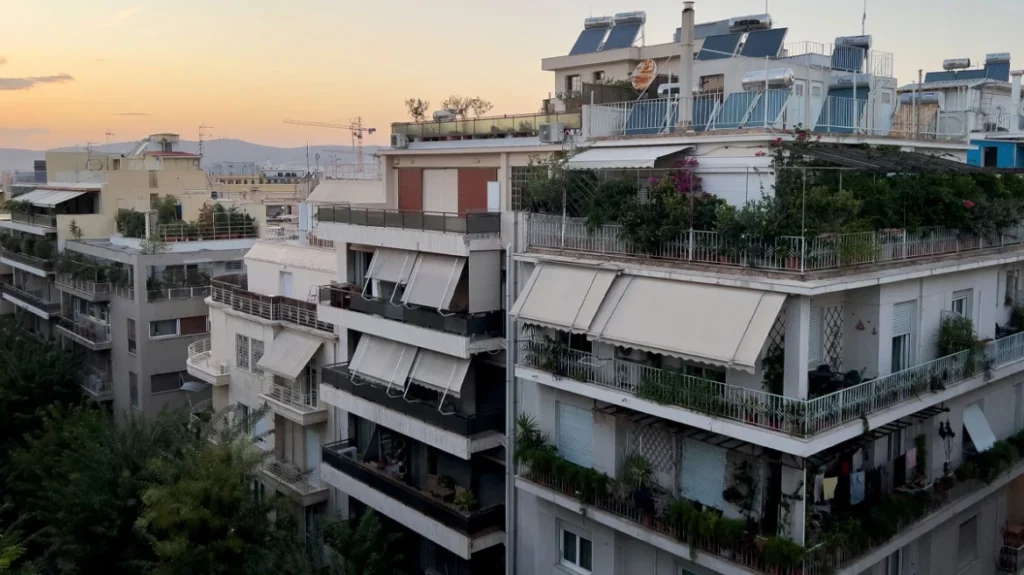
With rents reaching as much as €550 even for a small 40-square-meter home, the search for student housing begins again this year. Thousands of families currently looking for accommodation near universities are facing a two-tier market: on the one hand, Athens and Thessaloniki, where small apartments now command “gold” per square meter, and on the other, major university cities in the regions, where cheaper options are still available.
The greatest pressure is being felt around Athens’ universities. The latest data for the first half of 2026 show that asking prices for small homes of 15 to 50 sq. m., within 1.5 kilometers of major universities in Athens and Thessaloniki, reach €13.7 per square meter in the most expensive areas.
At these levels, a 40-square-meter home corresponds to an asking rent of approximately €550 per month. This is an indicative calculation based on a price of €13.7 per square meter, not a uniform price that applies to every property of this size.
At the top are the areas around Panteion University and the University of Piraeus, where the price reaches €13.7 per sq. m. They are followed by the area around Harokopio University at €13, while around the National and Kapodistrian University of Athens the price stands at €12.3 and around the Athens University of Economics and Business at €12.2 per sq. m.
The speed at which rents have risen is particularly noteworthy. Around the University of Piraeus, asking prices have risen by 29.2% over three years, the largest increase among the university areas examined. In the area of the University of West Attica, the cumulative increase reaches 23%.
The picture of high prices is also confirmed by data from Athens’ traditional student neighborhoods. In the city center, the average asking price stands at €12.58 per sq. m., up 7.3% in one year. Indicatively, a 35-square-meter studio corresponds to approximately €440, and a 50-square-meter apartment to approximately €630.
In Zografou, one of the areas with consistently strong student demand, the average price stands at €11.83 per sq. m., an increase of 6.3%. A 35-square-meter studio corresponds to approximately €420 and a 50-square-meter apartment to €590. In Kallithea, the average price stands at €11.53 per sq. m., in Piraeus at €11.40, and in Aigaleo at €10.90.
In Thessaloniki, the picture is slightly better, although small homes near the universities can no longer be described as cheap. Around Aristotle University, the asking price stands at €11.8 per sq. m., while around the University of Macedonia it is approximately €12. The final price, of course, depends on the age and condition of the property, its distance from the university, and above all whether it has been renovated and furnished.
There is a wider range of options in the regions, although expensive properties can be found there as well.
In Patras, an unrenovated studio apartment in the city center, from the Ypsila Alonia area to Agia Sofia, ranges between €280 and €350 per month. If it is renovated and furnished, the price rises to €350–€400. For a two-room apartment, rent starts at approximately €400 and can reach as much as €700 when the property is renovated, furnished or newly built. Outside the city center, there are still studios of up to 30 sq. m. with prices starting at approximately €200.
In Ioannina, a studio apartment in the city center costs approximately €350 per month, while a renovated or newly built two-room apartment costs approximately €450. There are also properties offered at higher rents with electricity, heating and water included in the price. In these cases, a studio can reach €430–€450 and a two-room apartment €600–€650.
In Larissa, the greater supply of small apartments keeps prices more in check. Options start at approximately €200 and can reach €450 for fully equipped studios, depending on the area, the age of the property and its amenities.
The key points for securing a home
The search for student housing also conceals pitfalls, particularly when it is conducted under time pressure. POMIDA, in its guide for new students and their parents, recommends above all avoiding panic and a rushed choice of property.
According to the Federation, one of the most common mistakes is searching exclusively around the university entrance. A few streets or several stops farther away may offer more and cheaper options. The search should be organized and involve comparing multiple properties. However, once a home that meets the family’s needs and budget is found, excessive delay can result in losing it, particularly in areas of high demand.
If the asking rent exceeds the family’s financial means, the solution is not necessarily to increase the budget. Searching a little farther from the university can significantly reduce the cost.
Sharing a home is also one of the solutions becoming more attractive as the prices of small homes rise. Two or more students can share a larger apartment, meaning the cost per person is often lower than that of a studio.
Before the agreement is finalized, the property should be carefully inspected and without rushing. If the first viewing takes place at night, it is useful to make a second visit in daylight. Heating, window frames, dampness, electrical and plumbing installations, appliances, building charges and energy costs can significantly alter the actual monthly bill.
Particular attention is required before handing over any money. POMIDA points out that rent or deposits should not be paid before the prospective tenant has established that the person requesting the money is actually the owner of the property or someone legally authorized to act on their behalf.
Attention is also needed with so-called “information offices,” which ask for money in advance with the promise of immediately finding a suitable home. The recommendation is that prospective tenants turn to legitimate real-estate agencies, know the terms of the cooperation and the agreed fee from the outset, and not pay money without the necessary receipts and documentation.
The deposit and any advance rent payments should also be clearly agreed upon before signing. There is no single legally mandated deposit amount that applies to all leases, so the prospective tenant should know exactly what is being requested and why before paying any amount.
The key points with the tax authorities
The lease agreement is particularly important. In addition to the written agreement between the two parties, the landlord electronically submits to the Independent Authority for Public Revenue (AADE) the Declaration of Information on the Lease of Real Estate.
After the electronic submission, the tenant is notified through myAADE and has 30 days to accept or reject the declaration. If the tenant takes no action within the deadline, the declaration is deemed accepted.
Before accepting it, the agreed monthly rent, the duration of the lease, and the details of the property and the contracting parties must be carefully checked. A mistake that goes unnoticed can later cause problems during electronic cross-checks.
Correctly declaring student housing now also has a direct financial benefit for the family. The annual rent refund corresponds to one-twelfth of the declared annual rent and can reach up to €800 for each student residence, provided the applicable conditions are met.
For student housing, an income criterion applies, but not the property-ownership criterion that applies to a primary residence. The calculation is based on the information in tax returns, and AADE carries out electronic cross-checks against the lease data.
There is also the student housing allowance, which may be increased in cases of shared accommodation, provided the relevant conditions are met. For this reason, the details of the lease, the student and the residence must be correctly declared from the outset.
The final bill, however, does not stop at the rent. Before signing, building charges, heating, electricity, internet and transportation costs need to be added. A cheaper but energy-intensive home, or a property located very far from the university, may ultimately cost more than a slightly more expensive option in a better location.
Ask me anything
Explore related questions




