





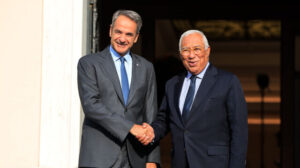
Prime Minister Kyriakos Mitsotakis welcomed European Council President António Costa to the Maximos Mansion, the Greek prime minister’s official offices in Athens, on Thursday afternoon (3 September). The two leaders were giving joint statements live at the time of writing.
Addressing the recent escalation with Turkey, Mitsotakis said: “My country is a peaceful nation, which poses no threat to anyone. But it will not accept instructions from anyone on how it strengthens its defensive capabilities.”
Mitsotakis sent a firm message to Ankara after his meeting with Costa, saying that “Greece will not accept guidance from anyone on how it strengthens its defence.”
He briefed Costa on the recent escalation in Turkish provocations, particularly in the Aegean, and reminded him that participation in the EU’s SAFE defence funding programme is conditional on not undermining the security interests of member states.
“Respect for international law and for good neighbourly relations is a precondition for the European path of any candidate country,” he said.
The prime minister then raised the stakes further, putting the question of casus belli and Turkish challenges to Greek sovereignty directly on the European table.
“There is an active threat of war and a challenge to Greek sovereignty from a country that expects to improve its relations with the European Union,” he said, adding that Turkey’s European path “cannot but go hand in hand with building good neighbourly relations.”
Mitsotakis also said that “Greece is already preparing for the presidency of the Council of the EU in the second half of 2027 with a sense of responsibility, and is ready to make a substantial contribution to advancing our shared priorities.”
On competitiveness, he noted that “we cannot talk about a competitive Europe when our businesses and households continue to pay more for energy than our competitors.”
The meeting also covered the complex negotiation over the new MFF for 2028 to 2034. As Mitsotakis put it, “we must reach an agreement by the end of the year. The Cypriot presidency has laid the groundwork. We are awaiting the Irish presidency’s proposals on the size of the budget and the allocation of resources. But we all need to push to reach the necessary consensus at the European Council in Brussels in December, which I predict, my dear President, will also run long, but we need a political agreement. We need an agreement, a more ambitious budget.” He stressed that “we cannot achieve more by spending less.”
Costa, for his part, underlined that “protecting the interests of its member states will always be a priority for the European Union.”
Costa said the EU “also has a strategic interest in a stable and secure environment in the Eastern Mediterranean,” adding that “the prime minister briefed me on the latest developments in relations between Greece and Turkey.”
He said “the European Union is interested in developing a mutually beneficial, cooperative relationship with that country. Turkey’s own constructive engagement is decisive for advancing the various areas of cooperation, as the European Council’s conclusions have clearly and repeatedly stated.”
“In any case, protecting the interests of the European Union’s member states will always be its priority,” he stressed.
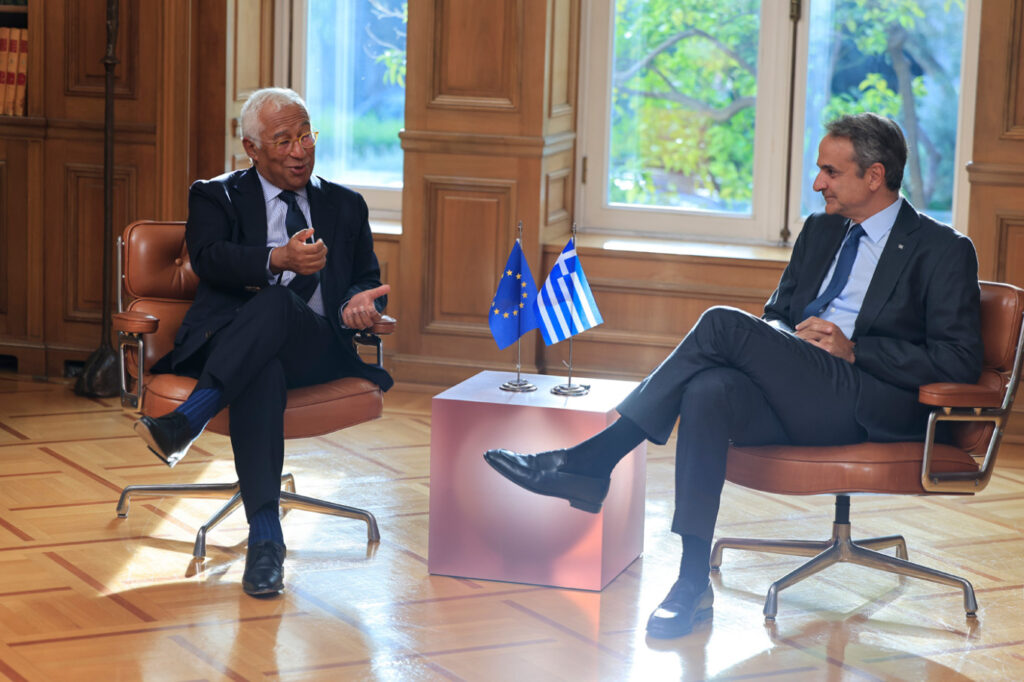
Full statement by Prime Minister Kyriakos Mitsotakis following his meeting with European Council President António Costa at the Maximos Mansion:
“President of the European Council, dear António, I welcome you back to Athens. Your visits here always give me personal pleasure, but above all they are an opportunity for us to jointly examine current developments, and of course Europe’s strategic direction, especially in a highly complex and fluid international climate like the one we face today, which confronts Europe with critical decisions about its future path.
For our part, Greece is already actively involved in the relevant processes, with very clear positions and bold proposals. I believe these are positions that serve our shared vision of a stronger, more competitive, more secure Europe.
All the European Council’s decisions show that we must move in this direction, and it is in this spirit that Greece is already preparing for its presidency of the Council in the second half of 2027, with a sense of responsibility and readiness to make a substantial contribution to advancing our shared priorities.
The President and I had the chance to discuss many issues, foremost among them the extremely complex negotiation over the new Multiannual Financial Framework for 2028 to 2034. We agree that we must reach a political agreement by the end of the year. The Cypriot presidency has already laid the groundwork. We are looking forward to the new proposals from the Irish presidency on the size of the budget and the allocation of resources, but we all need to push to secure the necessary consensus at the European Council in Brussels in December, which I predict, my dear President, will also run long, but we need to reach a political agreement.
Greece has repeatedly argued that we need a more ambitious European budget, one that can serve the new priorities we ourselves have set, without undermining Europe’s identity policies, its cohesion funds or its Common Agricultural Policy, within the new architecture proposed by the European Commission, which we agree with in principle.
To put it simply, and I think you have said this yourself: we cannot achieve more by spending less. For us, the policies that support convergence ensure that growth ultimately benefits all countries on the Union’s periphery, but also, in the end, benefits the countries at the core of our shared European family.
I want to make special mention of the need for adequate resources to adapt to new conditions and tackle the consequences of the climate crisis. This year many European countries were hit by devastating wildfires. My own country avoided the worst this year, but we know very well that this is an ongoing challenge that must be treated as a shared European threat.
But of course, we also know that in order to safeguard cohesion funding and the Common Agricultural Policy, and to finance our new priorities, we need an increase in own resources.
Greece comes to this discussion ready to put forward new, and I believe creative, proposals, such as the possible use of revenue from auctioning 5G and 6G spectrum frequencies, while we also remain open to considering new financing instruments. I will say it again: I believe that shared European public goods, such as defence, which is the ultimate shared public good, could under certain conditions be financed through new joint borrowing instruments.
António and I discussed the broader challenge of competitiveness. Europe must make a leap forward faster than its own decline, taking bold initiatives with artificial intelligence and new technologies at the forefront, technologies that are already transforming our economy and our lives. Otherwise we risk falling behind global developments and missing a critical opportunity.
And of course, as I have said many times, and the President knows this well, we cannot talk about a genuinely competitive Europe when our businesses and households continue to pay more for energy than our competitors. It is therefore an absolute priority to complete the single energy market as soon as possible. This summer, in August, we saw high energy prices, but also major disparities between European countries.
The same, of course, applies to the Savings and Investments Union, so that our businesses can grow without having to seek attractive financing elsewhere.
Finally, on defence, Europe as a whole must raise an impenetrable shield against threats, wherever they come from, whether from the north, the south, the west or the east. The funding for protecting every part of it must therefore also be unified.
SAFE was an important initiative and a step in the right direction, but we need more, and we also need to choose our partners very carefully. I would remind you that the condition for third countries joining the programme was, and remains, that it must not undermine the security and defence interests of member states.
It was therefore natural for me to brief the President on the recent escalation of Turkish provocations, particularly in the Aegean. Respect for international law and for good neighbourly relations is, after all, a precondition for the European path of any candidate country. This is something laid out in a series of European Council decisions.
And it is unacceptable, I will say it again, for there to be an active threat of war and a challenge to Greek sovereignty from a country that expects to improve its relations with the European Union. Turkey’s European path, which we want to support, cannot but go hand in hand with building good neighbourly relations with Greece.
I will say it again: my country is a peaceful nation that poses no threat to anyone. But it will not accept guidance from anyone on how it strengthens its defensive posture.
I now turn to migration. The recent events in Ceuta have unfortunately brought the weaponisation of migration flows back into focus. We know this well, having faced a hybrid attack in the Evros region. We were the first European country to face this challenge, in March 2020.
We need to strengthen our cooperation with third countries and become more effective in returning those not entitled to asylum. It is important that the countries of the south stand united here.
And yes, the time has come to examine new, innovative solutions for our cooperation with third countries. We need to send a clear message that people smugglers will not decide who enters Europe.
Finally, the President and I also discussed other pressing international issues, including the, unfortunately, widening war in Ukraine. We firmly support the country under attack, and we declare our readiness for Europe, and this is very important, to be present and represented, Mr President, by European institutions when the time comes for negotiations.
I also want to note something important in closing: freedom of navigation guarantees food security and energy supply. Attacks on lawful shipping are therefore unacceptable. And freedom of navigation must equally be non-negotiable, without tolls, in the Strait of Hormuz.
We discussed developments in the Middle East, and finally I want to recall that Greece is one of the few European countries taking part in Operation Aspides, a joint European initiative that has shown that when Europe wants to, it can be autonomously present in regions of major geostrategic and geopolitical interest to it, provided that participation from European countries is broader and stronger. I believe this would send a very serious message that we, as Europe, are capable of carrying out such missions.
I will end here by saying it is my pleasure, dear António, to welcome you to Athens once again. I know we have very difficult work ahead of us, but I am certain that when we join forces, and we will prove this once again that we can, we can win our shared challenges. We have, after all, proven this before.
So we renew our appointment at the coming European Councils, and I want to personally express my complete confidence in your ability to manage these complex negotiations objectively, so that we always arrive at solutions that advance our shared European project.
Thank you again very much for being here.”
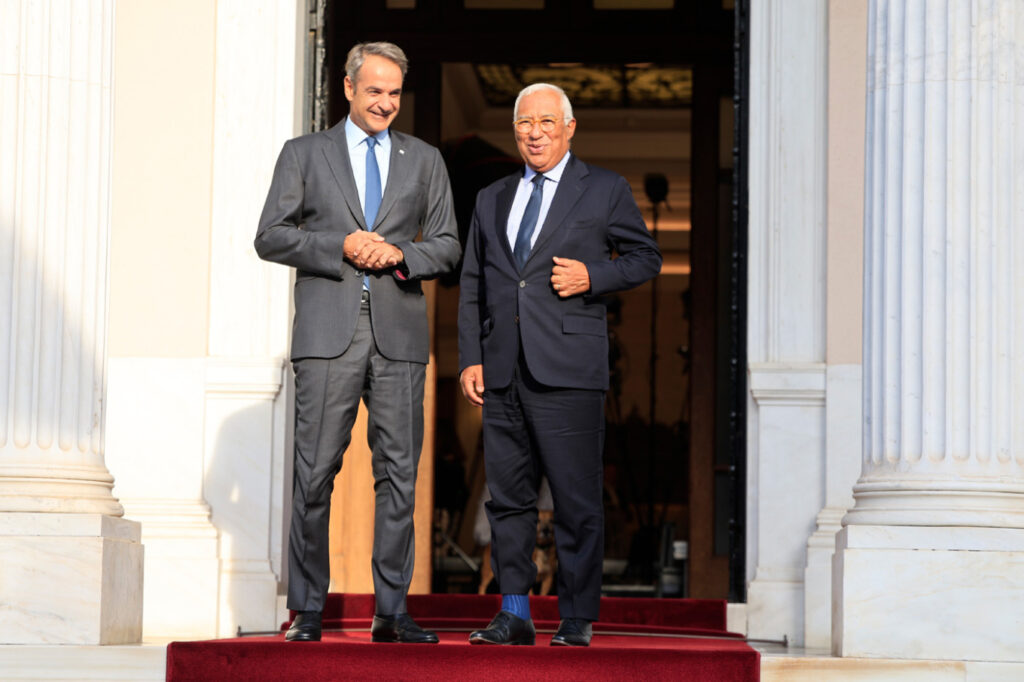
Full statement by European Council President António Costa following his meeting with Prime Minister Kyriakos Mitsotakis at the Maximos Mansion:
“Thank you very much, Prime Minister, dear Kyriakos. It is always a pleasure to visit you in Athens, and thank you for the warm welcome. It is vital for me to hear directly from each leader in their respective capitals during this tour. I intend to draw on what I hear over these weeks to prepare for the coming European Council meetings. And now, especially with you, to begin preparing for the Greek presidency of the Council in the second half of 2027.
The coming months will be critical for our Union. We are approaching one of the most important decisions of recent years: our next long-term European budget for 2028 to 2034. We must reach agreement by the end of this year. That is the only way to avoid disruption to our investments in farmers, businesses, students, researchers and innovators.
Furthermore, this summer’s events, from the devastating wildfires, including here in Greece, to the severe droughts, have once again shown that Europe must be ready to respond to unpredictable challenges. That is why it is so important that our next budget is fit to address the realities of the world we live in and to respond to the needs of our citizens and businesses.
We are operating in a geopolitical environment fundamentally different from the one we faced when we agreed the current budget in 2020. This new reality demands a new approach to our budget, with a new structure and a new way of allocating our resources.
We need a budget that responds to our shared priorities, including in key areas such as defence and security, competitiveness, innovation and strategic resilience. At the same time, as you said, we must continue to support our cohesion and agricultural policies. They are fundamental to ensuring that prosperity, resilience and opportunity reach every corner of Europe.
However, like national budgets, the European Union’s budget must meet its priorities within the limits of finite resources. Most of it is funded through member states’ national contributions, and we must keep those contributions within reasonable limits. That is why a balanced and ambitious package of new own resources, new revenue sources for the European Union, will be an essential part of an overall agreement. It will be difficult work, but I am reassured by the constructive tone of the discussion so far, and I am confident we will reach agreement before the end of the year.
Prime Minister, dear Kyriakos, Greece holds a strategic position, looking out towards the Mediterranean and the Middle East, with a perspective that extends further than we can sometimes see from Brussels. That is why it was so important for me to hear your views. We must protect our borders, including our maritime borders, and ensure Europe has the capabilities it needs to respond effectively.
We also have a strategic interest in a stable and secure environment in the Eastern Mediterranean. The prime minister briefed me on the latest developments in relations between Greece and Turkey. The European Union is interested in developing a mutually beneficial, cooperative relationship with that country. Turkey’s own constructive engagement is decisive for advancing the various areas of cooperation, as the European Council’s conclusions have clearly and repeatedly stated. In any case, protecting the interests of the European Union’s member states will always be its priority.
On the Middle East, we agree that developments in the region affect peace and stability in Europe. They also affect migration flows and have a direct impact on our energy security. For this reason, we must remain active in the region. I am grateful to Greece for the active role it plays in this context, particularly in strengthening relations with our partners in the Gulf. To further strengthen these ties, the European Union will hold a summit with the countries of the Gulf Cooperation Council on 24 October.”
Ask me anything
Explore related questions




