





A new debate over the content of school textbooks and the way the concept of family is presented to children has emerged in recent days, following the publication of excerpts and images from two new primary-school textbooks.
The books in question are the 2nd-grade Language textbook, titled “My Language,” published by Nisos, and the 6th-grade Social and Political Education textbook, published by Poukamisas. Both belong to the new teaching packages approved as part of the Multiple Textbook reform.
It should be noted, however, that the debate does not concern textbooks that will be distributed to students in September 2026. These particular textbooks have been incorporated into the new system and are intended for use beginning in the 2027–2028 school year, when the Multiple Textbook system will be implemented in practice.
Government spokesman Pavlos Marinakis, for his part, was categorical in stating that “there is no woke agenda in the government,” emphasizing: “There are two sexes; a father is a father, a mother is a mother. There is no Parent 1 and there is no Parent 2.”
What the 2nd-Grade Textbook Says
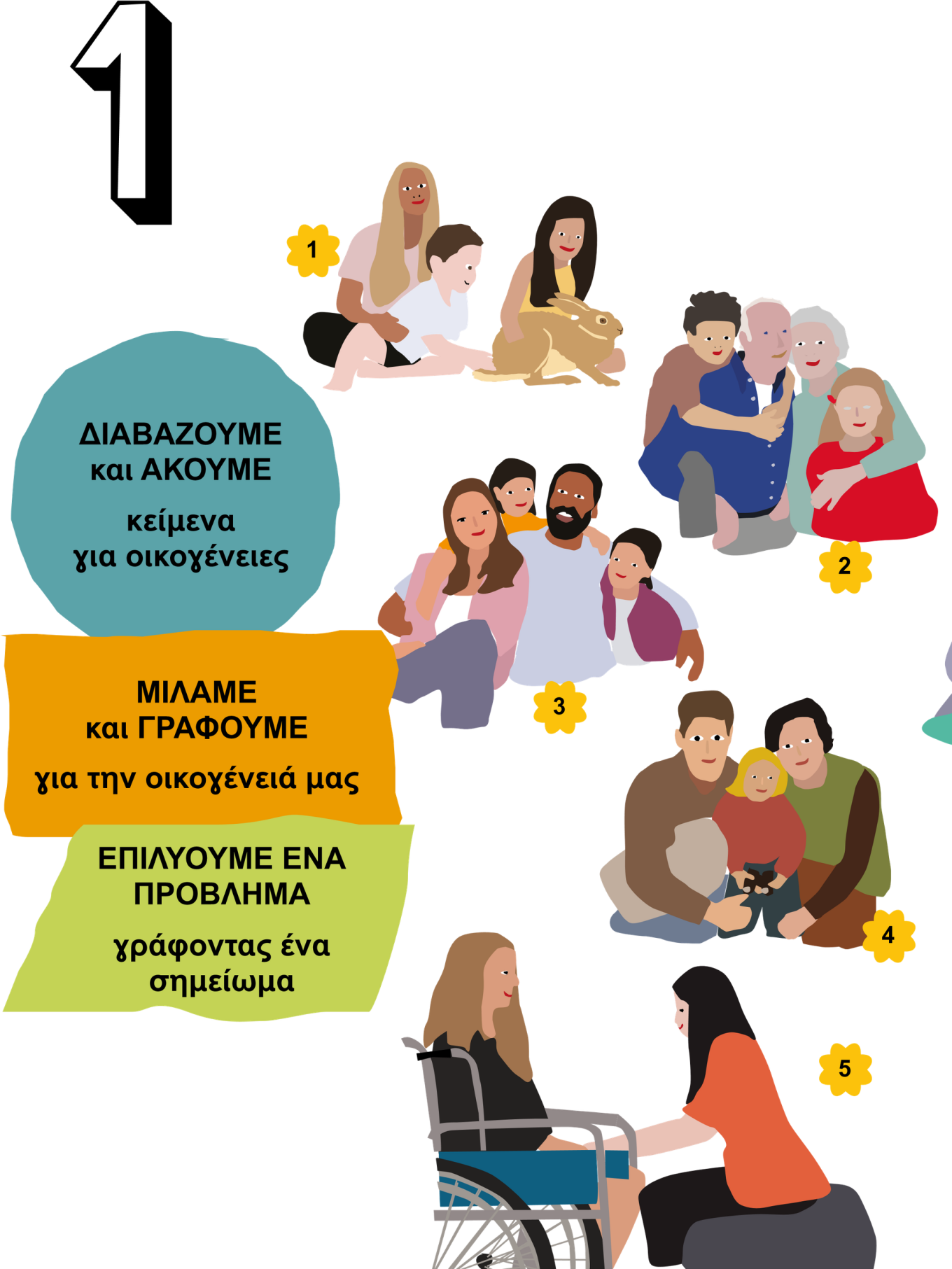
In the 2nd-grade Language textbook, in the first thematic unit titled “Who are the important loved ones around us?”, different family structures are presented through illustrations.
According to the material that has been made public, some of the images depict families with two fathers or two mothers. The activity asks students to observe the pictures, comment on them and identify which one most closely resembles their own family, which they can then draw.
This presentation has triggered the strongest reactions, mainly because of the age of the children for whom the book is intended and the question of whether—and in what pedagogical manner—different family realities should be presented in the early years of primary school.
There is, however, one crucial detail: this is not the only textbook that teachers will have available.
Under the Multiple Textbook system, this 2nd-grade Language textbook is one of four available options, and teachers will choose the teaching material they use.
What the 6th-Grade Textbook Says
The reference to family is more extensive in the 6th-grade Social and Political Education textbook, written by sociologist Manousos Maragkoudakis.
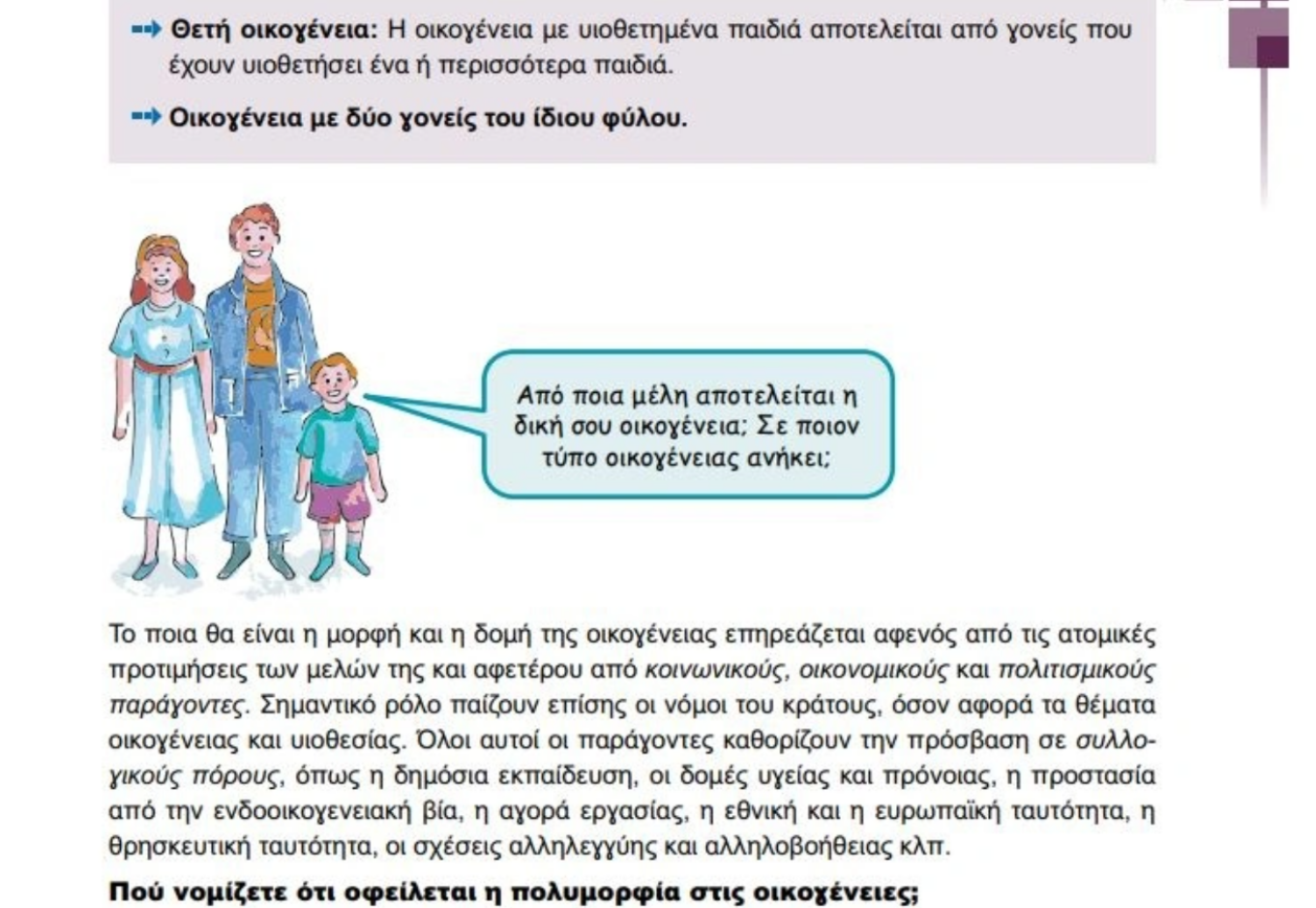
In the first unit, “The Greek Family,” the textbook refers to the “great diversity” of family structures and presents different types of families.
These include the nuclear family, single-parent family, extended family and adoptive family. There is also a separate reference to a “family with two parents of the same sex.”
The subject is not limited to a simple reference. In a subsequent activity, students are asked to divide into groups, take responsibility for one type of family and create a relevant poster using images and photographs. They are also asked to identify which category their own family belongs to.
The textbook is registered under code 95 in the Register of Teaching Textbooks. It was officially added on April 8, 2026, and has been entered into the official “Melispi” digital repository of DIOfANTOS. The official registration lists Manousos Maragkoudakis as the author and Poukamisas Publications as the provider of the teaching package.
Here, too, however, there is an important factor: under the new system, this textbook is one of three options for 6th-grade Social and Political Education.
Who Approved the Textbooks?
Responding to the controversy, the Ministry of Education referred to the evaluation process conducted by the Institute of Educational Policy (IEP).
According to the ministry’s position, as reported by MEGA, the evaluation was carried out by independent scientific committees involving more than 900 members in total, through procedures involving review and re-review. The ministry maintains that the textbooks were published in accordance with the recommendations of the evaluation committees and without intervention in their content.
The official registration of the 6th-grade textbook confirms that it forms part of the project “Writing, Evaluation and Inclusion of Teaching Textbooks in the Register of Teaching Textbooks and the Digital Library of Teaching Textbooks,” implemented under the IEP for the 2021–2027 period.
In other words, these are not textbooks that suddenly appeared without institutional oversight. They have gone through the prescribed evaluation process and have been officially incorporated into the new Register.
That, of course, does not mean that their content cannot be criticized. Scientific evaluation and public debate over the suitability, wording and pedagogical approach of a textbook are two different matters.
Marinakis: “There Is No Woke Agenda”
Asked about the issue during a radio interview with MEGA NEWS 104.6, government spokesman Pavlos Marinakis said:
“As the father of a three-year-old child, this news concerned me greatly. The Ministry responded officially about how the curriculum is developed and how the textbooks are selected. That answer is available from the Ministry of Education to anyone who wants it…”
He continued:
“I believe—and this is something I will say without fear, as I have demonstrated that I do—that when we select books, when we select curricula, especially for primary-school children, and even more so for children in the first, second and third grades, we must be particularly careful and show heightened sensitivity.”
In this context, he also stressed:
“There is nowhere—in an entire state, in public services, in the laws that have been passed, in the way someone obtains an identity card, in the way someone obtains a passport—where it emerges from any legislation or any decision by ministers, deputy ministers or secretaries-general that this government has even the slightest intention of implementing a woke agenda.”
Concluding his comments, Marinakis said:
“It is one thing to raise an issue and address it, and another thing to claim that the motivation is a woke agenda—let’s not distort the scale of the news. Yes, we should respond to the public, and each ministry should respond, but it is one thing if something may have caused concern. And I have not hidden my words. It is another thing to say that, for these reasons, this government has a woke agenda. It neither has such an intention nor implements such a policy, nor will it implement one. There are two sexes. A father is a father, a mother is a mother. There is no Parent 1 and there is no Parent 2.”
What the Author Says
The author of the 6th-grade textbook, Manousos Maragkoudakis, rejected the characterization of the book as part of a “woke agenda.”
Speaking to MEGA NEWS 104.6, he argued that the reference to families with same-sex couples is part of the presentation of contemporary forms of family and does not constitute ideological promotion.
He pointed out that the textbook records, alongside other family forms, families with same-sex parents, arguing that this is simply a reference to a social and legal reality.
The textbook, after all, does not focus exclusively on this particular type of family. The unit attempts to present a broader range of family structures, from nuclear and single-parent families to extended and adoptive families.
There Is Also a Legal Reality
The discussion takes on a different dimension when it is taken into account that Greek legislation has now recognized civil marriage between people of the same sex.
Law 5089/2024 introduced changes to family law and established equality in civil marriage regardless of sex. Corresponding provisions were also introduced concerning parental responsibility and family rights.
Therefore, a reference in a school textbook to a family with two parents of the same sex does not concern a concept that exists outside Greece’s institutional and legal framework.
The political and social disagreement mainly concerns whether, when and through what pedagogical approach this reality should be presented to children of different ages.
And this is essentially at the heart of the controversy.
The Greek Family Is Changing
Beyond the political dispute, there is also a broader social reality.
Figures from the latest Population and Housing Census conducted by the Hellenic Statistical Authority (ELSTAT) show significant changes in the population’s family status.
Between 2011 and 2021, the number of married people fell by 10.8%, while the number of divorced people, people who were separated and those in civil partnerships increased significantly.
Specifically, the number of people in civil partnerships rose from 1,765 in 2011 to 39,984 in 2021, while the number of divorced people increased from 332,018 to 484,237.
These figures do not answer the pedagogical question concerning the content of a particular school textbook. They do, however, show that family life in Greece is no longer one-dimensional and that school textbooks are attempting to reflect a society in which different forms of family life coexist.
The Real Question Is Pedagogical
Behind the political disputes lies a question that ultimately concerns the very purpose of a school textbook:
Should a textbook present children only with the family model regarded as traditional, or should it also reflect the different family realities that exist in society?
And, more specifically: At what age, using what language and within what pedagogical framework is it appropriate to make such a presentation?
The 2nd-grade textbook approaches the subject through pictures and a simple activity asking children to identify their own family.
The 6th-grade textbook takes a more systematic approach, socially classifying different family forms.
The difference in age is therefore crucial. Asking a seven-year-old child to identify their family among a series of pictures is different from having 11- or 12-year-old students discuss social institutions and different forms of family organization as part of Social and Political Education.
And Schools Are No Longer Dealing With Just One Textbook
Another point that deserves to remain at the center of the discussion is that the new system changes the very way educational material is selected.
These textbooks are not necessarily the sole teaching textbooks for their respective subjects. They are approved options within the new Register.
The 2nd-grade textbook that has prompted the controversy is one of four available choices, while the 6th-grade textbook is one of three for the subject.
This means that the final picture in the classroom will also depend on the choices made under the Multiple Textbook system.
The ministry has already announced that the reform will be fully implemented from the 2027–2028 school year, together with the new textbooks based on the updated curricula.
The Multiple Textbook System Changes the Model
The controversy cannot be separated from the broader change currently under way in Greek school textbooks.
For decades, Greek schools generally operated with one main state-approved textbook per subject. The Multiple Textbook system introduces a different model: several approved textbooks and teaching packages will be available for the same subject, and teachers will choose the material they use.
The IEP defines teaching textbooks as not only printed or digital books used in teaching, but also supplementary material connected to them and necessary for the educational process.
The Ministry of Education has set the 2027–2028 school year as the implementation horizon. In April 2026, it announced the approval of 230 textbooks/teaching packages, while Education Minister Sofia Zacharaki described the process as a large-scale reform involving significant scientific, pedagogical and organizational requirements.
A recent ministry briefing also states that the new textbooks will be implemented from 1st grade of primary school through 1st grade of upper secondary school, and that teachers have already proceeded with selecting the books they will use, so that the ordering and distribution procedures through DIOfANTOS can follow.
Therefore, the current public debate concerns material that has already been approved and registered, but the full implementation of the new system still lies ahead.
Ask me anything
Explore related questions




