





The Exaltation of the Holy Cross, one of the most important immovable feasts of the Christian faith, celebrated every year on 14 September by both the Orthodox and Catholic Churches, is being marked with particular splendour this year, as it coincides with the 1,700th anniversary of the discovery of the Cross in Jerusalem following investigations carried out by the mother of Constantine the Great, Augusta Flavia Julia Helena, later known as Saint Helena.
It was an event that played a decisive role, becoming a major milestone in the further consolidation of what was still a relatively new religion at the time. Firstly, because it was the ultimate proof of the martyrdom of the crucifixion suffered by Jesus. For Christians and their faith, the Holy Cross is the supreme symbol of God’s love for humanity, sacrifice, as well as a life-giving source of resurrection and eternal life, and a spiritual weapon that protects the faithful from all manner of temptations.
At the same time, however, it strengthened Emperor Constantine the Great’s conviction that, by acting much earlier (313) to end the persecution of Christians through the Edict of Milan, together with Licinius, and recognising their right to religious freedom, he had done the right thing. It also prompted him ultimately to make the new religion a cornerstone on which he would build the empire. Although its recognition as the official religion of the new state came much later (380), and he himself was baptised a Christian shortly before his death (337), his decisions following his mother’s discovery of the Holy Cross not only paved the way for the triumph of Christianity, but also changed the course of history. This culminated in the foundation of Constantinople, which became the centre of the empire for more than 11 centuries, as well as the centre of the new religion to this day.
Furthermore, this year’s anniversary coincides with the impressive findings from excavations that have been under way for three years in the Holy Land by a team of archaeologists from the Italian Sapienza University. As they announced a few days ago, the findings categorically confirm that this site corresponds to the key geographical and morphological characteristics described in the Gospels.
“In this, conquer”
The historical chain of events that led to the discovery of the Holy Cross begins on 28 October 312, when Constantine’s army, marching towards Rome, clashed with that of Maxentius at the Milvian Bridge over the River Tiber, with control of the western Roman Empire at stake. Constantine prevailed, but inextricably linked to his victory is the famous vision he is said to have experienced on the eve of the great battle: a luminous cross formed by the Greek letters Chi-Rho, with the inscription “In this, conquer”.
According to the Christian rhetorician Lactantius, tutor to Constantine’s eldest son Crispus, Constantine’s vision was a dream. The historian Eusebius, however, states that Constantine “prayed to the God of heaven and for His Word, Jesus Christ”. In the work The Life of Constantine, the event is described as a true vision, which appeared in the sky in broad daylight and was also seen by the soldiers. That evening, following the divine vision, Christ appeared to Constantine and commanded him to place the cross-shaped emblem on the shields of his legions.
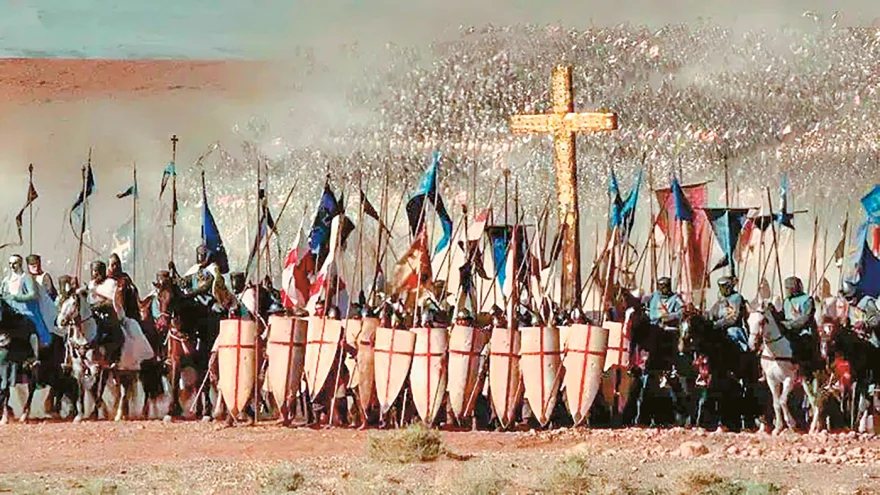
In any case, Constantine gave the unprecedented order, for a Roman army, that instead of the statues of the gods that marched before his legions, red cloths bearing an embroidered combination of the letters Chi and Rho should be carried, in accordance with his vision, and that the symbol of the cross should be painted on the soldiers’ shields. He won the battle and attributed the victory to the God of the Christians. For the Orthodox Church, which honours Constantine as a Saint and Equal-to-the-Apostles, the vision was real and had a divine origin.
Saint Helena
In 326, while Constantine had consolidated his power, having also eliminated Licinius, and after the First Ecumenical Council had been convened in Nicaea, his mother Helena, whom the Christian Church also proclaimed a Saint and Equal-to-the-Apostles, decided, despite her advanced age — almost 80 — to visit Jerusalem to pray. He helped her by providing a ship for the journey, as well as ample funds to finance the construction of Christian churches in the area.
Because of the intense religious devotion that drove her, she proceeded with extensive archaeological investigations, hoping to uncover the sites of Jesus’s Crucifixion and Resurrection on the hill of Golgotha.
The fact is that the Holy Cross was found during these excavations. As for exactly how this happened, however, historical events are intertwined with tradition, which holds that while inspecting the area, Saint Helena was led to the discovery of the Holy Cross with the help of an aromatic plant growing at a particular spot there — the basil plant, as we know it. This is why basil is distributed in churches on 14 September as a symbol of blessing. When she smelled it, she sensed that the Holy Cross lay beneath that spot and ordered the workers to dig.
Another tradition also states that a young Jewish girl led the empress to Judas, a resident of Jerusalem, because he knew from his elders the location where the three crosses — those of Jesus and the two thieves — had been buried. Helena went there with her entourage and, before ordering the excavations to begin, knelt down and devoutly prayed to Christ. However, as soon as she stood up, a major earthquake occurred, only at that particular spot, and the ground split open to a great depth.
The excavations then began immediately, and all three crosses were found, to the general astonishment of those present. A small board bearing the inscription that proved the authenticity of the three crosses was also found, detached. Four letters in three languages: Greek, Hebrew and Latin. INRI: Jesus of Nazareth, King of the Jews. According to the ecclesiastical historian Philostorgius (368–433), the Holy Cross was identified among the three after a miracle took place before everyone present, when it was placed on a dead woman and she was resurrected. According to another version, she was dying and was healed.
It is certain that the pagan temple of Aphrodite stood at this location, having been erected in 135 AD by the Roman Emperor Hadrian after the second destruction of Jerusalem. Helena ordered it to be demolished and built the Church of the Resurrection on the site, which has since become a foremost monument of Christianity. The discovery of the Holy Cross is commemorated by the Orthodox Church on 6 March.
The Cross was handed over to Patriarch Macarius of Jerusalem, who raised it on Golgotha on 14 September 335. Immediately afterwards, he placed it in the Church of the Resurrection. The Holy Cross was 4.50 metres high and 2.40 metres wide. All of this is recorded in historical sources.
In exile
Flavia Julia Helena was born between 247 and 250 in Drepanum in Bithynia and came from humble origins. In 270, she married the Roman officer Constantius Chlorus, and in 272 she gave birth to Constantine. According to one version, Helena was Constantius’s concubine, whom he never married. In any case, when Constantius was due to become Caesar of Gaul, he was forced to divorce/separate from Helena, as Roman law regarded her humble origins as incompatible with accession to high imperial office.
Constantius married Theodora, the niece of Maximian, Augustus of the West. Helena then left for the East, where she lived humbly, with the unwavering support of her son. Constantine later granted her the title of Augusta, issued coins bearing her image and renamed her birthplace Helenopolis.
According once again to the ecclesiastical historian Eusebius of Caesarea, it was Constantine the Great himself who led her to the Christian faith, converting her from a pagan into a devout Christian. This happened either immediately after the Battle of the Milvian Bridge (312) or later, around 324–325. After the archaeological investigations and the discovery of the Holy Cross, the construction of the Church of the Holy Sepulchre, as well as the Church of the Basilica of the Nativity in Bethlehem, Saint Helena returned to Rome. She then went to Constantinople, where she died between 328 and 330.
The second Exaltation
The second Exaltation of the Holy Cross is also celebrated on 14 September. In 614, the Persians conquered the entire region of Palestine, looted and destroyed Christian holy sites and took the Holy Cross with them as booty, although they attributed the appearance of certain miracles to its “magical” powers. Thus, they preserved it and venerated it, as a pagan symbol, of course.
The Byzantine Emperor Heraclius, however, defeated them and in 628 also recovered the sacred symbol of Christianity. He initially took the Holy Cross to Constantinople, entering the city to the acclaim of the Byzantines on 14 September 628, and subsequently sent it to Jerusalem, where it arrived on 21 March 630, followed by its second Exaltation by Patriarch Zacharias on 14 September.
Pieces scattered everywhere
Returning to Rome in 327, Saint Helena also brought with her a large piece of the True Wood, which had meanwhile been divided into pieces, part of the inscription from the Cross and other relics. Many of these are now housed in the Basilica founded above the Augusta’s palace, known as the Holy Cross of Jerusalem (Santa Croce in Gerusalemme). The remaining pieces were taken to various parts of the Empire and scattered among churches and monasteries.
The largest part of the Cross remained in Jerusalem, passed into the hands of the Persian King Khosrow II, was recovered by Heraclius and handed back to the Patriarchate of Jerusalem. In the hands of the Crusaders, the sacred relic was turned into a standard. It was used on various occasions. The tragic defeat of the Christian army by the Muslim forces of Sultan Saladin on 4 July 1187 at Hattin, near Tiberias, also marked the disappearance of part of it. Many pieces, however, are said to have “survived” to this day and are scattered throughout Europe.
Impossible to authenticate
And that is where a cycle of mystery begins, as science struggles to provide definitive answers as to which of the purported relics of the Holy Cross are authentic and which are not. For some of them, there are serious historical records that point towards their authenticity. For most, however, the first and foremost basis is legend and tradition, which raises reasonable doubts.
Between the 5th and 7th centuries, 54 references to reliquaries of the Holy Cross were identified. After the 12th century, however, probably as a result of the Crusades, the numbers increased almost dramatically. The reliquary containing a piece of the Holy Cross preserved at the Vatopedi Monastery on Mount Athos bears the number 886, with approximately one page of description.
The distinguished French Byzantinologist and art historian, professor of Byzantine Art at Paris I University of the Sorbonne, Anatole Frolov, in his monumental research works The Relic of the Holy Cross, concerning the history, dispersal and veneration of pieces of the Holy Cross in the Byzantine and Christian world, identified a total of 1,150 references by 1961 to reliquaries containing pieces of the Holy Cross in churches, monasteries and other locations in various countries around the world. In Greece, too, particularly in various monasteries, especially those on Mount Athos, Meteora, the Pammegiston Taxiarchon Monastery in Aigialeia, as well as Crete (Preveli), other islands and elsewhere. This in itself makes any assessment of the authenticity of the relics precarious, except perhaps in certain cases where it is confirmed by historical sources.
At Xiropotamou Monastery
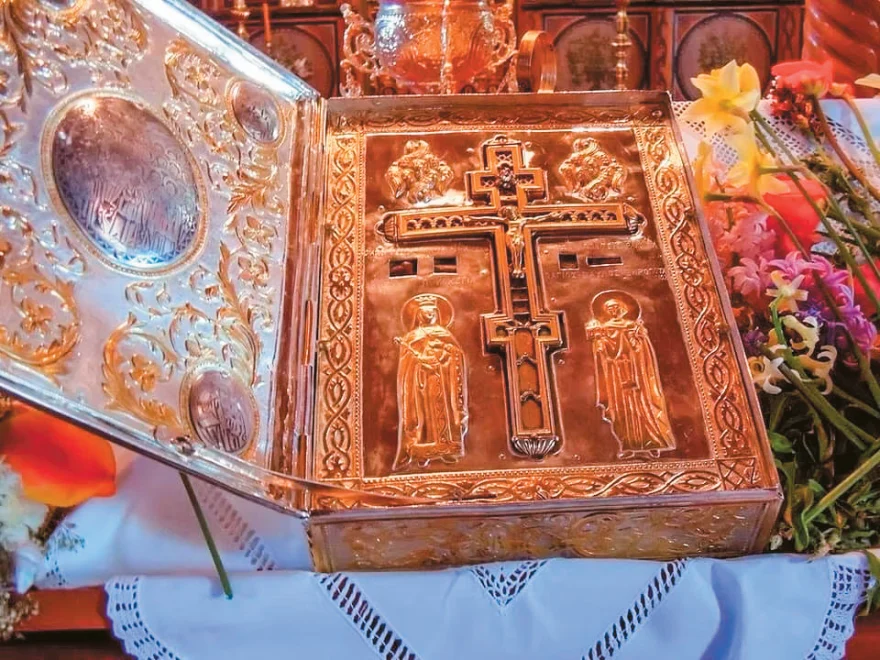
In the Katholikon (Central Church) of the Holy Monastery of Xiropotamou on Mount Athos, a total of 13 pieces of the Holy Cross are kept. Among them is the largest piece in the world, measuring 31 centimetres in length, 16 in width, 25 in thickness and weighing 320 grams. It is enclosed in a pure gold inner casing designed to display the entire piece of the Cross. According to tradition, it was given to the Monastery as a gift by Emperor Romanos I or Empress Pulcheria. A hole made by the nails of the Crucifixion can also be found on this piece. In addition, the treasury contains part of the gifts of the Magi who worshipped at the birth of Christ, a section of the Crown of Thorns, the Sponge and the Holy Robe. This piece of the Cross remains permanently at the Monastery and is displayed only on feast days. The second-largest piece of the Cross kept there is the one that leaves Mount Athos when requested by various metropolitan dioceses outside it.
In the Imperial Treasury of Vienna, reliquaries believed to contain pieces of the True Wood are on display. Among the best known is the one housed in a gold reliquary decorated with precious stones in the shape of a cross, displayed next to the “Spear of Destiny”.
Among the churches that preserve relics believed to be pieces of the True Wood is Notre-Dame de Paris, where the venerated Holy Relic is kept, including the Crown of Thorns, together with a piece of the Holy Cross.
Also included are the Cathedrals of Pisa and Florence, as well as many monasteries. Legend also has it that a piece of the True Wood is kept in the cross crowning the great obelisk that dominates St Peter’s Square in the Vatican.
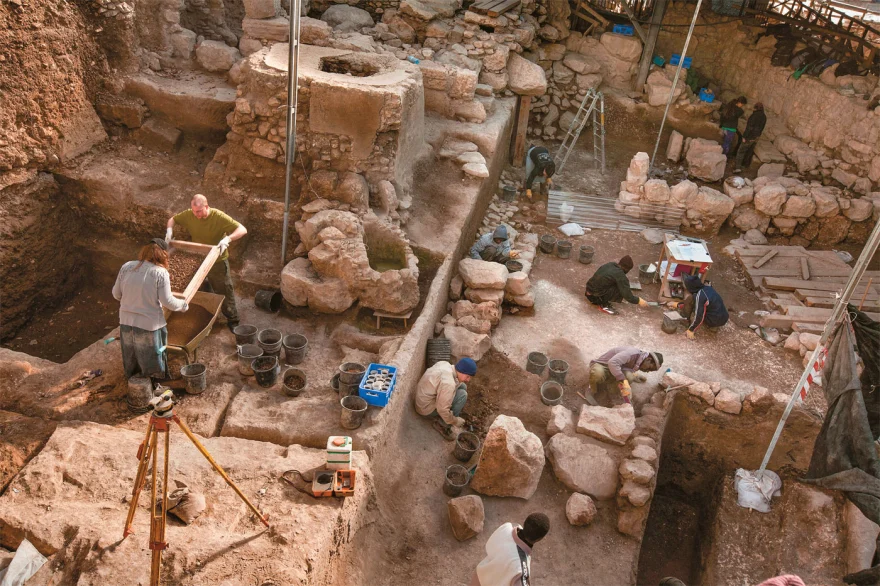
The new archaeological finds discovered beneath the Church of the Resurrection in Jerusalem strengthen the belief that this particular site is indeed connected with Jesus’s martyrdom and burial. Italian archaeologists identified a quarry, rock-cut tombs, cultivated areas and traces of an ancient garden, features that bear striking similarities to the descriptions in the Gospels. The initial findings of the research were published in the Jerusalem archaeological journal Liber Annuus.
The recent findings
The Church of the Resurrection, in the Old City of Jerusalem, stands above the site where, according to Christian tradition, Jesus was crucified, buried and subsequently resurrected. The excavations began three years ago as part of restoration work on the church floor. Last year, archaeologists began uncovering a distinctive landscape.
These findings show a remarkable correspondence with the description found first and foremost in the Gospel according to John. According to it, at the place where Jesus was crucified there was a garden and, within it, a new tomb in which no one had previously been buried. According to the archaeologists and researchers, the concentration of so many common features is particularly interesting.
The same Gospel states that the crucifixion took place near Jerusalem, while the Epistle to the Hebrews says that it occurred outside the city gate. According to the researchers, the ancient quarry was indeed located outside the walls of Jerusalem at the time of Jesus.
Some sections of the quarry are 6 metres deep and filled with soil, indicating that the area may later have been converted into agricultural land. The agricultural use of the site is also supported by the discovery of remains of olive trees and vineyards. These are in fact dated to around 30–33 AD, adding another element to the similarities with the biblical account. The tombs also provide important additional information. They were carved directly into the rock, confirming that the area had indeed been used as a burial site.
Their form also corresponds with the descriptions in the Gospels of Matthew, Mark and Luke, where Jesus’s tomb is presented as having been hewn out of rock. According to the head of the excavations, Francesca Romana Stasolla, of Sapienza University of Rome, “the history of this site is the history of Jerusalem and, at least from a certain point onwards, it is also the history of the worship of Jesus Christ”.
Ask me anything
Explore related questions




