





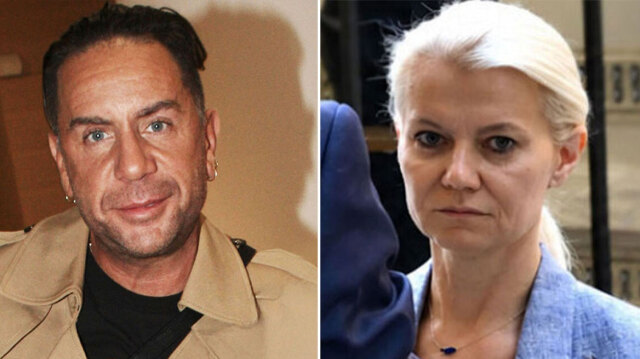
The investigation into the death of Giorgos Mazonakis is developing into a mystery, as Greek police have turned their attention to digital evidence they have collected, focusing on one of two photographs that Ioanna Gaka took of Giorgos Mazonakis and sent to an unknown recipient.
The defendant in the case concerning Giorgos Mazonakis’ death had taken two photographs and one video. She deleted all of the files before going to the Kypseli Police Station later that afternoon to give a statement.
One of the photographs was taken at 14:43:36 on September 9. The file appears to have been created at 14:44:19 and was subsequently deleted at 19:09:09.
In one of the two photographs, according to information obtained, Giorgos Mazonakis appears lying on the bed at the clinic, while the machine is operating. He is wearing a yellow short-sleeved T-shirt and is covered with a blanket from the waist down. His head is turned to the right, with his eyes closed. An IV catheter can be seen in his right hand, while a similar connection appears to be present on the left.
Of particular importance is the fact that the image also contains geolocation data. The coordinates found in its metadata correspond, according to the Directorate of Forensic Investigations’ inquiry, to a location on Karneadou Street in Athens that matches the location of their medical practice. It was precisely for this photograph that forensic experts identified digital traces showing that it had been shared.
This means that Gaka sent the file to an unknown recipient who cannot currently be identified. Determining the recipient would require access to telecommunications data. According to information available so far, it cannot be taken for granted that the image was sent to Ilias Theodoropoulos.
The second photograph was taken at 14:45:22 and created as a file four seconds later, at 14:45:26. This image was also found deleted. According to the available evidence, this was the time when Mazonakis began plasmapheresis. It was deleted at 19:09:13, just four seconds after the deletion of the first image. The second photograph also contained the same coordinates, pointing to Karneadou Street.
A deleted video file was also found on the same device. Its metadata shows that the video was created at 14:43:55, chronologically between the two photographs. The file was also found deleted and, according to the forensic examination, was deleted at 19:09:13.
What Access to Telecommunications Data Could Reveal
Access to telecommunications data is now considered critical to this part of the investigation.
Investigators expect the recovered data could establish:
the exact recipient of the photograph,
the application through which it was shared,
whether accompanying messages were sent,
and whether the image was subsequently forwarded.
The recipient’s identity could give the investigation a new direction, particularly if it can be linked chronologically to what was taking place at the medical practice at that time.
The Phones of Three Employees Under Scrutiny
It is also considered important that the mobile phones of three employees of the medical practice be examined in depth. Authorities are looking for communications, messages, calls, photographs, videos and any other digital traces that could help reconstruct what happened.
Of particular interest is whether there were communications with the two doctors during the critical hours, as well as whether the same or other audiovisual material was circulated after the incident. Examination of the phones could also help cross-check findings from Ioanna Gaka’s mobile phone and the medical practice’s computer.
Possible Administration of a Substance Also Under Investigation
Meanwhile, authorities are examining more closely the possibility that Giorgos Mazonakis was administered a substance before or during the plasmapheresis procedure. So far, no specific drug or substance has been identified, while crucial answers are expected from toxicological tests.
The issue under examination is that, if the use of a specific substance in the category being investigated is confirmed, its administration would have to take place under specific medical conditions and in the presence of a cardiologist and an anesthesiologist.
Ask me anything
Explore related questions




