





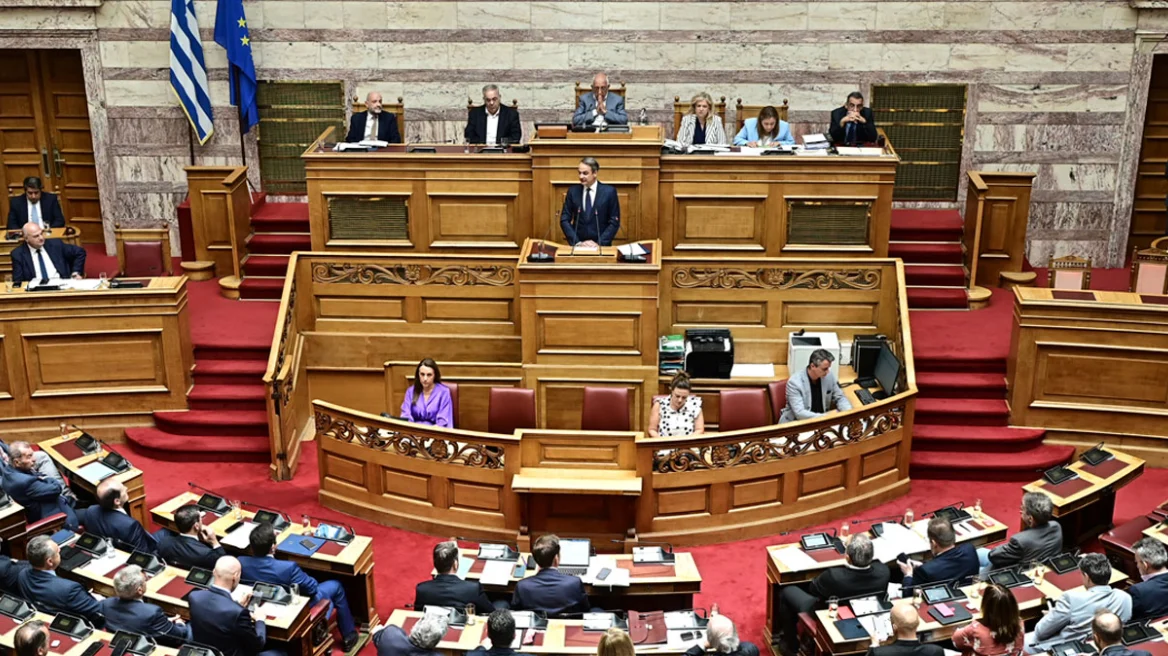
At the highest political level and amid an atmosphere of extreme political confrontation, Parliament is expected to hold today the second – and final for the current parliamentary term – episode in the Constitutional Revision process.
Kyriakos Mitsotakis, Nikos Androulakis, Dimitris Koutsoumbas and the other opposition leaders will cross swords over the necessary amendments to the country’s supreme constitutional charter and all matters of current affairs, while also raising the curtain on the new parliamentary landscape that will host political clashes until the 2027 elections.
The Prime Minister will speak after 1pm and, according to reports, will reiterate that Greece needs a new Constitution that keeps pace with the times, modern social needs and the rapid pace of technological developments. At the same time, he will launch a scathing criticism of the opposition – and PASOK in particular – over its stance during the revision process.
It is recalled that only New Democracy formally submitted a proposal to amend 33 articles, including changing Article 86 to remove Parliament from the preliminary investigation committees, amending Article 16 to allow non-state universities to operate, and constitutionally enshrining performance evaluation in the public sector, which would lead either to rewarding employees or to their removal.
The fact, however, that in the first vote held last July, PASOK and the opposition as a whole did not vote in favour of a single proposal, including those with which they agree, “sabotaged” once and for all any possibility of securing the enhanced consensus of at least 180 MPs that would have allowed the next Parliament to revise the Constitution by a simple majority.
It should be noted that the current, pre-revision Parliament selects the articles, while the next Parliament determines their content. Elections take place in between, allowing voters to take the parties’ positions into account. If an article is made subject to revision now with 180 votes (i.e. the enhanced majority is required in both votes), then in the next Parliament and in the final, third vote, 151 votes will be required to amend it. If the enhanced three-fifths majority is not secured now, however, 180 votes will be required at a later stage, in a post-election environment that is expected to be fluid.
PASOK’s ‘present’ vote and the opposition’s ‘no’ votes
PASOK is nevertheless attempting to give a constitutional rationale to its non-consensual stance, arguing that the second procedure that will follow the national elections is also the more important one.
Figures in the “green camp” argue that if they give New Democracy the 180 votes now, in the next Parliament the majority will be able to determine the wording on its own, as it wishes. Although such a stance could be interpreted as defeatist, as it appears to assume that New Democracy will retain its majority after the elections, PASOK’s position is final and definitive.
On the other hand, the government majority estimates that even if Harilaou Trikoupis, or another opposition party, is programmatically in favour of amending Article 86, the fact that it will go to the polls having, only a few months earlier, voted against or abstained from the vote will cost it electorally.
Consensus after the elections
Nevertheless, the process so far, despite the barren environment, has produced signs suggesting that the enhanced majority of 180 votes could be secured after the elections for the amendment of certain critical provisions. PASOK’s decision to vote “present” on 15 New Democracy proposals is interpreted as an early indication of a willingness for political convergence, which could turn into parliamentary consensus during the final stage that will follow the polls.
It is characteristic that the proposals to amend Articles 16 on universities, 86 on preliminary investigations, 24 on climate change and 90 on the selection of the judicial leadership secured 160 “yes” votes and up to 42 “present” votes, which are estimated to become positive votes, but only after the elections. Consequently, the pre-revision process of the current Parliament will not determine what the new Constitution will be, but it has highlighted which articles have a chance of securing the necessary majorities and which continue to face strong resistance.
14+1 provisions that can be revised
The list of articles with momentum for revision includes some of the most important chapters of the government’s proposal. These include Article 16 on non-state universities. The provision has strong prospects provided that its final form provides for the establishment of non-state, non-profit academic institutions and not simply “private” universities. In that case, it will be voted for (i.e. after the elections) not only by New Democracy, which has proposed it, but also by PASOK and Alexis Tsipras’s ELAS.
Article 86 concerns the criminal liability of ministers. New Democracy’s proposal provides for Parliament to be removed from the preliminary investigation committees. The mandatory procedures are abolished, while investigations, preliminary investigations or preliminary examinations will be conducted by a Court of Appeal Prosecutor and the proposal to bring charges will be made by a senior judicial body. The prosecution of ministers will be decided by Parliament, as is the case today, but the MPs’ final decision will be informed by the findings of the preliminary investigation conducted by the natural judge.
Favourable conditions are also emerging for amending the provisions governing the selection of the leadership of the Judiciary, with the government majority’s proposal stipulating that appointments to the positions of senior judges will be made by a special parliamentary committee, without government intervention, from a list of three judges for each position proposed by the respective plenary sessions.
Beyond the institutional changes, the social provisions of the revision have also attracted particular interest. The provision for constitutional protection of affordable housing, references to the climate crisis, regulations concerning artificial intelligence, the strengthening of postal voting and the protection of property are areas where political differences appear smaller compared with other issues.
Ask me anything
Explore related questions




