





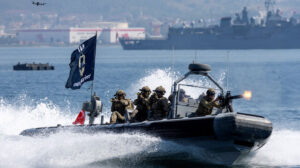
With headlines ranging from “the move that frightened Greece” to “Samos in the crosshairs of the Turkish Armed Forces,” Turkish media have been reporting in recent hours on the transfer of the 51st Commando Brigade from Hozat in Tunceli, eastern Turkey, to Söke in Aydın, just a few kilometers from the coast opposite Samos.
Sözcü even went so far as to directly link the move to recent Greek-Turkish tensions, while Yeni Asır claimed that approximately 2,004 professional commandos have now been stationed in the area. Beyond, however, the familiar exaggerations for domestic consumption that often accompany this type of reporting in the Turkish press, the transfer of an entire commando brigade from eastern Turkey to the Aegean coast has genuine strategic significance and deserves to be examined independently of the rhetoric surrounding it.
From Tunceli to the Aegean Coast
The significance of this move becomes clearer when the identity of the 51st itself is examined. This is not a new formation created specifically for the Aegean, nor is it a unit whose primary mission until now has been amphibious operations. It is a military formation with decades of history in eastern Turkey and an operational background shaped in a completely different environment.
Its historic base was in Hozat, in Tunceli province, one of Turkey’s most mountainous regions and for decades one of the main operational areas of Turkish security forces against the PKK. The unit was formerly known as the 51st Internal Security Infantry Brigade. It was gradually transformed and, by 2018, was officially recorded as the 51st Commando Brigade. The change is not merely one of nomenclature. It reflects a shift toward lighter, more flexible forces trained for deployment and operations in demanding terrain.
A Unit with Genuine Operational Experience
Its operational past is not limited to exercises. In December 2017, for example, the 51st was responsible for commanding the “Şehit Jandarma Yüzbaşı Fuat Oğuzcan-2 Operasyonu” — “Fallen Gendarmerie Captain Fuat Oğuzcan-2 Operation” — in the Hozat-Tanzi Deresi area of Tunceli. Under its command were forces from the Tunceli Gendarmerie, a Gendarmerie commando battalion from Elazığ and special operations forces. This also provides a more precise outline of its capabilities.
The 51st has developed within an operational environment requiring mobility, the deployment of small and medium-sized formations in difficult terrain, area searches and clearance operations, day and night operations, and cooperation with other elite units. Sözcü claims in its current report that the unit also participated in Turkey’s “Zeytin Dalı Harekâtı” — “Operation Olive Branch” — in Afrin, Syria, in 2018, presenting it as one of the experienced formations of the Turkish Land Forces. This particular reference comes from the Turkish report and was not accompanied in the Turkish Defense Ministry’s briefing today by a detailed operational history of the unit.
What also needs to be distinguished is the concept of “commandos” from that of “marines.” The 51st is not, based on the publicly available information, an amphibious brigade. Turkey’s amphibious forces constitute a separate operational branch, a significant part of which is located in Phocaea, north of İzmir. The transfer of the 51st to Söke therefore does not mean that Turkey is automatically establishing a new amphibious assault force opposite Samos. It does mean, however, that it is moving to the Aegean coast a land-force formation with experience in actual operations, the ability to deploy rapidly and personnel oriented toward highly mobile operations.
The Brigade That Hulusi Akar Served With
The 51st also holds a particular place in the recent history of Turkey’s military leadership. Hulusi Akar, later Chief of the Turkish General Staff and Minister of Defense, took command in 1998, after his promotion to brigadier general, of the then 51st Internal Security Infantry Brigade in Hozat, remaining in the position until 2000. When he returned to Hozat in March 2018 as Chief of the General Staff, the unit was by then known as the 51st Commando Brigade. Anadolu noted at the time that it was also known in Turkey as “Kut-ül Amare Fatihi” — “Conqueror of Kut al-Amara,” a name referring to the Ottoman victory over British forces at Kut in Mesopotamia during World War I. The connection with Akar does not, of course, by itself give the present-day unit greater operational strength. It does, however, show that the 51st is not a regional or newly established formation, but a unit with a long-standing continuity within the Turkish Land Forces.
What Does Ankara Officially Say?
A crucial development came today from the Turkish Ministry of National Defense itself. Ankara officially confirmed the transfer of the 51st Commando Brigade to Söke and clarified that the change in the unit’s base had already been approved in June 2026, “in accordance with the mission and operational requirements of the Turkish Armed Forces.”
This clarification is important because it places a limit on the interpretations appearing in some sections of the Turkish press. The decision was not made in recent days as an immediate response to Kyriakos Mitsotakis’ visit to Kastellorizo or to any specific Greek move. The process had already been set in motion in June, and the 51st’s new presence in Söke had been publicly visible since late August. The date on which the decision was made, however, is one thing, and the strategic significance of the choice of its new location is another.
Why Is Söke Important?
The transfer of a brigade from mountainous Tunceli to western Turkey represents a substantive change in the geographical distribution of Turkish land forces. Söke is located in Aydın province, in the broader zone of the Asia Minor coast opposite Samos and near the Kuşadası–Dilek Peninsula axis. The new base therefore places an experienced commando brigade in a completely different strategic environment from the one in which it operated for decades.
According to sources from the Greek Ministry of National Defense, Athens is closely monitoring the matter and is assessing both the transfer of the unit and the circumstances surrounding its new deployment. The same sources do not, at this stage, attribute characteristics to the move that would justify dramatic interpretations; however, the fact that this involves an entire brigade-level formation rather than a limited movement of personnel is an element being examined carefully.
The Greek side has, after all, reason to view the presence of such a unit differently from an ordinary redeployment. The broader Asia Minor coastline already has a significant number of Turkish military formations, while farther south and north there are units with different missions and capabilities. The addition of the 51st, in any case, increases the available high-readiness manpower in western Turkey.
The 2,000 Commandos and What We Actually Know
Particular attention is also required regarding the number of personnel. Yeni Asır specifically reports 2,004 professional commandos, while Sözcü uses the figure of approximately 2,000. So far, however, the Turkish Defense Ministry has not announced an official number of personnel transferred to Söke.
The figure of 2,000 is entirely consistent with the size of a brigade, but it should not be presented as a number confirmed by the Turkish government.
The picture that emerges is therefore more complex than the headlines about “2,000 commandos opposite Samos.” There is currently no evidence allowing the conclusion that the 51st was created or transferred specifically with a mission against the Greek islands. Nor is there official data that suddenly turns it into an amphibious formation.
There is, however, one indisputable fact: Turkey took a commando brigade with decades of operational continuity in the eastern part of the country and transferred it to the western Aegean coast, opposite Samos. The decision had been made months before today’s publicity, and this weakens the easy narratives about an “immediate response” to Athens. It does not, however, diminish its military significance. Because the essential question is not whether headlines in the Turkish press are attempting to create impressions for domestic consumption. That is almost to be expected. The essential point is that an experienced commando formation has changed its geographical orientation and is now integrated into the military deployment of western Turkey, in one of the Aegean’s most sensitive areas.
Ask me anything
Explore related questions




