





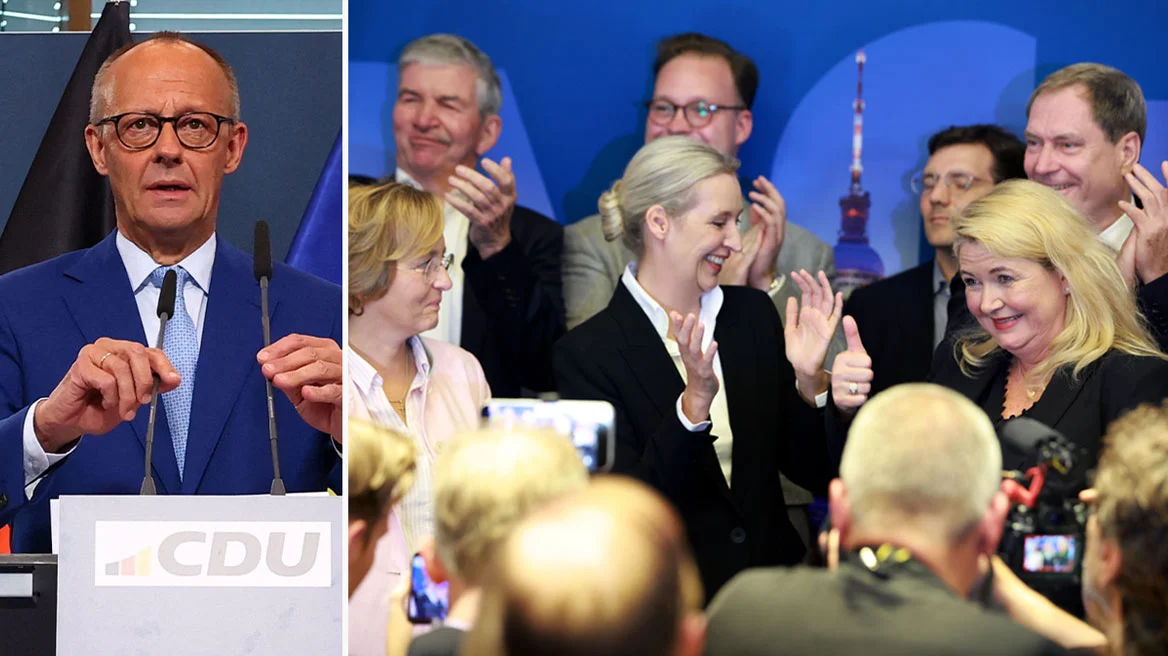
Friedrich Merz has not resigned. Nor has he left any room for an immediate departure from the Chancellery or the leadership of the CDU. Following heavy defeats in Berlin and Mecklenburg-Western Pomerania, he appeared before the German public to declare that he would continue with his reforms, knowing that what lies ahead “requires courage, stability and patience”.
It was a statement of staying put, but not a display of political strength. The German Chancellor remains in office because there is still no agreed alternative within the Christian Democratic Union and because eight state premiers have publicly backed him. He is not remaining because the ballot box endorsed his policies.
The two elections today did not produce the same result, but they had the same major loser. The CDU suffered a dramatic decline in both states, while the AfD continued to expand its influence. In Mecklenburg-Western Pomerania, it came first for the first time. In Berlin, it achieved its best-ever result in the capital. Germany’s political landscape is now becoming polarised not between the traditional parties of government, but between forces outside the old governing axis.
The rout in Mecklenburg-Western Pomerania
According to the first projections, the AfD was on around 37 per cent, ahead of the SPD of state premier Manuela Schwesig, which was close to 35.5 per cent. The Left followed on 7.5 per cent, while the CDU and Greens were both limited to around 5.5 per cent. The BSW was sitting exactly on the five-per-cent threshold for entering parliament.
The latest estimates, however, shortly before the count was completed, put the CDU at 4.9 per cent and outside the state parliament. In any event, whether inside or outside parliament, this is unquestionably its worst result in a state election since the Federal Republic of Germany was founded in 1949. Compared with the 13.3 per cent it secured in 2021, the Christian Democrats have lost more than half of their electoral strength and came within a narrow margin of being excluded from the state legislature.
Merz himself made no attempt to downplay the scale of the failure. “We cannot gloss over the result in Mecklenburg-Western Pomerania. It is a disaster,” he said. He attributed the rout to the polarisation between the SPD and AfD. The explanation, however, does not alter the political reality: in yet another eastern state, the CDU has ceased to be a major centre of political power.
The AfD has no route into the state government, at least on the basis of today’s figures. The other parties rule out cooperation with it, while the initial estimates give an SPD-Left-Greens coalition a parliamentary majority. The political “firewall” is still preventing the far right from entering government. It does not, however, prevent its electoral expansion or its ability to shape the political agenda.
Berlin turns left — AfD almost doubles its support
The picture is different in Berlin. The Left has emerged as the strongest party for the first time, with around 24.8 per cent, while the CDU follows on 20 per cent. The AfD takes third place with almost 16 per cent, ahead of the Greens, who are close to 15 per cent. The SPD falls to 12 per cent, recording a historic collapse in the city with which it had been identified for decades. The BSW is hovering just above the five-per-cent threshold.
Merz described the CDU’s result in Berlin as “respectable”. The reality is that the party lost more than eight percentage points compared with the 28.2 per cent it secured in 2023 and has surrendered first place to the Left. At the same time, the AfD has risen from 9.1 per cent to close to 16 per cent, recording its highest-ever result in an election for the parliament of the German capital.
The most likely governing option is a coalition of the Left, Greens and SPD. Numerically, a CDU-Greens-SPD coalition also remains possible, but the electoral blow suffered by the two current governing partners makes such an arrangement politically more difficult. Turnout reached around 75 per cent, compared with 62.9 per cent in 2023. The change was not the result of apathy, but of strong mobilisation and a conscious movement of voters.
Merz has bought time, not political security
The Chancellor chose to respond to the defeats with a speech of broader political scope. He spoke of a state that “has become excessively complicated”, an economy undergoing “profound transformation”, the hardening of public discourse and declining trust in institutions. He placed Germany and Europe in the face of “very specific threats” and insisted that the country still has the capacity to reform itself.
The message had two audiences. To the CDU’s internal ranks, Merz said that he had no intention of giving up the leadership. To Germans, he argued that reforms need time to deliver results and that the immediate electoral costs should not derail the government’s course. No senior CDU figure has so far publicly called for his resignation, although criticism within the party is intensifying.
The time the Chancellor is asking for is simultaneously working in the AfD’s favour. Within a matter of weeks, the far right has taken first place in Saxony-Anhalt and Mecklenburg-Western Pomerania, dramatically strengthened its presence in Berlin and is now leading in nationwide opinion polls.
Merz’s attempt to contain the AfD through a tougher migration policy has not delivered. Rather than bringing voters back, it shifted an even greater part of the political debate towards an issue on which the far right presents itself, in the eyes of its supporters, as the “authentic” choice.
Winter threatens to turn political crisis into social crisis
The government is heading into winter with the economy weak, industry under pressure and energy costs returning as a central political issue. Developments in the Middle East, disruptions to energy and trade routes and rising international fuel prices have already revived fears of a new European energy crisis.
It cannot yet be taken for granted that Europe will face a crisis on the same scale as the one in 2022.
The risk, however, is real and politically explosive for Germany. It is Europe’s largest industrial economy, with sectors such as chemicals, steel and car manufacturing particularly sensitive to energy costs. A fresh rise in household bills, fuel prices and the cost of goods will put precisely the “patience” Merz has called for to the test.
The AfD has demonstrated that it can turn economic insecurity into political anger, linking rising prices to sanctions against Russia, migration, the green transition and decisions taken in Brussels. If the winter brings renewed energy pressures, redundancies or further industrial contraction, the CDU will not be facing only a far right that has strengthened electorally. It will also face a challenge to Merz’s central promise: that he can restore Germany’s economic strength and political stability.
The next elections
Today’s elections bring to a close an exceptionally demanding cycle of contests in 2026. The next scheduled test is Bremen, where elections are due to take place on 30 May 2027. Elections are also expected in 2027 in Saarland, Schleswig-Holstein, North Rhine-Westphalia and Lower Saxony, although not all dates have yet been finalised.
The available opinion polls in these states are not yet sufficiently recent and systematic to allow a reliable overall forecast. The nationwide trend, however, is clear: the AfD is leading in national polling and the CDU is falling back. In the western states, the far right has not yet approached the levels recorded in eastern Germany, but its growth is no longer exclusively an eastern German phenomenon. The Berlin ballot demonstrated that as well.
Merz’s decision to remain in office does not resolve the crisis. It postpones the next decision. The Chancellor is asking for time to prove that Germany can reform itself. The AfD is using the same time to present itself as the force waiting to inherit a country weary of economic stagnation, difficult governing coalitions and the sense that the old political system can no longer protect either prosperity or everyday security.
Ask me anything
Explore related questions




