





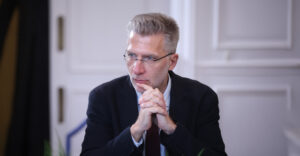
“Under no circumstances will we leave the incomes of citizens and households unprotected,” Minister of State Akis Skertsos said today in an interview with SKAI 100.3, when asked about the government’s support measures amid the energy crisis.
“We are keeping a close eye on the figures. We are trying to provide solutions for every possible development. We will do the best we can,” Mr. Skertsos stressed, making clear that this does not mean that “we will undermine the stability and fiscal responsibility that we have built over the past few years,” making particular reference to the recent upgrades of the Greek economy by two international credit rating agencies.
Referring to the energy crisis, the Minister of State stressed that it is a huge problem, but one that, as he said, is international. “It is a common problem for all countries around the world. It stems from and is a result of the crisis in the Gulf, from the war that began in recent months. It had also previously been triggered by the war in Ukraine,” he noted, adding: “Citizens are able to distinguish between the external factors driving price increases and inflation and domestic factors. We are not saying that the cost-of-living pressures that citizens and households experience in various aspects of their daily lives are exclusively due to external factors. However, the high cost of fuel, heating and petrol is to a very large extent due to external factors. And I believe that this is where we are doing our best, trying, based on the fiscal capacity and possibilities that we have and that other countries do not have, to provide support. The Prime Minister announced that this will happen in the coming days, due to the sharp increase that is certainly placing a heavy burden on households in terms of the needs that will arise in the coming winter. We will provide support to reduce this burden.”
Mr. Skertsos also referred to the advantageous position in which Greece finds itself, noting that “Greece is currently one of only five countries in Europe which, thanks to sound fiscal and economic management, is recording surpluses and has the ability, instead of raising taxes or cutting public spending, to return benefits, increases in wages and allowances, while also reducing taxes.” “We have the privilege of being one of only five countries. The other European countries are doing exactly the opposite,” he stressed.
Asked about the housing issue, he acknowledged that it is one of the most serious issues affecting every household’s “basket,” particularly households that rent their homes. He stressed, however, that the government has been implementing a national strategy in recent years, as, he said, “we have identified the major changes taking place and being observed in the housing market, which are the result of the fact that the economy is growing, tourism is increasing, there is strong demand for housing and for short-term rentals, the so-called Airbnb, as well as for long-term rentals.”
“More homes need to be created over the next few years, and this will balance prices in response to the increased demand. When there is increased demand, prices rise. When there is increased supply, prices fall. This is the challenge we are trying to address through the National Strategy, and there is not just one measure that will provide the solution. The ‘My Home 1 and 2’ programme was a successful programme, which is why the Prime Minister also announced the third phase, the ‘My Home 3’ programme, which will cover approximately another 20,000 to 30,000 households,” he added.
Comparing Greece with the European average in terms of home ownership, Mr. Skertsos stressed that “in Greece, we are fortunate that 7 out of 10 Greeks own their own home… An even more important figure is that 6 out of 10 Greeks who own their own home do not have a loan to service for it. Therefore, the acute problem concerns 3 out of 10 Greeks who rent, and primarily affects younger people whom we want to become independent, acquire their own home and pay a reasonable rent in relation to their income,” he added.
Asked by journalists about reducing the Special Consumption Tax on fuel and the criticism levelled by the opposition, Mr. Skertsos made clear that the revenue it generates for the state coffers must be taken into account. “It generates €4.5 billion in revenue. Therefore, cutting it in half would cost approximately €2 to €2.2 billion. That is another Thessaloniki International Fair package,” he stressed. He continued: “Anyone who claims that they can cut the Special Consumption Tax on fuel without proposing where these revenues would be sourced from is simply lying. The Prime Minister said something simple and, I believe, reasonable. He said that if it becomes possible to have an exception from the expenditure ceilings, we will also consider this measure precisely because we are not a dogmatic government. We understand how difficult things are for people, what uncertainty and insecurity this explosion in prices is causing, which, I repeat, is caused by the war in the Gulf, and we are here to discuss every possible solution.”
Finally, asked to comment on the results of the German elections, Mr. Skertsos argued that before drawing political conclusions, it would be useful to assess the trajectory of the German economy in recent years.
“Germany, from being a country that for decades was the economic and industrial engine of Europe, is no longer in that position. In recent years, it has gone through periods of economic recession; it was in recession in 2024, it has experienced weak growth in recent years that is below the European average, and it is facing a major wave of deindustrialisation,” Mr. Skertsos said, among other things, adding that “we are therefore seeing disappointment and perhaps a shift by German citizens towards more extreme political choices.”
“I do not think there is a political shift towards the far right, but there is certainly disappointment with the ability of governments in recent years to provide convincing answers to the economic problems facing German citizens,” he added. He clarified, however, that this is not the case for all European countries, and certainly not for Greece, noting that “we must also make the necessary comparisons.”
“We must always look at the period of our own government, from 2019 to the present day, and what has happened to our economy, what has happened to Greece’s industry and manufacturing, which, I remind you, was a weak link both up to and during the crisis. Employment in Greek manufacturing has increased by 19% over the past seven years, while in Germany it has decreased by 7%. Industrial production in Greece has increased by 25% from 2019 to the present day, while in Germany it has decreased by 12%. And the added value of industrial manufacturing production in Greece has increased by 44%, while in Germany it has decreased by 5%. I think it is clear that we must always look at what is happening in the economy. To a very large extent, the economy provides the answers regarding the political choices made by citizens in each country. There is no need for dramatization or generalisation,” he concluded.
Ask me anything
Explore related questions




