





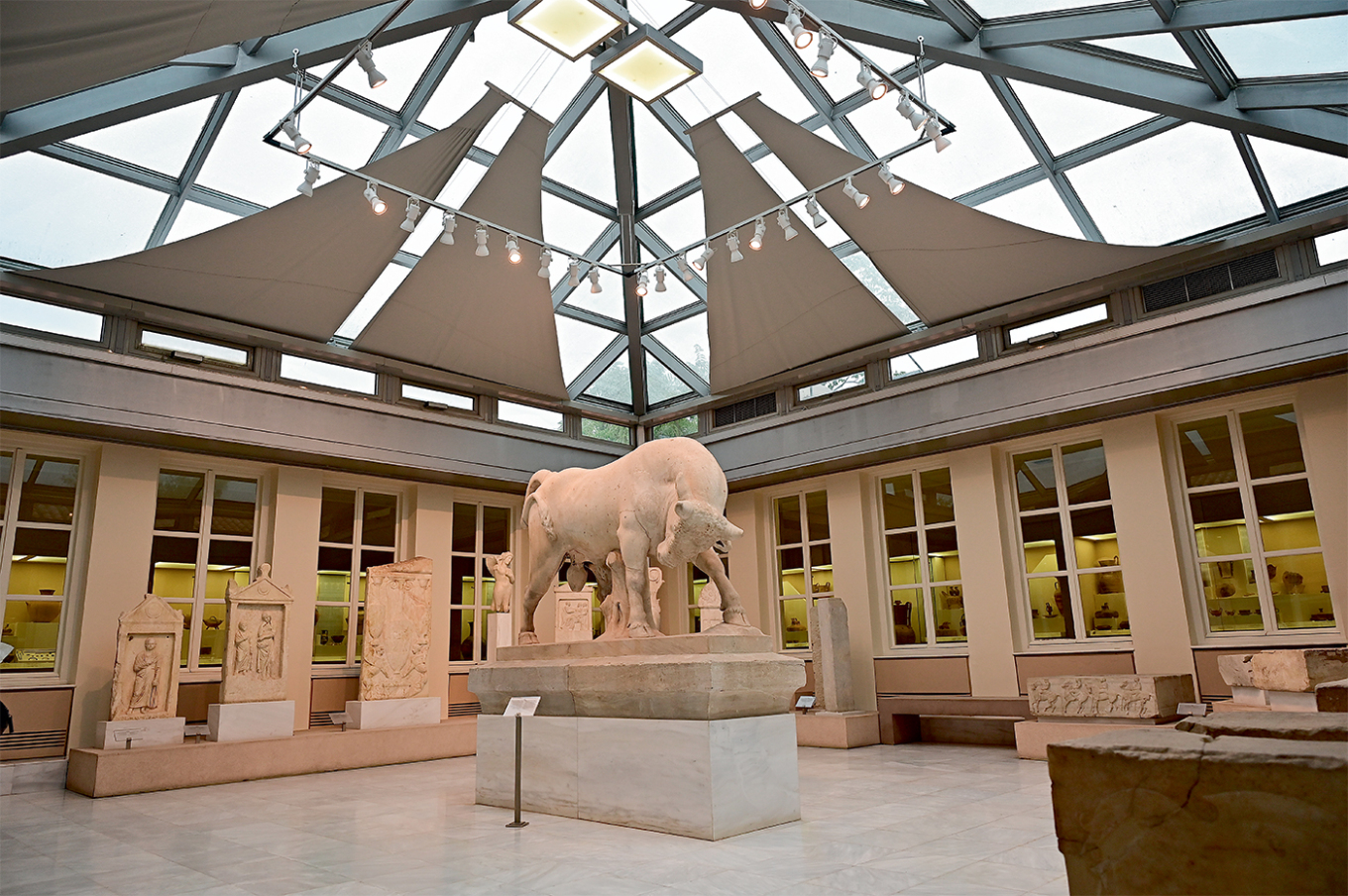
Step through the main gate on Ermou Street and the Kerameikos opens up like a break in the fabric of the modern city. Few places in Athens still show so clearly how the ancient city was laid out, or how it saw itself. The site, one of the most important landmarks of antiquity, has now been handed back to Athenians and tourists following a restoration and accessibility project inaugurated by Prime Minister Kyriakos Mitsotakis and Culture Minister Lina Mendoni on Tuesday 15 September.
A place on the threshold
From the outset, the Kerameikos was a boundary. It marked the line between the city and the countryside, between this world and the next, and between the living and the dead, while also bringing them together.
The Dipylon, the most important gate of ancient Athens, stood here. So did the Sacred Gate, through which the procession to Eleusis passed. The road to Plato’s Academy began here, and the Panathenaic Way set off from this point, crossing the Agora before climbing to the Acropolis. It was also where Athenians buried their dead, not out of sight but openly and with reverence.
Cemeteries in the ancient world always lay just beyond the city walls, yet the dead were not banished from view. Tombs, grave stelae, carved reliefs and names inscribed in marble formed part of a landscape that remained woven into everyday life. Grief had a place in public space, and the dead stayed within sight of the community.
Layers of meaning
The history of the site is far richer than that of a burial ground alone. The Kerameikos was a place to live and work, a crossroads and a line of defence, a setting for ritual and for public remembrance. Its very name recalls the potters who worked the clay banks of the Eridanos river.
Once the Themistoclean Wall was built in the fifth century BC, the district was effectively split in two. One part lay inside the city, with homes, workshops, altars and shrines. The other lay outside the walls, where the great necropolis grew. Together they give the site the feel of a palimpsest, a landscape with its layers still very much alive.
Mendoni made the same point at the ceremony, describing the Kerameikos as one of the few places in today’s Athens where the ancient topography can still be read across such a large area, and where visitors can still sense the passage from the walled city to the land beyond. The great processions set out from here, she said, not only to the Acropolis but also to Eleusis, and it was here that funeral orations were delivered for the city’s war dead.
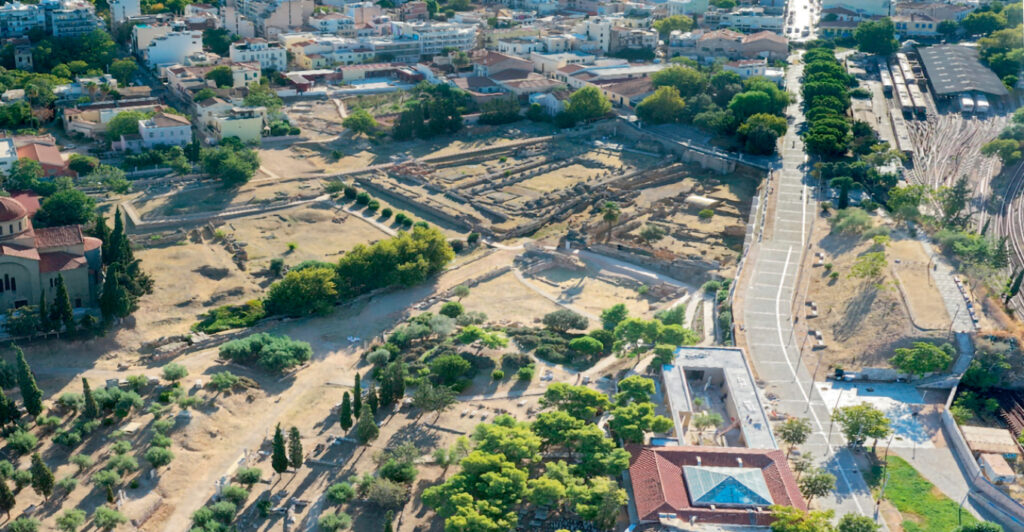
The minister also stressed the link between the Kerameikos and the Ancient Agora, where a separate major project was completed a few weeks earlier. The timing of the two carries an almost geographical logic. Important roads converged on the Dipylon, the main entrance to ancient Athens, and from there the Panathenaic Way ran through the Agora up to the Acropolis.
If the Agora was for centuries the heart of the democratic city, the Kerameikos was the physical and symbolic link between the city and the world outside. It was a way in and a way out, a place of work and production, of public memory, worship and ritual.
The works carried out between 2023 and 2026 set out to make that story legible again. Funded with around €4 million from the EU’s Recovery and Resilience Facility, the project was not, in Mendoni’s view, about cosmetic or technical fixes.
“The project is not a collection of piecemeal interventions,” she said, “but a complete rethink of how visitors enter the site, move through it and understand the monuments and the evolution of the archaeological landscape over time.” The aim, in other words, was to restore a sense of the site’s importance and its relationship with the city.
The new routes and restoration work are designed to help visitors understand where they are, what the Kerameikos meant, from its striking grave stelae to its individual monuments, and where the necropolis met the city of the living.
4,500 square metres of new ground
Perhaps the most significant change is the least showy. Around 4,500 square metres have been added to the archaeological site, including a 2,700-square-metre area of particular importance that had until now been cut off and closed to the public. Following excavation and conservation work, remains of the city’s fortifications, houses and workshops dating from the Hellenistic to the Roman period are now on view and form part of the site’s wider story.
The so-called Staktothiki (literally “ash heap”), an odd mound built up from the waste of an old soap factory and rubble from earlier digs, has also been transformed. Its contours have been restored and it has been replanted so that it now sits naturally in the landscape, as part of more than 3,500 trees, shrubs and smaller plants added across the site. The greenery is not merely decorative.
Nature has always played an active part in the experience of the Kerameikos. Perhaps it is because the Eridanos still flows, symbolically at least, beneath the Athenian sky. Perhaps it is because funerary monuments need the small pocket of quiet that greenery can still create around them.
From Ermou to Asomaton
The Ermou Street entrance has been upgraded, and the makeshift hut that had housed the ticket office and a basic shop since 2011 has been replaced by a modern reception building. Visitors are now greeted by a replica of the funerary shrine of Aristonautes, a masterpiece of Attic grave sculpture, while a small display of funerary monuments has been arranged in the forecourt.
The most important gesture towards the modern city, however, comes at the other end of the site. A new exit has been created on Agion Asomaton Street, along with a complex of facilities covering around 1,700 square metres. Until now, visitors had to follow a loop and leave the way they came in.
The Kerameikos now takes on a different character: you enter from the city, pass through the ancient city and emerge back into the modern one. The change seems practical, almost obvious, yet it has a curious symbolic precision for a place that served for centuries as a passageway. The new multipurpose building brings together facilities the site had long lacked, including areas for rest and study, educational programmes, exhibitions and children’s activities.
Mendoni dwelt on this aspect of the project, explaining that the new facilities allow visitors to stay longer and, above all, make it easier for “people with disabilities, older people and families” to take part. This may be the most meaningful change of all. The Asomaton entrance is not simply a second door; it turns the Kerameikos back towards its own neighbourhood. The displays also include the artwork Transfer by Maria Loizidou, donated to the Culture Ministry by the NEON cultural organisation.
The new shop
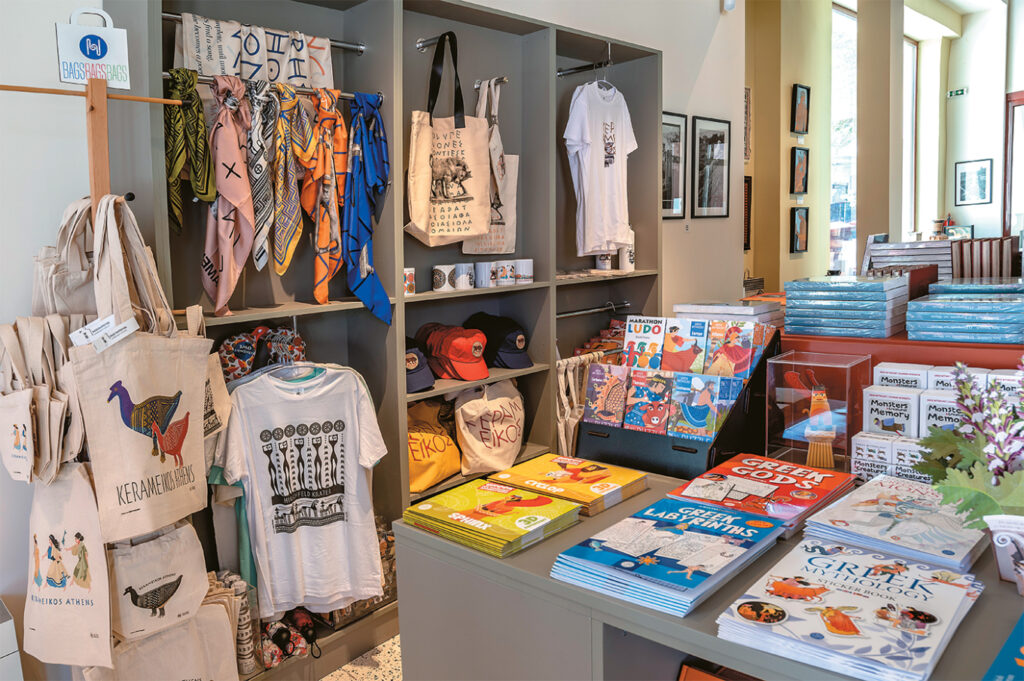
The site is well worth a visit, not only to discover one of the most remarkable corners of both the ancient world and the modern city, but for the experience as a whole. After a walk around, visitors can stop at the café, settle into the dedicated study area or browse the shop.
Entering from Asomaton, visitors pass the Roman sarcophagus of Philotera, set in an imposing display case visible even from the street. To the left is the well-designed shop, stocked with souvenirs to take home, from books on the site to authentic replicas of well-known vases and objects linked to rituals of the underworld.
The white lekythoi, slender oil flasks used in funerary rites, are particularly striking. As archaeologist Mimika Giannopoulou explains, they are authentic replicas painted by Thomas Kotsigiannis, a vase painter certified by the National Archaeological Museum and the Culture Ministry to produce high-quality reproductions from every period.
Other pieces are decorated with elegant birds, clearly inspired by bird-shaped vessels known as askoi, or by the painted birds that adorned pottery of the Geometric period, when the Kerameikos was the leading centre of production and geometric patterns filled the bodies of the animals. Elsewhere, a tote bag carries a scene of ritual dancing or a funeral procession, a motif also found on burial amphorae and kraters of the Late Geometric period. There is also an attractive T-shirt bearing the Hirschfeld Krater, an emblematic Geometric vase discovered at the Kerameikos.
An “open museum”
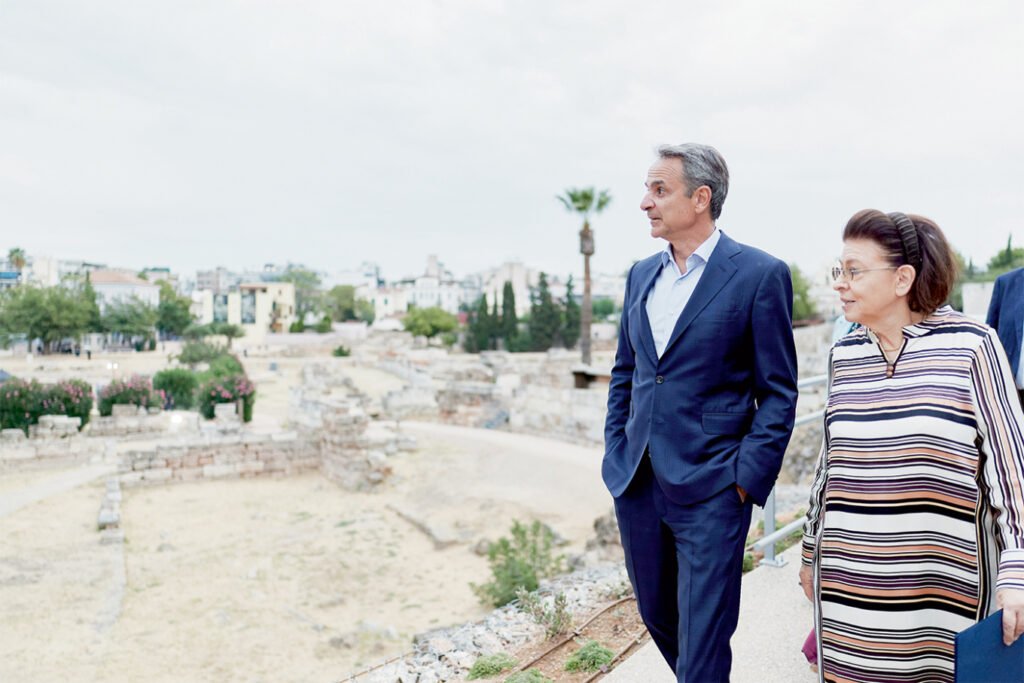
Mitsotakis took up the theme of the site’s connection with modern Athens in his own speech, beginning not with the project’s figures but with the experience of the place. He spoke of the sense of awe it inspires, precisely because today’s visitors can walk the same paths once trodden by the ancient Athenians.
The word matters, because the Kerameikos does not command awe in the way the Acropolis does. There is no towering monumentality of the Parthenon here, nor any architecture looming over the city. The awe comes instead from the enduring memory of human strength, and of Athens’ democratic memory above all. Mitsotakis invoked this by referring to Pericles’ Funeral Oration, delivered at the place where the city honoured its fallen, one of the most important texts of ancient literature and one that resonates strongly at a difficult time for democracy.
The Kerameikos thus becomes more than a landscape of death. It is also where the city sought to turn the loss of its citizens into public reflection on the symbolic and real strength of the polis.
From there, Mitsotakis turned to modern Athens, describing a vast “open museum”, a continuous archaeological landscape of more than 2,100 stremmata (around 210 hectares) that allows visitors to walk from the Temple of Olympian Zeus and the Acropolis to the Ancient Agora and finally the Kerameikos. He placed the project within a wider programme for Attica comprising more than 100 cultural interventions worth around €350 million. For the prime minister, investment in cultural heritage is also tied to Athens’ changing place on the international tourism map. Visitors, he said, no longer treat the capital as a stopover on the way to the islands, but increasingly as a destination in its own right.
“Getting to know our city”
Towards the end of his speech, Mitsotakis set aside tourism, budgets and building works and turned his attention to Athenians themselves. “Many Athenians still do not know the riches of their own city,” he said, adding that “first of all, we need to get to know our city”. The remark neatly captures the place the Kerameikos holds in Athens today. It may lie almost at the heart of the city, yet for many it remains largely unexplored.
To grasp it, you have to descend to the level of the ancient ground, leave the hum of Ermou Street behind for a while, follow the course of the Eridanos and walk among the grave stelae. Only then does it become clear that Athens tells a very different story here from that of the monumental Acropolis. It is the story of its people: the potters and craftsmen, the families and children, the soldiers who never came home, the women preserved in marble holding a piece of jewellery, the names that survived because someone carved them into a stone. You feel it standing before these imposing ancient remains and the beautiful grave stelae, whose replicas stand as a reminder not only of their history but of their symbolic glory.
Ask me anything
Explore related questions




