





Ankara chose the deck of the TCG Anadolu to deliver three pointed messages to Greece and the Republic of Cyprus as its latest naval exercise reached its climax. The Denizkurdu-I (“Sea Wolf”) drill ran from 20 to 24 September across the Black Sea, the Sea of Marmara, the Aegean and the Eastern Mediterranean, culminating in a Distinguished Observer Day aboard the Anadolu, Turkey’s amphibious assault ship and drone carrier. The briefing was held on board off Aksaz, home to one of Turkey’s main naval bases.
Turkey called for prior coordination on work for the Greece-Cyprus electricity interconnector, revived its demand that the eastern Aegean islands be demilitarised, and questioned Nicosia’s right to strengthen its air defences without taking Turkish objections into account.
None of these positions is new. But the setting showed how much weight Ankara places on restating them at a moment when Greek and Cypriot plans are moving from announcement to implementation.
Turkey’s demand over the cable
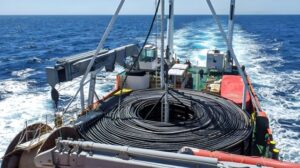
The most immediate message concerned the power link between Greece and Cyprus, known as the Great Sea Interconnector. Turkey’s Ministry of National Defence said that laying cables or pipelines, and carrying out scientific research, in areas it regards as its own continental shelf “must be coordinated in advance” with Ankara. It added that it would not allow activities which, in its view, disregarded its rights and interests.
The aim is plain. Ankara wants a say before any work begins at sea, relying on its own reading of where continental shelf boundaries lie in the Eastern Mediterranean.
The wording matters because it lumps together activities that international law treats differently. Under Article 79 of the UN Convention on the Law of the Sea (UNCLOS), all states are entitled to lay submarine cables on the continental shelf. The coastal state’s consent is required for the route of submarine pipelines, but there is no general requirement for prior permission before a cable is laid. Marine scientific research falls under a separate regime altogether. Turkey, which is not a party to the convention, glosses over these distinctions with its call for blanket “prior coordination”.
Behind the dispute over the works lies a broader disagreement over maritime zones. Turkey maintains that parts of the planned route fall within its continental shelf. Greece and Cyprus reject Turkish claims that curtail the maritime rights of islands, as well as the legal effects Ankara seeks to draw from its 2019 maritime memorandum with Libya. That is why the cable has taken on a significance far beyond its technical scope. Every step towards completing it puts the two sides’ opposing positions to a practical test.
Island defences back on the table
In the Aegean, Turkish Defence Ministry spokesman Rear Admiral Zeki Aktürk invoked the 1923 Treaty of Lausanne and the 1947 Treaty of Paris to restate Turkey’s position that the islands should be demilitarised. He urged Greece to refrain from activities which, he said, could harm peace and stability in the region.
The remarks come as Greece publicly debates strengthening its presence on the islands with unmanned systems. There is no indication, however, that this debate prompted the latest statement.
Athens rejects any link between sovereignty over the islands and Turkey’s demand for demilitarisation. It also invokes its right to self-defence, pointing out that Turkey keeps its Aegean Army, headquartered in Izmir, stationed opposite the Greek islands and still maintains its threat of war (the casus belli adopted by the Turkish parliament in 1995) should Greece extend its territorial waters.
These facts do not settle the legal disagreement over how the treaties should be interpreted. They do, however, explain why Greece regards fortifying the islands as a matter of security rather than a concession open to negotiation.
Cyprus in the same frame
The Turkish ministry also criticised the Republic of Cyprus’s arms procurement and its defence cooperation with other countries, arguing that these moves could upset the “delicate balances” on the island. On air defence specifically, it said assurances that the systems posed no direct threat to Turkish Cypriots were not enough to set aside Ankara’s concerns.
The Republic of Cyprus is an internationally recognised state and decides its own defence policy and partnerships. Turkey’s appeal to security, moreover, comes from a country that has kept troops in the north of the island since its 1974 invasion. That is the fact missing from Turkish references to “balances”. Nicosia need not accept that protecting its own airspace requires the approval of the power occupying part of its territory.
The statements from the Anadolu form a familiar Turkish line. Ankara is claiming a role in the route of a power cable, seeking limits on the defence of Greek islands and objecting to Cypriot arms purchases. The sharpness of the language does not in itself signal any move at sea. It is a reminder, though, that building the interconnector and bolstering the defences of Greece and Cyprus will run into the same claims Turkey has repeated for years, this time delivered from the deck of a warship.
Ask me anything
Explore related questions




