





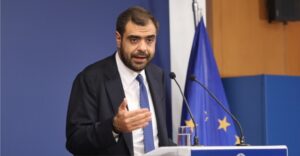
Government Spokesman Pavlos Marinakis spoke on housing and the cost of living, among other issues, stressing that the aim now is to create new homes to be offered for rent, following the government’s recent announcements. He also described the visit to Athens by US Secretary of State Marco Rubio as very important, while on the prospect of New Democracy broadening its ranks he said that this does not imply dilution.
‘This year, the extra VAT revenue came to €900 million, and the measures granted on an emergency basis, over and above the other measures already in place, amount to a further €1.2 billion,’ Marinakis said, speaking about the fiscal surplus.
‘Housing is one of the biggest issues across Europe, and at times the biggest of all, especially for fellow citizens who rent and for younger people. Every move must lead to more options for prospective tenants, so that they can find more homes and more homes come onto the market. An increase in the building coefficient can obviously be considered in areas where the decision would not conflict with previous court rulings,’ the government spokesman said initially on Mega News 104.6, adding:
‘All of this obviously depends on each area individually, and in order to assess it there will need to be an overall presentation. I understand that this is one of the major priorities, with a series of increasingly numerous measures to boost supply and tackle the problem. Let me remind you that at the Thessaloniki International Fair we heard about the My Home III programme, and around eight to ten months ago all the new tax breaks and tax reliefs were announced and implemented, because tax incentives are also needed, and we are applying them, so that closed-up homes can be renovated and offered for long-term lease, or converted from short-term to long-term rentals.
‘Then there are all the other initiatives we have taken, along with the permanent allowances: the two months’ rent received by doctors, nurses and teachers posted away from their home base, and the one month’s rent that is now returned every year, which will be paid this month and next, in November, to 80 per cent of tenants. This is an unprecedented crisis in Europe too, a major issue in Greece as well, and we can see what is happening in Spain, where it is not being tackled with a single measure. So the aim now is to create new homes to be offered for rent, and that must be the key condition.’
‘Measures are announced every month, and public revenue has increased’
Regarding the statement by Development Minister Takis Theodorikakos that additional support measures may be needed, Marinakis said:
‘First of all, measures have been announced every month, from the spring until today. The measures that have been announced and implemented have gone beyond even the “extra on top of the extra”, if you will forgive the unorthodox phrasing, so that people understand. In recent years, public revenue and tax revenue have increased. According to the opposition, that is the result of over-taxation.
‘According to what we say, and to the official budget figures, it is the result of job creation, because someone who finds work pays taxes and contributions to the state, even if taxes are lower, and of tackling tax evasion. Beyond that, there is an additional factor, which we do not deny either, though it is not the main one, not the main cause of the surplus. It accounts for only part of it and is the third cause: the extra VAT revenue. In 2026, the extra VAT revenue came to €900 million, and the measures granted on an emergency basis, over and above the other measures being applied, meaning those I mentioned earlier (rents, permanent support for pensioners and tax reliefs, which are the permanent measures), come to a further €1.2 billion.
‘Every month, then, these measures will continue to be extended. The reason some of them are now being announced every fortnight is that we have to see what the needs are. We will reach the spending limits, in other words we will give as much extra as we can and as the economy can bear. If the Prime Minister’s request at European level, for the additional measures we wish to take to be exempted, is accepted, we will look at which tax or area we will intervene in (that has not been announced or finalised yet), and then yes, even more measures will be taken. The reason we say “if” is that we cannot exceed the spending ceilings. So there will certainly be support month by month, with an emphasis on heating oil, then diesel, where the reduction we are bringing is greater,’ Marinakis added.
‘We have negative food inflation’
On whether a faster and more decisive government response is needed, the government spokesman said:
‘Let us not forget what the opposition accused us of when Mr Theodorikakos and the government announced the gentlemen’s agreement. The result of that intervention, together with a series of other interventions and inspections, is that, without my claiming we have become a paradise, mind you, and there is still a major problem with high prices in food too, we are one of four EU member states, four European states, where, while the European average for food inflation was 1.5 per cent, we had negative food inflation. I am not saying this to claim that the problem of food prices has been solved. Quite the opposite.
‘But compared with other European countries, in this sensitive food sector, we are handling this new wave of price rises better. Now, I come back to what you asked me. There are two kinds of protest. There are the protests of citizens, which are entirely justified. We are trying to give as much extra as we can, but people rightly ask for more. We will not, however, do what the opposition does and set out to be agreeable without being able to support what we say with corresponding revenue. And then there are the objections, or accusations, of the opposition, which remind me of what I have often called “armchair managers”, who say only pleasant things for people to hear but in reality solve no problem.
‘So let me come to the substance. What is it? That this government gives as much extra as the economy can bear, as quickly as possible. Yes, we must run faster, Mr Bolakis, but let me remind you that when we collect extra revenue, which is not the result of over-taxation because we are cutting tax rates for the reasons I gave earlier, the opposition accuses us of over-taxation. So an opposition that accuses the government of collecting more money through its policy, without raising taxes and indeed by cutting them, at the same time demands that even more be given. I think that is politically cost-free. What is the reality?
‘The reality is that, in an unprecedented period of inflationary pressure, the head of the International Energy Agency said when the crisis began: “We are talking about the biggest energy crisis in many years.” In this crisis, measured against GDP, Greece ranks third for the money and the relief it has given its citizens. That does not mean anyone has solved the crisis, but that, compared with other countries, we are doing the most we can. We understand people, and we will continue to stand by them.’
‘You never forget the problems of those who listen to you and watch you’
On the event marking New Democracy’s 52nd anniversary and the Prime Minister’s remark about modesty and humility, Marinakis said: ‘That is right, and especially when you have to manage one crisis after another, however much you are obliged to highlight what you are doing, you must not forget that those who hear you and see you continue to face significant problems.’
The government spokesman also commented on the remark by Adonis Georgiadis that some ministers are not showing signs of harmony and unity.
‘First of all, on all such occasions, people do not go for the party officials, in this case New Democracy supporters for the officials. It is the officials, ministers and MPs, who go to honour the New Democracy supporters. Obviously that applies to all parties, so as not to be misunderstood. That is where we went, with the Prime Minister first, to honour all those men and women who, without ever asking for anything or expecting anything, fought even in difficult years for their ideas, whatever each person believes. That obviously applies to the other political camps too. We went for those people. Now, I do not believe there was any unjustified absence. Georgiadis is a minister who always steps forward, including in difficult periods. And I have said many times, because the job of the government spokesman is to highlight what is happening, that the truth is many important things have been done in health too, but I do not think anyone was missing yesterday without good reason,’ he said.
Marinakis also addressed the absence of Nikos Dendias, saying: ‘Because I do not want us to speak in riddles, and because I saw some headlines saying that this referred to a specific minister, let us be fair. First of all, Dendias held an event. He is the top MP in preference votes in the Athens South sector, and he held a very important event, as does every MP seeking re-election, because it concerns a large electoral district. It was particularly well attended, which also shows a vote of confidence in the party.
‘Dendias is the Minister of National Defence. He took part in a very important conference in Venice, the summit of the Adriatic and Ionian Initiative, alongside the defence ministers of Italy and other states, including Croatia, Montenegro and Slovenia. So you understand it is what we call an inflexible obligation. I do not think anyone questions the dedication of Dendias or of the other ministers.’
‘Broadening does not mean dilution’
‘It is also very important, because there is an “accusation” of broadening. It is well known that I have been in New Democracy since I was young, and that when broadening does not mean dilution, when people come and join forces with the ideals and vision of a party, that is positive, especially when all of them are subsequently exposed to the preference vote and the judgement of citizens, in this case New Democracy voters,’ Marinakis said on the prospect of the party broadening its ranks.
Asked by the journalist whether this also implies a transformation of the party, Marinakis replied: ‘We are obliged to answer what journalists put to us too. Whether or not a party undergoes a transformation is judged by its policies. And I think that if you look at what we have done on migration, a theoretically right-wing agenda, though for me there is no such thing as a right-wing agenda, it is a correct, rational policy that respects human rights while cutting flows by 80 per cent.
‘Look at the handling of armaments issues: Rafale, Belharra, F-16, F-35. The exclusive economic zone (EEZ) agreement with Italy, the EEZ deal with Egypt, the extension of Greek territorial waters in the Ionian to 12 nautical miles. Non-state universities, one of the most emblematic proposals of the party’s youth wing. And most importantly, because New Democracy is first and foremost a popular party, the fact that through its policy, with increased investment and everything else it has done, tax cuts in difficult years and the digitisation of the state, it has created 600,000 jobs. I think it is an eminently compatible policy, one consistent with the founding declaration of Konstantinos Karamanlis.’
‘Rubio’s visit is very important’
On the visit of the US Secretary of State to Athens, Marinakis said:
‘It is a very important visit, and there is no need to explain why. The US Secretary of State is coming at such a critical juncture, with everything happening in the world and around us. He is coming, and we will also have the start of the sixth round of the strategic dialogue between Greece and the United States, which sends a message in many directions, along with his meeting with the Foreign Minister and then, of course, with the Prime Minister. We are waiting to see what will be said, but I think it marks the best possible point in relations between Greece and the US.’
Asked whether the visit takes place in the shadow of certain press reports, Marinakis said: ‘On the part that concerned the government, both I, representing the government and the Prime Minister, and the Energy Minister, Stavros Papastavrou, were clear and categorical, and I do not think we left any room. Beyond that, it is not the government’s job to comment on everything else. What I will say is that our strategic ally, the US, is sending a very strong, resounding message with the arrival of the Secretary of State, following on from Chevron, ExxonMobil, the Vertical Corridor and a series of actions and initiatives that are not empty words but have a very strong footprint at a very critical juncture.’
Asked whether the visit relates to the US midterm elections and counts on the Greek-American factor, the government spokesman said: ‘I think this visit will symbolise what I told you earlier. It is purely the continuation of a relationship of cooperation and trust, and Greece’s leading role in everything that has been happening in recent years, including in relation to the Middle East, is recognised across the board. Greece is a strong state that is growing ever stronger and always relies on respect for international law.’
Ask me anything
Explore related questions




